Last updated: August 2026
Passo Giau was one of the last stops of my day on the Dolomites' scenic roads and also one I enjoyed most. After passing through Passo Gardena, Passo Sella and the Rifugio Friedrich August area, I continued by car to Giau.
I visited the pass at the end of June 2026. When I reached the highest section, the landscape was completely different from what I had seen a few hours earlier. Instead of mountains standing very close on both sides of the road, I found a more open area, with large high-altitude fields and several mountain groups appearing on the horizon.
Passo Giau was one of the most beautiful roads I drove in the Dolomites, and I didn't need to hike to enjoy the visit. I parked, walked around the area and took in the view before continuing my route.
Quick Facts
- Altitude: roughly 2,236 meters
- Location: between Cortina d'Ampezzo and Selva di Cadore
- Access: car, bus, bicycle or on foot
- Parking: parking areas available at the pass
- Parking reservation: I didn't book ahead for my visit
- Time needed: about 30 minutes to 1 hour for a scenic stop
- Main draw: panoramic views and Ra Gusela
- Best time: in the morning or whenever visibility is good
- Hike required: no
- Difficulty: easy for a visit close to the road
Cortina's official tourism website lists Passo Giau at roughly 2,236 meters of altitude and mainly highlights the breadth of the views found in this part of the Dolomites.
Why Visit Passo Giau?
The scenery is the main reason to visit. Passo Giau sits in a very open area, and once you reach the top, you can see mountains in several directions.
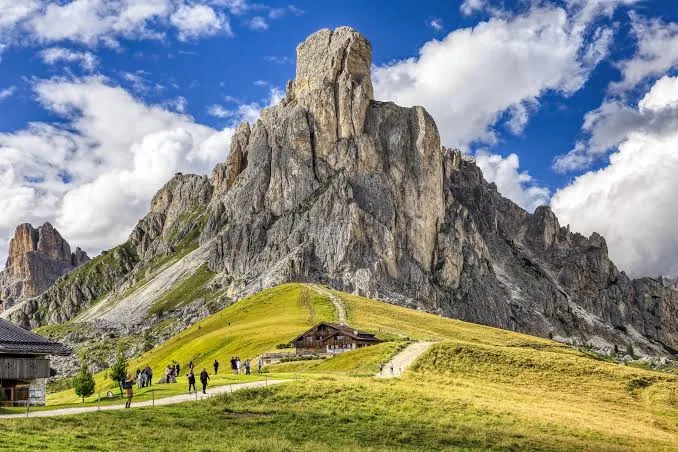
One of the most eye-catching formations is Ra Gusela, also known as Gusela del Nuvolau, which appears very close to the road. Cortina's official information also highlights Croda da Lago, Lastoi de Formin, Monte Cernera and the Cortina area.
On my visit, I mainly liked that sense of space. After driving roads where the mountains seemed to touch the pavement, finding that open panorama at Giau was a beautiful change at the end of the day.
Is It Worth Visiting Passo Giau?
For me, it's worth it, and I'd include Passo Giau in a road trip through the Dolomites. The best part is that you don't need to set aside several hours to enjoy the place.
I arrived, parked, walked a bit and took in the mountains. Even with a relatively short visit, I felt the stop was worth it.
If you want to turn Giau into a bigger activity, there are different trails in the area, but that's not required. That flexibility was exactly what I liked: after a day with several stops, I ended the itinerary in a really beautiful place without needing to start another long hike.
How to Get to Passo Giau
Passo Giau sits between Cortina d'Ampezzo and Selva di Cadore.
You can reach it by car from both sides.
Cortina's official tourism website lists a climb of roughly 15 kilometers from the Cortina area up to the pass, at 2,236 meters of altitude.
On the other side, the road descends toward Selva di Cadore.
On my trip, I reached Passo Giau after driving other scenic Dolomites roads that same day.
The road is paved but has many curves and typical high-mountain stretches.
I'd drive it again without any trouble, but I'd stay alert for cyclists, motorcyclists and other vehicles, especially during summer.
I'd also check road conditions before the trip, since weather, snow, roadworks or events can cause temporary changes.
What's It Like to Drive Passo Giau?
For me, driving Passo Giau was one of the most beautiful parts of the day. The road has many curves and gains altitude gradually.
From the Selva di Cadore side, official tourism information lists a climb of roughly 10 kilometers with 29 curves.
It's a road worth taking slowly. The scenery catches your attention at several points, but I'd always wait for a permitted spot before stopping.
Passo Giau is also very popular among cyclists, so paying attention to riders is especially important on this road.
Where to Park at Passo Giau?
There are parking areas in the Passo Giau region. Cortina's official tourism website even uses the pass's own parking area as a starting point for different hikes.
On my visit, I didn't book in advance. I arrived by car, parked and continued on foot around the area near the pass.
I'd avoid relying on any improvised spot on the roadside. During events or periods of heavy traffic, there may be specific restrictions, so I'd check the current rules before the trip.
There are also parking areas elsewhere along the road, but that's different from parking right at the highest point of Passo Giau.
Do You Need to Book Parking at Passo Giau?
On my visit, at the end of June 2026, I didn't need to book parking in advance at Passo Giau.
My experience was much simpler than at Tre Cime di Lavaredo, where car access requires specific planning.
At Giau, I arrived at the pass and found parking.
Even so, I wouldn't treat that as a guarantee for any day.
July, August, weekends and events can significantly increase traffic on the Dolomites' roads.
If I went back during peak season, I'd check access and parking conditions shortly before the trip.
Where Are the Best Views at Passo Giau?
You don't need to move far from the road to find beautiful landscapes. That was one of the things I liked most: after parking, I walked a little and already found very open mountain views.
Ra Gusela is one of the easiest formations to recognize, appearing as a huge block of rock above the fields.
I wouldn't just look for one specific photo. As you change position, different mountains and valley perspectives appear.
Cortina's official information highlights the variety of views from the pass. What interested me most was walking around and seeing how the landscape changed in each direction.
What Is Ra Gusela?
Ra Gusela, also known as Gusela del Nuvolau, is one of the most distinctive rock formations in the Passo Giau area.
It sits very close to the pass and catches the eye with its isolated, vertical shape.
Even without hiking, you can view it from several spots near the road.
There are also routes that start at Passo Giau and pass through the Ra Gusela area toward Nuvolau and other parts of the mountains.
On my visit, though, I didn't do any of those hikes.
My goal was to see Passo Giau as part of that day's road trip.
Do You Need to Hike at Passo Giau?
No. If you want to see the road, the top of the pass and the main nearby views, you don't need a long hike. That's what I did: I parked and walked only around the nearby area.
There are different trails that start at Giau and continue to other parts of the Dolomites, but I'd keep those separate from a simple panoramic visit.
Even without a hike, Passo Giau is already well worth it for the road and the views.
How Long to Spend at Passo Giau
For a visit like mine, I'd set aside roughly 30 minutes to 1 hour.
That's enough time to park, walk a bit, take in the mountains and take some photos without rushing.
If you just want to stop briefly to see the landscape, you can spend less time.
On the other hand, Giau can also be the starting point of a several-hour hike.
On my itinerary, a short stop made more sense because I had already passed through Passo Gardena, Passo Sella and Friedrich August that day.
Reaching Giau and simply taking in the scenery was a great way to end that sequence.
Best Time to Visit Passo Giau
I prefer to arrive early on the Dolomites' scenic roads to avoid some of the traffic. In my case, though, Passo Giau came later because I had made other stops, and it worked out really well.
So I wouldn't rearrange the whole day just to be at Giau at a specific time. Clear views of the mountains matter more to me.
With clear skies, the great advantage is being able to see different formations in several directions.
I'd also check wind and temperature, since at over 2,200 meters of altitude conditions can change a lot compared to the valleys.
Can You Visit Passo Giau Without a Car?
Yes.
Cortina's official tourism website states that Passo Giau can also be reached by bus.
Since routes and schedules can change by season, I'd check available transport for the specific travel dates.
If the goal is only to see Giau, using public transport can avoid the worry of parking and driving a road with so many curves.
In my case, the car remained the best option because Passo Giau was the last part of an itinerary with several different stops that day.
Are Passo Giau, Passo Gardena and Passo Sella Similar?
They're all mountain passes in the Dolomites, but my experience was different at each one.
Passo Gardena stood out to me for the road and the crossing between the mountains. Passo Sella was associated with the Sassolungo, the Città dei Sassi and the walks I did in the area.
At Passo Giau, what I liked most was the open panorama at the top. So I didn't feel like I was seeing the same thing all day.
The roads sit in different areas and the relationship with the mountains changes throughout the drive. If I repeated this road trip, I'd keep all three.
What to Expect
Passo Giau was a simple stop. After driving several Dolomites roads that day, I arrived, parked and walked a bit around the area.
I didn't need to look for one specific viewpoint, because the landscape opened up in every direction. You look one way and find Ra Gusela; change position and other mountain groups, fields and valleys appear.
After Passo Gardena and Passo Sella, I felt Giau closed out the day really well because it showed another side of the Dolomites' scenery.
Passo Giau is also part of my one-day itinerary through Passo Gardena, Passo Sella and Passo Giau, where I show how I organized all these stops on the same day.
Practical Tips for Visiting Passo Giau
- Check road conditions before leaving
- Check the forecast and the mountains' visibility
- Only use permitted parking areas
- Don't rely on stopping on the side of the road
- Watch out for cyclists and motorcyclists
- Set aside roughly 30 minutes to 1 hour for a scenic visit
- Walk a bit around the pass to find different perspectives
- You don't need to hike to enjoy the landscape
- Bring an extra layer of clothing even in summer
- Set aside more time if you plan to start a hike from the pass
- Combine Passo Giau with other Dolomites passes if you're doing a road trip