Last updated: September 2026
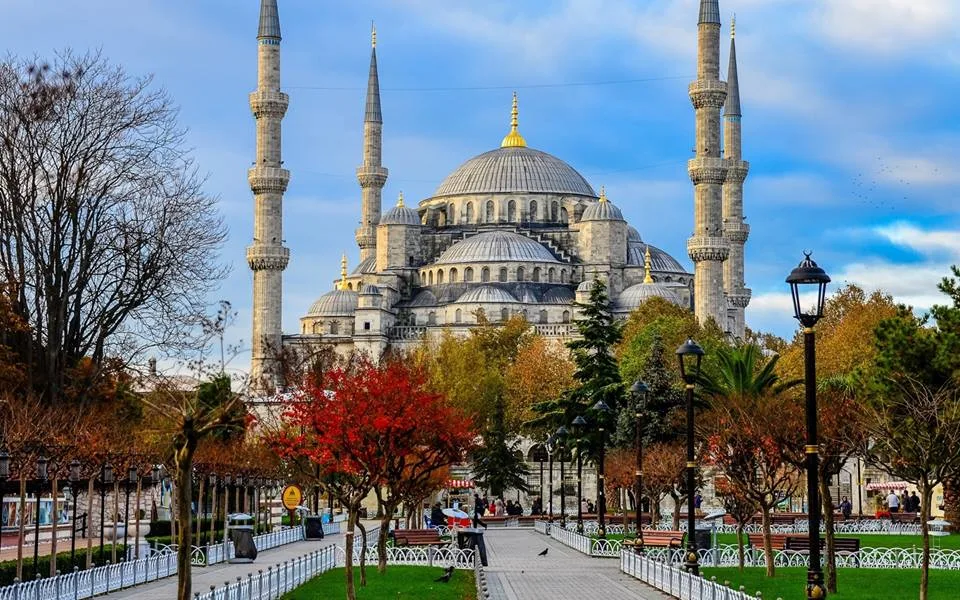
The Blue Mosque is one of Istanbul's best-known monuments and continues to function as an active mosque. Located in Sultanahmet, facing Hagia Sophia, it combines large domes, six minarets and an interior decorated with thousands of İznik tiles.
Its official name is the Sultanahmet Mosque, or Sultanahmet Camii in Turkish. The nickname "Blue Mosque" comes mainly from the bluish tones found in its interior decoration.
Entry is free, but visitors need to respect prayer times, dress rules and the building's religious function.
Quick information
- Visit duration: about 30 minutes to 1 hour
- Location: Sultanahmet, Fatih, Istanbul
- How to get there: T1 tram to Sultanahmet plus a short walk
- Entry: free
- Summer hours: 8:30am to 7pm
- Winter hours: 8:30am to 5pm
- Last entry: 30 minutes before closing
- Friday: tourist visits from 2:30pm
- During prayers: tourist access temporarily paused
- Women: hair must be covered
- Footwear: must be removed before the carpeted area
- Photography: allowed, no flash
- Best time: early morning, outside prayer times
Hours can change for religious, seasonal or operational reasons. Confirm again close to your visit.
Is entry to the Blue Mosque free?
Free entry.
There's no mandatory ticket to visit the Blue Mosque.
Companies may sell guided tours, but in those cases the price corresponds to the service offered, not to entry into the mosque itself.
Donations may be accepted, but they're voluntary.
Why visit the Blue Mosque?
The Blue Mosque lets you experience a major historic Ottoman mosque that's still used for worship.
Architecturally, the main highlights are the cluster of domes, the six minarets, the courtyard and the thousands of İznik tiles decorating the interior.
The building's ongoing religious function also makes the experience different from visiting a conventional museum.
History of the Blue Mosque
The mosque was built during the reign of Sultan Ahmed I.
Construction began in 1609 and was completed approximately between 1616 and 1617.
The project was led by the architect Sedefkâr Mehmed Ağa and occupies one of the most important areas of ancient Constantinople, near the old Hippodrome and directly facing Hagia Sophia.
Why is it called the Blue Mosque?
The exterior isn't actually blue.
The name comes mainly from the more than 20,000 İznik tiles used in the interior decoration, many featuring floral patterns and bluish tones.
Depending on the light, these tones appear with more or less intensity.
The six minarets
The six minarets are one of the mosque's most recognisable features.
Together with the large central dome and the semi-domes, they create the silhouette that dominates part of Sultanahmet Square.
At the time of construction, six minarets were unusual for an imperial mosque.
What is the interior visit like?
Before entering, visitors need to follow the rules that apply to an active mosque.
Inside, pay attention mainly to:
- İznik tiles;
- the dome and semi-domes;
- calligraphy;
- stained-glass windows;
- decoration;
- natural light;
- the scale of the prayer hall.
Respect the areas reserved for worshippers and behave appropriately for a religious space.
What are the hours?
Summer
From April 1 to September 30:
8:30am to 7pm
Winter
From October 1 to March 31:
8:30am to 5pm
The last entry is 30 minutes before closing.
These windows don't represent continuous tourist access, because visits are paused during prayers.
How do the prayer-time pauses work?
Since the Blue Mosque remains a place of worship, tourist visits are suspended at certain times.
Prayer times change throughout the year, so there isn't a single list of times valid for every month.
Check the times close to your visit date and leave some margin in your schedule.
Friday
On Fridays, tourist visits only start at:
2:30pm
If you have flexibility, another day tends to be simpler. If Friday is your only option, plan the visit for the afternoon.
What should you wear?
Shoulders and knees must stay covered.
Women need to cover their hair before entering.
Coverings may be available on site when needed, but arriving prepared makes entry simpler.
Before the carpeted area, you also need to remove your shoes.
Can you take photos?
Yes.
Photography is allowed, but don't use flash.
Avoid photographing people during prayer and don't block circulation or areas reserved for worshippers.
How much time should you allow?
Allow roughly 30 minutes to 1 hour.
That's usually enough to see the courtyard and interior at a relaxed pace.
The wait can grow longer if you arrive close to a prayer time.
What's the best time to visit?
Early morning tends to be a good choice.
Besides making it easier to plan the rest of your day in Sultanahmet, this time can help you avoid some of the busiest periods.
On Fridays, remember that tourist visits only start at 2:30pm.
How to get to the Blue Mosque
The mosque is in Sultanahmet Square, in Fatih.
The address is:
At Meydanı No:7, 34122 Sultanahmet, Fatih, Istanbul.
Take the T1 tram to the Sultanahmet stop. From there, it's a short walk.
Hagia Sophia, the Basilica Cistern and Topkapi Palace are all in the same area.
Are the Blue Mosque, Sultanahmet Mosque and Sultanahmet Camii the same place?
Yes.
All three names are used for the same monument:
- Blue Mosque;
- Sultanahmet Mosque;
- Sultanahmet Camii.
The name Sultanahmet refers to Sultan Ahmed I, who commissioned its construction.
Blue Mosque or Hagia Sophia?
The two attractions are different and can be visited on the same itinerary.
The Blue Mosque is one of the great examples of 17th-century Ottoman architecture and has free entry.
Hagia Sophia is much older, dating from the Byzantine period, and has moved through different religious functions over the centuries.
Since they stand almost directly across from each other, there's no need to choose just one on a first trip.
What to combine with the Blue Mosque?
Hagia Sophia: directly across the way.
Basilica Cistern: a few minutes on foot.
Topkapi Palace: also nearby, but requires roughly 3 to 4 hours.
The best strategy is to take advantage of the proximity without trying to turn Sultanahmet into a rushed sequence of attractions.
Does the Blue Mosque still function as a mosque?
Yes.
It remains an active place of worship.
That's the reason for the prayer-time pauses, the dress code and the separation between areas for worshippers and visitors.
Practical tips for visiting the Blue Mosque
- Free entry.
- Allow roughly 30 minutes to 1 hour.
- In summer, the published tourist hours are 8:30am to 7pm.
- In winter, they're 8:30am to 5pm.
- The last entry is 30 minutes before closing.
- Visits are paused during prayers.
- On Fridays, tourists enter from 2:30pm.
- Women should cover their hair.
- Shoulders and knees must stay covered.
- Remove your shoes before the carpeted area.
- Photography is allowed, but no flash.
- Take the T1 tram to Sultanahmet.
- Hagia Sophia and the Basilica Cistern are nearby.
- Check prayer times close to your trip.