Last updated: August 2026
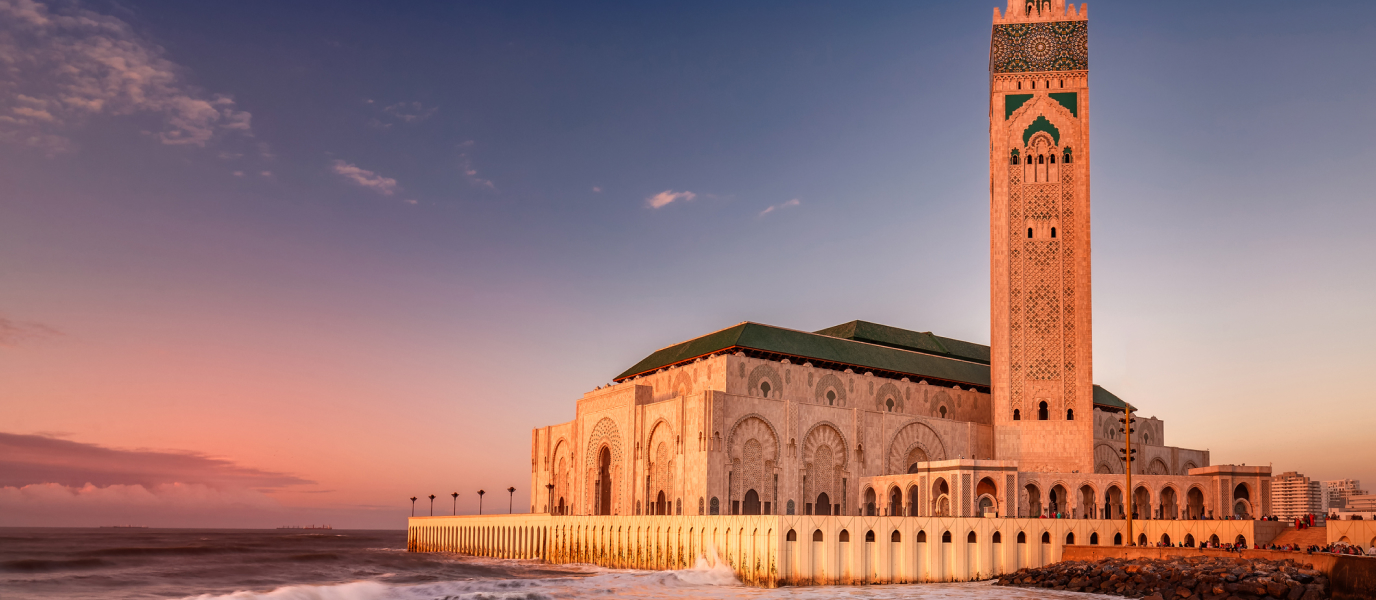
The Hassan II Mosque is Casablanca's main architectural landmark and one of the most important attractions to include in any visit to the city. Built on the shore of the Atlantic Ocean, it stands out for its 200-meter minaret, its vast esplanade, and details crafted by Moroccan artisans.
For non-Muslim travelers, the main draw is the chance to see the interior during guided tours held at set times. The route usually covers the prayer hall, the minaret hall, and the ablutions room, letting visitors get a close look at woodwork, marble, copper, stucco, and zellij.
The visit requires some planning, since the mosque remains an active place of worship and tourist access happens between prayer times. This guide is a professional recommendation based on information published by the Hassan II Mosque Foundation and on how travel logistics work in Casablanca. It is not presented as a personal experience report, since I have not yet visited the attraction.
Quick facts
- Visit time: about 1 hour for the tour and up to 2 hours counting the esplanade, ticket purchase, and outdoor photos
- Location: Casablanca's seafront, on Boulevard Sidi Mohammed Ben Abdellah
- Best time: one of the first morning tours
- Access for non-Muslims: only during guided tours at authorized times
- Price for a foreign adult: 140 MAD (approximately US$14)
- Dress code: shoulders and torso covered, with clothing reaching below the knees
How to fit the Hassan II Mosque into a Casablanca itinerary
The Hassan II Mosque can be visited during a morning on your Casablanca itinerary. The best approach is to choose one of the official time slots in advance, arrive early, and set aside the rest of the period to see the esplanade and walk along the seafront.
Allow between 1h30 and 2 hours for the whole experience. The tour itself lasts about an hour, but you still need to find the ticket office, get organized with the group, take off your shoes, and follow the guide's instructions.
After the mosque, the itinerary can continue through the old medina, the central area, or Casablanca's seafront. The Ain Diab Corniche is on a different part of the coast and requires additional travel, so it shouldn't be confused with the area immediately around the mosque.
Anyone with only a few hours in the city should prioritize the mosque's interior and the esplanade. The visit fits easily into a one-day Casablanca itinerary, without needing to add several far-apart attractions in the same morning.
What is the Hassan II Mosque?
The cornerstone of the Hassan II Mosque was laid in July 1986, and the building was inaugurated in August 1993. The project was designed by architect Michel Pinseau in collaboration with Moroccan master craftsmen and artisans.
Its location on the Atlantic is part of the project's symbolism. According to the Hassan II Mosque Foundation, building over the ocean was inspired by the Quranic reference to God's throne resting upon water.
The minaret stands 200 meters tall and carries a laser beam aimed toward Mecca. The prayer hall covers approximately 20,000 square meters and holds around 25,000 worshippers. The outdoor esplanade can hold approximately 80,000 people.
Despite the numbers, the visit isn't just about scale. Carved wood, zellij, marble, copper, stucco, and light fixtures show how traditional Moroccan crafts were combined with modern resources.
How to get to the Hassan II Mosque
The mosque sits on Casablanca's seafront, about 2 kilometers from Casa-Port station and close to the old medina.
The most practical options are:
- On foot: possible from Casa-Port or the old medina, depending on where you're staying and the weather
- Petit taxi: a direct option from downtown; ask the driver to use the meter
- Car or transfer: useful if you have luggage, are traveling in a group, or are heading straight to another part of the city
- Tram combined with a walk or taxi: the tram can help you reach the central area, but there's no stop right at the mosque's entrance
Allow about 25 to 35 minutes to walk from Casa-Port or some central areas. The time depends on your starting point and pace.
Anyone using the tram should get off at a central stop and cover the rest of the route on foot or by taxi. Since there's no station at the mosque's entrance, check the line and final stretch before boarding.
On the way back, it can be harder to find an empty taxi right after a busy tour. Consider walking toward a larger avenue or ask your accommodation for help arranging transport.
How the guided tour works
Non-Muslim travelers enter the interior during official guided tours. Independent access to the prayer hall outside this format is not allowed.
The route published by the Foundation is divided into three parts:
- Prayer hall: the main interior space, with a retractable roof, light fixtures, marble, wood, and zellij
- Minaret hall: an area used to present details of the design and structure
- Ablutions room: a space related to the ritual preparation before prayers
The visit to the minaret hall does not include going up to the top. The hall is part of the guided route, while the minaret itself does not function as a tourist viewpoint.
The group must stay with the guide and respect the boundaries indicated throughout the route. Since the mosque is an active place of worship, the itinerary can be adjusted for prayers, religious celebrations, events, or maintenance needs.
What to look for during the visit
Prayer hall
The prayer hall is vast in scale, with two elevated areas reserved for women and a retractable roof that can open the central part of the space. The roof does not necessarily open on every tour.
Look for the carved woodwork, the zellij, the marble, the chandeliers, and the geometric details. These elements help show how different traditional crafts came together in the project.
Don't cross chains or barriers to take photos. Some areas seen in promotional images may not be accessible on every visit.
Minaret
The 200-meter minaret dominates the seafront skyline and can be seen from different points on the esplanade. Its upper section carries a laser beam aimed toward Mecca.
Set aside a few minutes to look at the minaret from the esplanade, where it's easier to grasp its scale in relation to the rest of the complex.
Ablutions room
The ablutions room is used to explain the ritual preparation carried out before prayers. The space has fountains and decorative elements that follow the same architectural language as the rest of the complex.
Listen to the guide's instructions and avoid sitting, touching, or crossing into indicated areas without authorization.
Esplanade and Atlantic view
The esplanade offers views of the façade, the arches, the minaret, and the building's relationship with the ocean. Set aside some time before or after the tour to walk around the area open to the public.
The wind can be strong and the ground can get slippery when wet. Access to certain parts of the esplanade may be limited during prayers, events, or security operations.
Tickets and prices
According to the official price list checked in August 2026, guided tour prices are:
- Foreign adult: 140 MAD (approximately US$14)
- Foreign student: 70 MAD (approximately US$7), with valid proof
- Child category from age 6: 30 MAD (approximately US$3)
- Children under 6: free entry
The Foundation lists different categories for Moroccans, residents, students, and private tours. Confirm at the ticket office which rate applies to you and which documents are required.
The dollar conversions are approximate and were calculated in August 2026. The final amount may change depending on the exchange rate and any fees charged by your card or payment service.
Arrive early to find the ticket office and join the correct group. Before visiting, check the official website to see whether there's a current option for advance purchase or any change to the ticket office procedure.
Guided tour schedules
The Foundation uses different schedules depending on the time of year.
Between September 16 and March 14, the times usually published are:
- Saturday to Thursday: 9am, 10am, 11am, noon, and 3pm
- Friday: 9am, 10am, and 3pm
Between March 15 and September 15, a 4pm tour is usually added:
- Saturday to Thursday: 9am, 10am, 11am, noon, 3pm, and 4pm
- Friday: 9am, 10am, 3pm, and 4pm
During Ramadan, the schedule follows a special program and may be reduced. Always check the official calendar before planning your day.
Schedules can change due to religious celebrations, maintenance, or decisions made by the Foundation. Don't rely on an old schedule as your only confirmation.
Dress code and behavior rules
The Foundation asks visitors to wear clothing that covers the shoulders and torso and reaches below the knees. Short shorts, sleeveless clothing, and very revealing pieces are not suitable for the visit.
Shoes must be removed before entering the prayer hall. Bags for carrying your shoes are usually provided at the entrance.
During the visit:
- stay with the group and respect the schedule
- don't cross chains or restricted areas
- don't smoke, eat, or drink inside
- keep your phone on silent
- confirm the current rules for photos and video
- avoid loud conversations during explanations and in prayer areas
Covering the head does not appear as a general mandatory rule for women on the tourist visit as published by the Foundation. Even so, all visitors should follow the guidance given by staff on the day.
How long to spend
The guided tour usually takes about an hour. Set aside between 1h30 and 2 hours to include buying the ticket, waiting, taking off your shoes, and walking around the esplanade.
Anyone planning to photograph the exterior at a relaxed pace or walk along the seafront should allow more time.
Don't schedule another attraction right after the tour's expected end time. Group organization, crowds, and possible changes can extend the visit.
Best time to visit
Each period offers a different experience:
- First tour of the morning: the best option for starting your day and avoiding some of the crowds
- Late morning: convenient for combining the visit with lunch downtown
- Afternoon: an alternative for those arriving in Casablanca after noon
- Late afternoon: good light for viewing the exterior, but it doesn't guarantee there will be an interior tour at that time
Friday requires special attention because of prayer times. Tourist visiting hours are more limited and can be adjusted.
For most itineraries, one of the first morning tours is the most practical choice. After the visit, there will still be time to explore other parts of Casablanca.
Accessibility and physical effort
The visit doesn't require the same effort as attractions with trails or long staircases, but it does involve moving between spaces in the complex and taking off your shoes.
People with reduced mobility should contact the Foundation before the visit to confirm access points, available elevators, and any assistance needed.
Anyone using a wheelchair, cane, or other equipment should mention the need when buying the ticket and follow the route indicated by staff.
Practical tips
- Check the official website before your visit
- Arrive ahead of the tour's start time
- Wear clothing that covers the shoulders, torso, and legs below the knees
- Choose footwear that's easy to take off and put back on
- Have dirhams on hand for any on-site payments
- Keep your ticket and a student ID handy if applicable
- Factor in strong wind when walking on the esplanade
- Confirm the photo and video rules with the guide
- Set aside time to see the esplanade
- Combine the visit with the old medina or downtown Casablanca
Final tip
Choose one of the first morning tours and arrive early to buy or collect your ticket. See the prayer hall, the minaret hall, and the ablutions room with the official group.
After the tour, walk around the open part of the esplanade and take in the façade, the minaret, and the Atlantic Ocean. From there, continue on to the old medina or head back to downtown Casablanca.
This plan lets you see the city's main architectural attraction without making the morning too rushed, while still leaving time for other stops on your Casablanca itinerary.