Last updated: August 2026
The drive from Ifrane to Merzouga offers one of the most dramatic changes in scenery on a journey through Morocco. The road begins among the mountains, forests and higher elevations of the Middle Atlas, passes through towns and arid valleys, and ends at the Erg Chebbi dunes.
This is not a day for packing in too many attractions. It is a long drive that requires an early start, carefully chosen stops and enough time to reach Merzouga before dark. Midelt is the main stop, while Errachidia, the Ziz Valley, Erfoud and Rissani can be included if time allows.
This itinerary is a professional recommendation based on research into the route, distances and travel logistics. Since I have not yet travelled through this part of Morocco, I am not presenting it as a first-hand account.
How this Ifrane to Merzouga itinerary was planned
The day begins with an early departure from Ifrane. The first stretch crosses the Middle Atlas landscape before heading toward Midelt, where it is worth taking the longest break of the day for lunch, fuel and rest.
After Midelt, the landscape becomes progressively drier. The route continues toward Errachidia and the Ziz Valley, where a scenic stop can be added without turning the drive into a rushed string of attractions.
Erfoud is one of the last main towns before reaching the Merzouga area. Rissani is optional and should be removed from the plan if you leave later than expected or have a scheduled transfer to a desert camp.
Ifrane to Merzouga route overview
Day-by-day itinerary
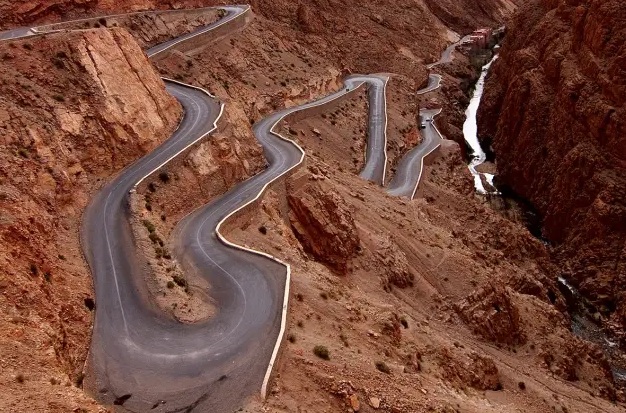
Middle Atlas: from Ifrane to Merzouga along the road between the mountains and the desert
Early departure from Ifrane
The best approach is to leave Ifrane in the morning, after breakfast, without starting the drive too late. The total journey time depends on road conditions, traffic, the number of stops and the exact location of your accommodation in Merzouga.
Check the route on a navigation app before leaving, but do not rely only on mobile signal. Download the map for offline use and confirm the exact arrival point with the accommodation in Merzouga, especially when a transfer to a camp is involved.
Fill up the tank before the longest stretches and carry water and a snack. Even though there are towns along the way, it is not advisable to count on a specific stop without checking whether it will be open at the time you pass through.
Middle Atlas and the changing landscape
At the start of the drive, the road crosses mountainous areas and landscapes associated with the Middle Atlas. Depending on the route chosen, travelers may pass near Azrou again before heading south.
Anyone who already visited the forests and surroundings of Azrou the day before does not need to repeat the stop. On this day, the main thing is to keep up the pace of the drive and watch how the vegetation and the terrain change gradually.
Weather conditions at higher elevations can differ a lot from those found in the desert. During winter, rain, cold, fog or snow can affect the drive. Before leaving, check road conditions and follow local guidance.
Midelt: the main stop on the route
Midelt is the most practical stop for breaking up the drive. The town sits between the mountain regions and the road south, making it a good place to pause before continuing toward Errachidia.
Set aside time for lunch, a restroom break, coffee and fuel, but avoid turning the stop into a long visit. There is still plenty of road to Merzouga, and the next stretches are best covered in daylight.
If the trip is running behind schedule, prioritize a simple meal and get back on the road. The goal is to reach the Ziz Valley area and the roads near the desert with a safe margin of time.
Errachidia and the Ziz Valley
After Midelt, the landscape becomes more arid and the route continues toward the Errachidia region. On this itinerary, Errachidia is mainly a transit stop, so there is no need to plan a full visit.
The Ziz Valley is one of the most interesting landscapes on the way to Merzouga. Palm groves follow the valley between rock formations and dry terrain, creating a sharp contrast with the scenery near the start of the drive in Ifrane.
There are scenic viewpoints along the way, but stops should only be made in safe spots. Do not stop on curves, narrow shoulders or areas that block the flow of other vehicles.
A short stop to enjoy the view and take photos is enough. The Ziz Valley deserves attention, but it should not put the arrival time in Merzouga at risk.
Erfoud and Rissani
Erfoud is one of the last main towns before the desert. Depending on the route and the time, it can be a useful place to refuel, take a break, have a coffee or pick up any last-minute supplies.
There is no need to plan a long visit to Erfoud on this day. Additional activities should be considered carefully, especially when there is an agreed time to reach the accommodation or meet the transport arranged by the desert camp.
Rissani can be included as an optional stop. The town has regional importance and a traditional market, but how busy it is and whether it is open depend on the day and the time.
If there is enough time, a brief stop in Rissani can add interest to the journey. If the trip is running late, head straight to Merzouga instead. Trying to visit Rissani late in the afternoon can turn the final drive to Merzouga into a race against the clock.
Arrival in Merzouga
As you approach Merzouga, the landscape changes again and the Erg Chebbi dunes start to dominate the horizon. This marks the final transition from the mountain route to the edge of the Sahara.
Confirm in advance whether the booking is for accommodation in the village, a hotel near the dunes or a camp located outside the urban area. Many camps arrange a meeting point at a hotel or parking area and cover the final stretch in a different vehicle or as part of a previously booked activity.
Anyone with a camel ride or a late-afternoon transfer to the camp should let the operator know about any delay during the drive. Sunset times change throughout the year, so do not assume that a late arrival will leave enough time for the planned experience.
After arrival, leave the detailed desert activities for the dedicated Merzouga itinerary. The priority on this day is completing the drive safely, checking in and resting after the long journey.
What I would prioritise on this route
I would prioritise an early start, a proper break in Midelt and a safe stop to take in the Ziz Valley.
I would also stay in touch with the accommodation or the camp operator to confirm the meeting point and time in Merzouga.
This stretch should be treated as an important part of the trip, but without any obligation to stop in every town. The shift between the Atlas landscapes and the desert already makes the drive worthwhile.
Arriving in Merzouga in daylight matters more than adding long visits in Erfoud or Rissani.
What can be optional
Repeating the stops near Azrou is optional for anyone who already explored the area the day before.
Erfoud can simply work as a pass-through town, especially when there is no need to refuel or rest.
Rissani is optional too. The stop should be dropped if the drive is running late, if you are tired, or if there is a set time for the transfer to the camp.
Shopping, long visits and unplanned detours can wait for another time. This is a long driving day, not an itinerary meant to explore every town along the way in depth.
Mistakes that can make the journey tiring
The most common mistake is leaving Ifrane late and still trying to keep every planned stop even once the schedule has slipped.
Another problem is trusting an exact travel time. Roadworks, traffic, weather, breaks and road conditions can all add to the length of the drive.
Avoid driving at night on unfamiliar stretches just to stick to a rigid schedule. It is better to drop an optional stop and arrive without rushing.
Do not park on narrow shoulders to photograph the scenery. Only use spots where you can stop without putting the vehicle's occupants or other drivers at risk.
It is also not advisable to arrive in Merzouga without confirming the address and logistics of the accommodation. A camp's meeting point can be different from the address shown when you first booked.
Finally, do not confuse this route with the Merzouga activities post. This content covers the drive between Ifrane and the desert. Dunes, camel rides, 4x4 excursions and camps are covered separately in the Merzouga itinerary.
Planning the journey from Ifrane to Merzouga: essential tips
Route and timing
- Leave Ifrane in the morning
- Check the route and road conditions before the trip
- Download the map for offline use
- Avoid planning to arrive in Merzouga after dark
Fuel and breaks
- Start the drive with enough fuel
- Use Midelt as the main stop for lunch and rest
- Carry water and a snack in the car
- Do not wait until the final stretch to refuel or take an essential break
Stops and safety
- Only stop in parking areas or safe spots
- Do not block the road to take photos
- Make a short stop at the Ziz Valley if there is time
- Drop Erfoud or Rissani from the plan if you are running late
Arriving in Merzouga
- Confirm the exact address of the accommodation
- Ask whether there is a meeting point for the camp
- Let the person handling your booking know about any delays
- Save the desert activities for the dedicated Merzouga itinerary