Last updated: August 2026
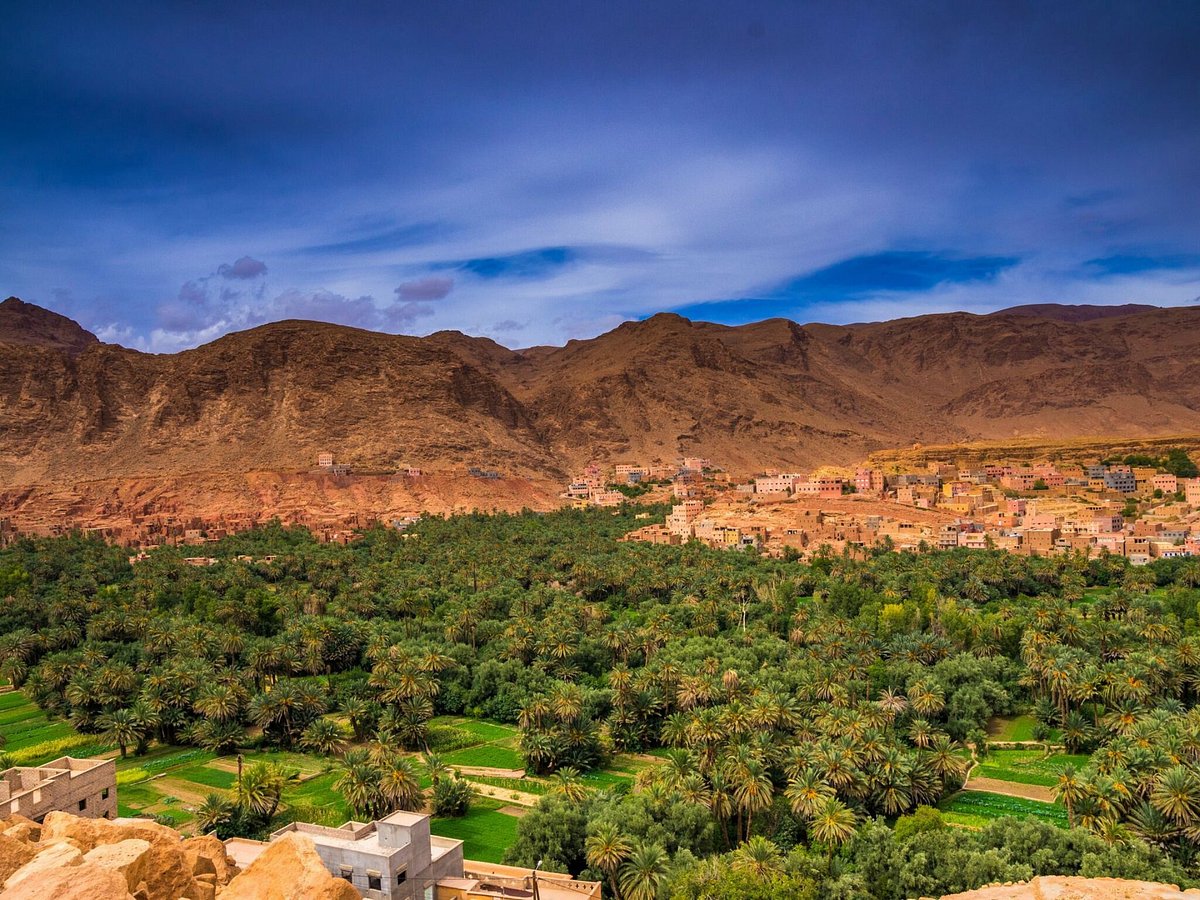
The Tinghir palm groves follow the Todgha valley and form a cultivated strip between the town, the region's communities, and the road to the Todra Gorge. Palm trees, fruit trees, small crops, and irrigation channels occupy the valley floor, surrounded by drier land and rock formations.
The landscape isn't just scenery. The palm grove remains a working agricultural area, divided into properties and paths used by residents. Beneath the palms you may find olive trees, fig trees, pomegranate trees, almond trees, vegetables, herbs, and crops grown for animal feed.
Water from the Todgha River and underground sources is distributed through open channels known locally as seguias or tirgouine. Khettaras, made up of underground galleries, also appear in lower parts of the valley, but they don't represent the whole of Tinghir's irrigation system.
For anyone heading toward the Todra Gorge, it's worth combining a viewpoint with a short walk through the palm grove. Since the paths run through farmland and residential areas, the visit is more pleasant when travelers use the main routes and respect local life.
This guide offers a professional recommendation based on research into the valley, access points, and how to organize the visit. The content is not presented as personal experience, since I have not yet visited the Tinghir Palm Groves.
Quick facts
- Visit time: 1 to 2 hours
- Location: the Todgha valley, around Tinghir and along the road to the gorge
- Best time: morning or late afternoon, mainly because of the temperature
- Entrance: no general ticket for viewing the valley or using the public paths
- Extra costs: a guide, taxi, and private transport are charged separately
- Type of visit: viewpoint, walking, and taking in the agricultural landscape
- Access: varies depending on the point chosen and path conditions
- Accessibility: limited on dirt paths and between the farmland
Is it worth visiting the Tinghir Palm Groves?
The palm groves are worth visiting for anyone wanting to see part of the Todgha valley's agricultural landscape and understand how water enables farming in a dry-climate region.
The experience is different from a visit to the Todra Gorge. In the gorge, the focus is on the rock walls and the narrow canyon section. In the palm grove, attention turns to the vegetation, the channels, the crops, and the earthen buildings along the valley.
You can see a viewpoint and take a short walk before continuing your trip. Anyone with more time can hire a local guide to explore less obvious paths and better understand the region's water distribution and farming use.
What are the Tinghir Palm Groves?
The Tinghir palm groves are part of the Todgha oasis, a large cultivated area along the watercourse that crosses the valley. This isn't a fenced park or an attraction with a single entrance.
The landscape brings together palm trees, fruit trees, and crops grown in smaller plots. The shade from the taller trees helps reduce direct sun exposure and creates conditions for other plants to grow beneath them.
How the valley looks changes depending on the season, water availability, and the crop cycle. Some parts can be green and irrigated, while others show dry soil, sparse vegetation, or channels with little water.
The palm grove keeps changing along with water availability, urban growth, and new forms of land use. The landscape seen today brings together old farming practices and more recent changes to the valley.
How does irrigation work in the Todgha valley?
Farming in the valley depends on the distribution of water from the Todgha River, springs, and underground reserves. Part of this water flows through open channels called seguias or tirgouine, which carry the flow to different cultivated areas.
Distribution follows local agreements and usage periods set for the valley's communities and properties. How much water is available changes depending on rainfall, spring levels, the time of year, and each area's position along the watercourse.
In lower stretches, there are also underground structures known as khettaras. They carry water by gravity, but they form just one part of the different methods used in the region.
During a walk, you may find channels with water and others temporarily dry, depending on the irrigation schedule for each farming area.
How to fit the palm groves into a Tinghir itinerary
A practical plan is to start at a panoramic point, take a short walk in the valley, and then continue along the road toward the Todra Gorge.
Set aside about 1 hour for the viewpoint and a brief walk. With 2 hours, you can walk at a more relaxed pace, take in the channels, and see part of the agricultural landscape without turning the visit into a long trek.
The best-known stretch of the Todra Gorge is approximately 15 kilometers north of Tinghir along the main road. Since the palm grove follows much of that route, it's easy to combine both visits in the same outing.
If your schedule is tight, prioritize a panoramic point and a short walk. Seeing the palm grove only from the vehicle window offers a general view, but it doesn't let you take in the channels, the crops, and the different layers of vegetation.
How to get to the Tinghir Palm Groves
The cultivated valley begins near the urban area and follows the road toward the Todra Gorge. Since the palm grove is extensive, there's no single entrance for all visitors.
The main options are:
- On foot: possible from points near the town, after identifying a suitable public path
- By car: lets you combine a viewpoint, a walk, and continuing on to the gorge
- By taxi: an alternative for reaching a panoramic point or the start of a route
- With a local guide: useful for longer walks and for understanding the valley's irrigation and organization
Walking time from the center varies depending on where you're staying and which stretch of the palm grove you choose. Ask your accommodation which access best fits the route you plan to take.
The main road doesn't require a vehicle with special traction. Narrow paths between the crops, however, aren't suitable for cars and can end up on private property.
Viewpoints over the palm grove
There are elevated points around Tinghir and along the region's roads that let you see the cultivated valley set against drier land.
When choosing a viewpoint, look for a safe area to park and keep bends, narrow shoulders, and entrances used by residents clear.
How the landscape looks changes depending on the sun's position, clouds, and the time of year. Morning and late afternoon tend to offer more pleasant temperatures, but each viewpoint catches the light differently.
Some hotels, restaurants, and private terraces may also have views over the valley. Access can depend on ordering something, staying there, or getting the owner's permission.
Walking among the palms
The walk lets you take in the irrigation channels, the farm plots, and the vegetation beneath the palms. The route can be short or part of a longer path through the valley.
The more defined paths tend to be easier to follow. Gates, fences, and cultivated areas indicate private space; if in doubt, ask a resident or choose another route.
Don't pick fruit, plants, or farm produce. Even when an area looks empty, it may be under cultivation or used by a family.
After rain or irrigation, some stretches get muddy and slippery. Wear closed shoes and only cross channels at points set up for crossing.
Communities and traditional buildings
Along the valley there are Amazigh communities and buildings made of earth, stone, wood, and other materials available in the region. Some structures have been restored, while others show wear or have been modified.
The valley's communities are part of everyday life for people living in Tinghir. Use the public paths and only enter homes, courtyards, terraces, or other buildings when invited or authorized.
Ask permission before photographing residents, children, interiors, open doors, or people working in the fields.
A local guide can help distinguish public paths, farmland, and residential spaces, as well as explain aspects of the architecture and life in the valley.
Tickets and costs
Viewing the palm grove from the roads and public-use paths doesn't require buying a ticket.
Guides, taxis, transfers, and private tours are independent services. Since they don't follow a fixed rate, check the price in Moroccan dirhams, ask about the service's duration, and agree on the total before starting.
Viewpoints located at hotels, restaurants, or private properties may require authorization, an order, or a specific payment. Check the conditions before entering.
How long to spend
A visit of about 1 hour lets you see a viewpoint and take a short walk. Set aside about 2 hours if you want to cover a larger part of the valley or walk with a guide.
A long trek toward the Todra Gorge requires separate planning. Distance, heat, orientation, and return transport need to be considered before setting out.
For most itineraries, a short walk through the palm grove combined with a visit to the gorge offers a balanced plan for the same day.
Best time of day to visit
Morning tends to offer more comfortable temperatures for walking. It also leaves more margin to continue on to the Todra Gorge or continue your road trip.
Late afternoon can work well for anyone staying in Tinghir, as long as you return before dark. The farm paths have no lighting or standardized signage.
At midday, especially during the hottest months, the walk can become tiring. Even with the palms' partial shade, bring water and sun protection.
Best season to visit
Spring and fall generally offer more comfortable temperatures for walking through the valley. In summer, the heat can limit outings during the central hours of the day.
In winter, mornings and nights can be cold. An extra layer of clothing helps anyone starting early or staying in the region after late afternoon.
The vegetation, the volume of water in the channels, and the look of the crops change throughout the year. Each period shows a different stage of cultivation, so the valley won't always be fully green or the palms loaded with fruit.
Safety and orientation
The palm grove's paths can split between channels, properties, and cultivated areas. Download the map for offline use, but don't rely on it alone, since not every path appears with precision.
On a short walk, stay close to familiar landmarks. For longer routes or connections between different communities, consider going with a local guide.
Bring water, sun protection, and closed shoes. After rain or irrigation, take extra care with mud, loose stones, and channel edges.
Don't walk inside the channels, don't damage small earthen barriers, and don't alter structures used to distribute water.
Accessibility
Viewing from some panoramic points can be done without a long walk, depending on access and where you can stop.
The paths inside the palm grove usually have dirt, rocks, level changes, mud, and narrow passages. These conditions can make the route difficult for people with reduced mobility, strollers, and wheelchairs.
Anyone needing simpler access can prioritize a viewpoint near the road and confirm in advance whether the vehicle can stop in a safe spot.
Practical tips
- Start at a viewpoint to get a sense of the valley's extent
- Choose public paths and respect gates and properties
- Wear closed, comfortable shoes
- Bring water, a hat, and sun protection
- Download the map for offline use
- Ask before photographing residents
- Don't pick fruit or plants
- Don't enter homes, courtyards, or terraces without permission
- Avoid crossing channels outside designated points
- Combine the visit with the Todra Gorge
- Agree on the price for guides and transport in advance
- Head back before dark
Final tip
Start the visit at a panoramic point to see how the palm grove follows the valley floor. Then take a short walk along a permitted path, paying attention to the channels, the crops, and the shifts in vegetation.
Continue to the Todra Gorge when there's enough time to see both places without rushing. The palm grove helps convey the valley's agricultural use, while the gorge shows the rock formation shaped by the Todgha's course.
During the walk, remember that the palm grove is also a place of work and residence. Respecting the paths, the crops, and residents' privacy lets you experience the valley without disrupting the community's routine.