Last updated: June 2026
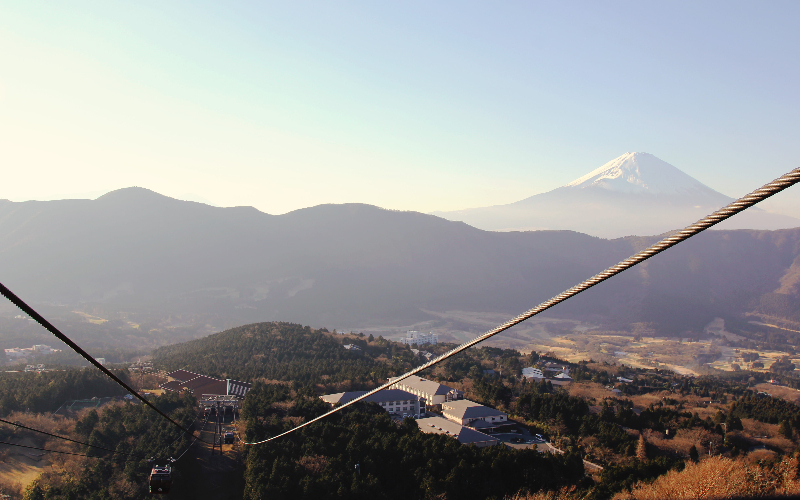
The Hakone Ropeway is one of the most scenic parts of a Hakone itinerary. It connects key areas of the region while passing over mountains, valleys and volcanic terrain, with views of Mount Fuji on clear days.
Even though it is part of the local transport system, the Hakone Ropeway should not be treated as just a transfer. The crossing is an attraction in itself, especially the stretch near Owakudani, where you can see volcanic vapours rising from the ground and a landscape very different from Japanese cities.
For a one-day visit to Hakone, I would prioritise the ropeway alongside Lake Ashi and Owakudani. Together, they bring together the region's natural and volcanic scenery, the possibility of seeing Mount Fuji and the main sections of the classic Hakone circuit.
Quick info
- Visit duration: 30 to 40 minutes for the full route only
- Time with a stop at Owakudani: 1 to 2 hours
- Location: Hakone, Japan
- Best time: early morning or early afternoon
- Difficulty: easy
- Adult one-way price: ¥2,000, about US$13
- Adult round-trip price: ¥3,000, about US$20
- Children one way: ¥700, about US$4.70
- Children round trip: ¥1,000, about US$6.50
- Hakone Freepass from Shinjuku: ¥7,100, about US$47
- Hours February to November: usually 9am to 4:45pm
- Hours December and January: usually 9am to 4:15pm
Is the Hakone Ropeway worth using?
Yes, it is definitely worth it. The Hakone Ropeway is one of the most interesting parts of the Hakone circuit and makes the journey itself part of the experience, rather than simply a series of transfers.
It is particularly worthwhile when combined with Owakudani and Lake Ashi. The ropeway connects the two areas and offers wide views along the way. On clear days, you may also see Mount Fuji.
If the weather is very overcast, the view can lose some of its impact, but the ropeway can still be worth it for the volcanic scenery and the convenience of getting around Hakone.
Why use the Hakone Ropeway?
The main reason to use the Hakone Ropeway is the scenery. The route passes over mountainous areas and offers a wide view of the region. The most striking part is the crossing near Owakudani, where volcanic vapours, open slopes and a landscape very different from urban Japan appear.
Another reason is convenience. The ropeway is part of the classic Hakone circuit and connects Sounzan, Owakudani, Ubako and Togendai. Togendai is close to Lake Ashi, so the route pairs very well with the boat cruise.
For anyone doing Hakone as a day trip from Tokyo, using the ropeway helps organise the day logically. You do not need to go back and forth along the same path, because you can cross the region using different forms of transport.
How to get to the Hakone Ropeway
The Hakone Ropeway can be accessed from different points of the Hakone circuit.
One of the most common ways is to arrive at Gora, continue via the Hakone Tozan Cable Car to Sounzan and then board the ropeway. From there, the route passes Owakudani, Ubako and arrives at Togendai, near Lake Ashi.
You can also do the route in the opposite direction. You can start at Lake Ashi, arrive at Togendai and use the ropeway towards Owakudani and Sounzan.
I would choose the order based on the weather. If the sky is clear in the morning, it is worth prioritising the spots with a chance of seeing Mount Fuji. If you are doing the full circuit, the ropeway fits very well between Owakudani and Lake Ashi.
How the visit works
The Hakone Ropeway operates with cabins that circulate between stations. The gondolas pass frequently, so it is usually not an attraction where you need to choose a specific time slot.
The full route between Sounzan and Togendai takes about 30 minutes, but it is divided into sections. From Sounzan to Owakudani takes about 15 minutes. From Owakudani to Ubako takes another 15 minutes. From Ubako to Togendai, another 15 minutes.
In practice, almost everyone gets off at Owakudani. This is the ropeway's main stop and one of Hakone's most important attractions.
What to see on the Hakone Ropeway
Views of the Hakone mountains
During the journey, you see the Hakone mountains from above. The scenery changes as the ropeway advances, passing green areas, valleys and more open stretches.
On days with good visibility, the experience is much better. Because of this, it is worth checking the weather forecast before planning your day in Hakone.
Owakudani
Owakudani is the most important point of the Hakone Ropeway. The area is known for its volcanic activity, the vapours rising from the ground and the smell of sulphur in some stretches.
I would not just pass through Owakudani as a connection point. It is worth getting off, walking a little, observing the scenery and enjoying the stop before continuing the journey.
This is one of the parts that make Hakone worth visiting even when Mount Fuji does not appear.
Mount Fuji on clear days
On clear days, Mount Fuji can be seen during parts of the Hakone Ropeway route, mainly in the area near Owakudani and Ubako.
But it is important to remember that the view is not guaranteed. Fuji can be completely hidden by clouds, even when the weather seems good in other parts of the region.
I would treat Mount Fuji as a bonus. The itinerary needs to be worthwhile also for the volcanic scenery, the lake, the ropeway and the overall nature experience.
Lake Ashi near Togendai
Togendai Station sits close to Lake Ashi and the sightseeing boat port. Because of this, the ropeway pairs very well with the lake cruise.
A good approach is to use the Hakone Ropeway to Togendai and then continue by boat across Lake Ashi to Moto Hakone or Hakone machi.
How much does the Hakone Ropeway cost?
- Adult one-way ticket: ¥2,000, about US$13
- Adult round-trip ticket: ¥3,000, about US$20
- Children one way: ¥700, about US$4.70
- Children round trip: ¥1,000, about US$6.50
- Hakone Freepass (includes the ropeway): ¥7,100 for 2 days, about US$47
For anyone doing the full Hakone circuit, the Freepass can be worth more than buying separate tickets, mainly because it also includes other forms of transport in the region.
Is the Hakone Freepass worth buying?
For most travellers doing the classic Hakone circuit, I would consider the Hakone Freepass.
It includes important forms of transport in the region, such as the local train, cable car, Hakone Ropeway, sightseeing boat on Lake Ashi and buses in certain areas. The big advantage is convenience, because you do not need to buy a separate ticket at every step.
Even though it is a 2-day pass, it can be worth it on a day trip if you use several forms of transport on the same day.
If you only plan to travel a short section or visit one attraction, the pass may not offer good value. For an itinerary covering Owakudani, the ropeway, Lake Ashi and the sightseeing boat, however, I would consider the Freepass a practical option.
How long to spend on the Hakone Ropeway?
The full route takes about 30 to 40 minutes, not counting stops.
With a stop at Owakudani, set aside 1 to 2 hours in total.
If the weather is good and Fuji appears, you may want to spend more time at Owakudani or the viewpoints. If the weather is bad, the visit can be quicker.
For a 1-day Hakone itinerary, I would set aside enough time to use the ropeway without rushing and get off at Owakudani.
Best time to use the Hakone Ropeway
The best time is usually in the morning or early afternoon. Visibility tends to be better earlier, which increases the chances of seeing Mount Fuji.
It is also worth avoiding leaving the ropeway for too late, because the operating hours end relatively early. From February to November, it usually runs until 4:45pm. In December and January, closing is usually around 4:15pm.
Another important point is that the service can stop due to bad weather, strong wind, maintenance or volcanic conditions. Because of this, it is good to check operations on the day of your visit.
What to combine with the Hakone Ropeway
The Hakone Ropeway naturally combines with Owakudani and Lake Ashi.
A good sequence would be to leave Tokyo early, arrive in Hakone, continue to Sounzan, use the ropeway to Owakudani, continue to Togendai and then take the boat cruise across Lake Ashi.
You can also do it in the opposite direction, starting at Lake Ashi and going up the ropeway afterwards.
If there is time left, you can include an onsen at the end of the day or return to Tokyo after completing the circuit.
What I would prioritise on the visit
I would prioritise the stretch that passes Owakudani, the stop in the volcanic area and the continuation to Togendai to connect with Lake Ashi.
If Mount Fuji is visible, take your time at the viewpoints. If it remains hidden, continue with the itinerary as planned, because the volcanic landscape is still what sets this ropeway apart.
For anyone with little time, I would not try to fit in too many extra attractions. Hakone works best when you do fewer things at a calmer pace.
What can be optional
- Buying a round-trip ticket can be optional. In many itineraries, the one-way section makes more sense because the ropeway is used as part of the circuit.
- Using the Hakone Freepass can be optional if you are only doing a short stretch.
- Spending a long time at Ubako can be optional. For most visitors, Owakudani is the most important stop.
- Waiting too long for Mount Fuji can be optional. If the mountain is covered, it is better to continue the itinerary and enjoy other parts of Hakone.
Mistakes to avoid on the Hakone Ropeway
The first mistake is thinking the ropeway is just transport. It is one of Hakone's main attractions and deserves time within the itinerary.
Another mistake is leaving the ropeway for the end of the day. Since operating hours end early, you may end up missing part of the circuit.
It is also worth avoiding buying a round-trip ticket without thinking about your route. If you are continuing to Lake Ashi, the one-way section often works better.
Another mistake is relying entirely on the Mount Fuji view. The mountain may not appear, and that does not mean the trip was wasted.
Practical tips for using the Hakone Ropeway
- Check the weather forecast before going.
- Confirm the ropeway is operating on the day of your visit.
- Use the Hakone Freepass if doing the full circuit.
- Set aside time to get off at Owakudani.
- Bring a jacket, because it can be windy and cold in the higher areas.
- Do not leave the ropeway for too late.
- Use the section to Togendai to connect with the Lake Ashi boat cruise.
- Treat Mount Fuji as a bonus, not a guarantee.