Last updated: June 2026
Dotonbori is one of Osaka's most famous areas and one of Japan's most striking urban experiences. The district is known for its illuminated signs, giant façades, eye-catching restaurants, street food and the famous Glico Running Man sign, one of the city's most photographed symbols.
For a first visit to Osaka, I would make Dotonbori a priority, especially at night. The area reveals the city's lively, food-focused and relaxed character, in sharp contrast to Kyoto's traditional atmosphere and Tokyo's vast modern districts.
Dotonbori is not an attraction to rush through. Even though it is a free area, the experience is better when you walk without a strict plan, watch the signs, cross the bridges, photograph the canal and set aside time to eat.
Quick info
- Visit duration: 1 to 2 hours
- Location: Osaka, Namba area
- Best time: at night
- Difficulty: easy
- Price to walk through Dotonbori: free
- Glico sign: free
- Dotonbori Canal: free
- Tombori River Cruise: ¥2,000, about US$13 for adults
- Ebisu Tower ferris wheel: from ¥600, about US$4
Is Dotonbori worth visiting?
Yes, it is definitely worth visiting. Dotonbori is an essential stop for anyone who wants to experience Osaka's energy.
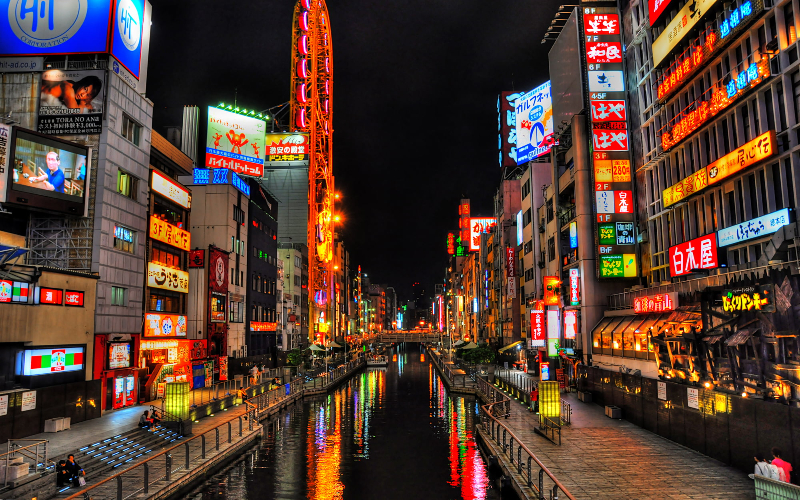
I would not call Dotonbori beautiful in the classic sense, like a temple or a garden. The charm lies precisely in the excess: lights, giant signs, packed restaurants, the smell of food, constant movement and lots of people walking through the area.
For a first trip, Dotonbori is almost mandatory. Even though it is touristy, it represents Osaka very well. The city is known for its food scene, its informality and its more relaxed atmosphere, and all of that shows up there.
Why visit Dotonbori?
The main reason to visit Dotonbori is to feel Osaka's liveliest side. The area concentrates restaurants, famous signs, shops, bars, street food and a lot of activity at night.
Unlike other attractions, Dotonbori does not depend on a ticket or a set time. You arrive, walk, eat, watch and let the experience unfold at the pace of the street.
It is also one of the best places to try typical Osaka foods, such as takoyaki, okonomiyaki and kushikatsu. Here, eating is part of the visit, not just a break between attractions.
How to get to Dotonbori
The most practical way is to go to Namba Station. The area is served by several subway and train lines, and the walk to Dotonbori takes just a few minutes.
You can also arrive via Osaka Namba Station or Nipponbashi Station, depending on where you are staying or which line you are using.
I recommend visiting Dotonbori together with Namba and Shinsaibashi, because these areas are close together and can be explored on foot. A good approach is to walk through Shinsaibashi in the late afternoon, continue to Namba and end the night in Dotonbori.
How the visit works
Dotonbori is an open, free area. There is no ticket, gate or access control.
The visit happens by walking through the area, mainly around the canal, the Ebisu Bridge, the Glico sign and the streets packed with restaurants.
The ideal is to go at night, when the signs are lit up and the area shows its most distinctive atmosphere. During the day, Dotonbori still works, but the visual impact is smaller.
What to see at Dotonbori
Glico Running Man sign
The Glico Running Man is Dotonbori's most famous symbol and one of Osaka's best-known images. The billboard shows a runner with raised arms and sits above the canal, near the Ebisu Bridge.
This is the classic photo spot. The area tends to get crowded, but that is part of the experience. I would go there at night, when the sign is lit up and the canal reflects the lights around it.
Dotonbori Canal
The canal is the visual heart of the area. Walking along the walkways beside the water is one of the best ways to see the signs, the restaurants and the buzz of the district.
At night, the reflection of the lights on the canal makes the scene even more striking. For anyone who enjoys photo and video, this is one of the best parts of Osaka.
Giant façades and eye-catching restaurants
Dotonbori is famous for its restaurants' exaggerated façades. A giant crab, a dragon, an octopus, a fish and other elements draw attention along the main streets.
This aesthetic is part of the district's identity. Even without going into every place, it is worth walking around looking at the details of the façades and signs.
Tombori River Cruise
The Tombori River Cruise is a short boat ride along the Dotonbori canal. It can be interesting for anyone who wants to see the area from another angle, especially at night.
The current price is ¥2,000 for adults, about US$13. Students pay ¥1,000, about US$6.50. Children pay ¥500, about US$3.30. The cruise may also be included for those using the Osaka e-Pass, depending on the pass conditions.
I would treat the cruise as optional. Walking through Dotonbori is already enough for many people. But if you want a different experience or are doing a more thorough trip, it can be worth it.
Ebisu Tower
The Ebisu Tower is the oval ferris wheel located at the Don Quijote store in Dotonbori. It is a curious attraction and appears prominently in the area's visual identity.
The officially listed prices for the attraction are a standard pass for ¥600, about US$4, a Majica pass for ¥1,000, about US$6.50, and a VR gondola for ¥1,600, about US$11.
I would also treat this as optional. If you want to save money, just view the ferris wheel from outside. If you want a quick and different experience, you can include it.
What to eat in Dotonbori
Dotonbori is one of the best areas in Osaka for eating. The city is known as one of Japan's great food hubs, and this area concentrates many options.
Takoyaki is one of the most classic dishes. These are octopus balls made on a griddle, usually served with sauce, Japanese mayonnaise, seaweed and bonito flakes.
Okonomiyaki is also one of the best choices. It is a type of savoury Japanese pancake, prepared on a griddle with different ingredients.
Another option is kushikatsu, battered and fried skewers, more traditional in Shinsekai but also found in several areas of Osaka.
I would set aside part of the budget for eating in Dotonbori. The visit becomes much better when you make food part of the itinerary.
How much does it cost to visit Dotonbori?
- Access to the area: free
- Glico Running Man sign: free
- Dotonbori Canal: free
- Restaurant streets and façades: free
- Tombori River Cruise: ¥2,000, about US$13 for adults
- Tombori River Cruise for students: ¥1,000, about US$6.50
- Tombori River Cruise for children: ¥500, about US$3.30
- Ebisu Tower, standard pass: ¥600, about US$4
- Ebisu Tower, Majica pass: ¥1,000, about US$6.50
- Ebisu Tower, VR gondola: ¥1,600, about US$11
The main expense in Dotonbori will usually be food. You can spend little on quick snacks or spend more at restaurants. The area works for various budgets.
How long to spend in Dotonbori?
For a quick visit, 1 hour can be enough. You can see the Glico sign, walk along the canal, pass through the main streets and feel the atmosphere.
For a better visit, I would set aside 2 hours. That way you can walk calmly, take photos, eat something and explore a bit of Namba around it.
If you plan to have dinner in the area or do the Tombori River Cruise, set aside more time. Dotonbori is not an attraction to rush. The ideal is to leave the evening more open.
Best time to visit Dotonbori
The best time is at night. That is when the signs light up, the restaurants get busier and the area shows its best atmosphere.
The late afternoon also works well, especially if you want to see the transition from daylight to night.
During the day, Dotonbori is still worth visiting, but the experience loses some of its visual impact. If you only have one time slot to go, choose the night.
I would avoid rushing through at peak times if you do not like crowds. The area can get quite busy, especially on weekends and holidays.
What to combine with Dotonbori on the same day
Dotonbori pairs very well with Shinsaibashi, Namba and Kuromon Ichiba Market.
A good sequence would be to visit Osaka Castle in the morning, continue to Shinsaibashi and Namba in the afternoon and end the night in Dotonbori. This order works well because the castle is best during the day, while Dotonbori is best at night.
You can also combine Dotonbori with Shinsekai or Umeda, but I would keep the end of the day open for Osaka without rushing, especially if it is your first time.
What I would prioritise on the visit
If it is your first time in Dotonbori, I would prioritise the Glico sign, the Ebisu Bridge, the walk along the canal, the giant façades and a stop to eat.
With more time, I would include the Tombori River Cruise or the Ebisu Tower, but only as extras.
In my view, the best Dotonbori experience is free: walking at night and eating something typical of the city.
What can be optional
- The Tombori River Cruise can be optional if you are saving money or would rather just walk.
- The Ebisu Tower can be optional because the area is already interesting seen from the street.
- Very famous restaurants with long queues can also be optional. In Dotonbori, sometimes it is better to go somewhere with good food and less waiting.
- Shopping in Namba and Shinsaibashi can be optional if your focus is just food and atmosphere.
Mistakes to avoid in Dotonbori
The first mistake is visiting Dotonbori only during the day. The area exists during the day, but the main experience happens at night.
Another mistake is rushing through too quickly. Dotonbori is not just a photo at the Glico sign. It is best to walk, observe the canal, look at the façades, try food and feel the movement.
It is also worth avoiding choosing a restaurant just because of the queue. Some famous places can have a long wait, and that does not always mean it will be the best option for your itinerary.
Another mistake is not carrying cash or an easy payment method for small snacks. Many places accept cards, but when travelling in Japan it is still good to have some cash for small purchases.
Practical tips for visiting Dotonbori
- Go at night to see the illuminated signs.
- Start around the Ebisu Bridge and the Glico sign.
- Walk along the canal before choosing where to eat.
- Set aside time to try takoyaki or okonomiyaki.
- Carry some cash for street food and small purchases.
- Combine it with Namba and Shinsaibashi.
- Avoid rushing, because the charm of the area lies in the movement.
- Consider the Tombori River Cruise only if you want an extra experience.