Last updated: August 2026
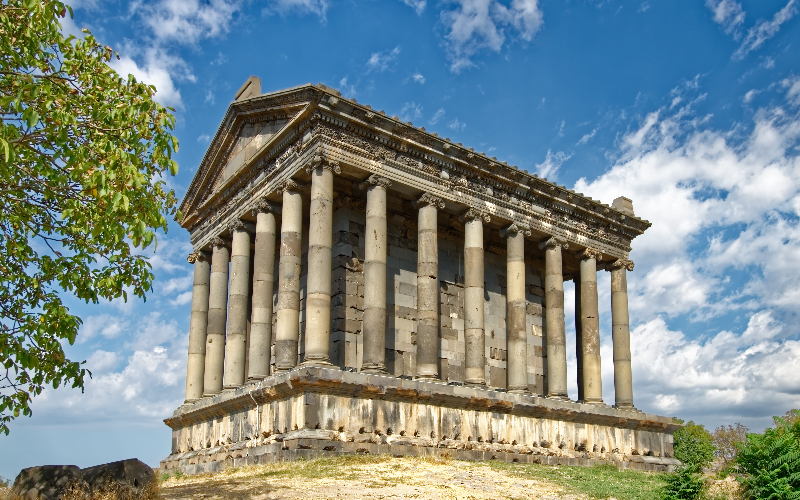
Garni Temple is one of the most distinctive and striking attractions near Yerevan. Amid the mountains of Armenia, the temple stands on the edge of a cliff, with classical columns, basalt stones and a view over the Azat River gorge.
The setting draws attention precisely because of the contrast. After visiting Armenian churches and monasteries, Garni feels out of place in time and space. The architecture recalls the Greco-Roman world, while the surrounding landscape is thoroughly Armenian, with mountains, canyons and rocky formations.
The temple was built in the 1st century, during the reign of Tiridates I, and is generally presented as Armenia's main preserved pagan temple. After the country's conversion to Christianity, Garni gained even more historic importance for representing an earlier period of Armenian culture.
The site also suffered damage from an earthquake in the 17th century and was rebuilt in the 20th century using original blocks found in the area. Today, the result is one of Armenia's best-known images and one of the best visits to do from Yerevan.
Garni pairs perfectly with Geghard Monastery, Symphony of Stones and Charent's Arch, forming one of the most classic excursions from the capital. For those with at least 3 or 4 days in Yerevan, I would place this itinerary as a priority.
Quick facts
- Visit duration: 1h to 1h30
- Distance from Yerevan: about 28 km
- Driving time from Yerevan: about 40 minutes
- Entry: paid
- Reference price: 1,500 AMD, about US$3.90
- Best time: early morning or late afternoon
- Pairs well with: Geghard Monastery, Symphony of Stones, Garni Gorge and Charent's Arch
- Type of visit: historic temple, landscape, architecture and day trip from Yerevan
Is it worth visiting Garni Temple?
Yes, it is very much worth visiting Garni Temple. This is one of Armenia's most unique attractions and one of the most interesting excursions to do from Yerevan.
The main reason is the combination of classical architecture and Armenian landscape. The temple with columns above the cliff, the gorge below and the mountains around it create a scene very different from the country's medieval monasteries.
Garni also helps show that Armenia's history is not limited to the Christian period. The temple represents an older layer of the region and creates a perfect contrast with Geghard Monastery, which is close by and can be visited on the same day.
I would place Garni as a mandatory stop for those visiting Yerevan for the first time and wanting a complete, varied day trip that is easy to organise.
What is Garni Temple?
Garni Temple is an ancient temple located in the village of Garni, near Yerevan. It sits in a very beautiful position, on the edge of a cliff overlooking the Azat River gorge.
The building has a classical style, with columns, a symmetrical façade and an appearance very different from Armenian monasteries. This look is precisely what makes Garni so special within the Armenia itinerary.
The temple is associated with the pagan period of Armenian history and is usually linked to the sun god Mihr. After Armenia adopted Christianity, most pagan temples disappeared, but Garni remained as a very important historic exception.
Besides the main temple, the complex also has ancient ruins, an outdoor area, a view over the canyon and remains of other structures. The visit is simple, but very rich in historic context and scenery.
Why visit Garni Temple?
Garni Temple is worth the visit for three main reasons: history, architecture and landscape.
For history, it shows an Armenia before Christianity, something very important for understanding the country more fully.
For architecture, the temple has a unique appearance within the Armenian itinerary. The columns and classical structure create a strong contrast with the churches, monasteries and fortresses seen in other parts of the country.
For landscape, Garni sits in one of the most beautiful settings near Yerevan, with a view over the gorge, mountains and volcanic formations.
Besides that, the visit is easy to combine with Geghard Monastery and Symphony of Stones, making for a very complete day.
How to get to Garni Temple
Garni Temple is about 28 km from Yerevan, in a region that is easy to access on a day trip.
The most practical way is by rental car, private driver or organised tour. The journey from Yerevan takes about 40 minutes, depending on traffic and stops along the way.
Tours leaving from Yerevan usually combine Garni, Geghard, Symphony of Stones and, sometimes, Charent's Arch. For those who don't want to worry about transport, this is a simple and efficient option.
It is also possible to reach the village of Garni by public transport, using a marshrutka or bus, but this option requires more patience and planning. From there, you may need to walk or take a local taxi to the temple and to the nearby attractions.
For those with little time, I would choose a tour, private driver or car. That way, it is easier to include Garni, Geghard and Symphony of Stones on the same day.
How the visit works
The visit to Garni Temple takes place within a historic complex. After paying the entry fee, you can walk around the area, visit the main temple, see the surrounding ruins and take in the view over the gorge.
The route is not difficult and can be done calmly in about 1 hour. Those who enjoy history, photos and landscapes may want to stay a little longer.
The main temple is the central attraction. That is where you find the columns, the staircase and the complex's most famous view.
It is also worth observing the ruins of the old Roman bath, the remains of ancient structures and the temple's position above the cliff.
The Symphony of Stones is in the gorge and usually requires a separate descent or a visit via a different access point. It should not be treated as the same visit as the temple, but it fits very well into the same itinerary.
What to see at Garni Temple
Main temple
The main temple is the absolute highlight of the visit. The building with classical columns sits in a very photogenic position, on the edge of the cliff and surrounded by mountain scenery.
The first impression tends to be strong because Garni doesn't look like most of Armenia's attractions. While many of the country's famous places are Christian monasteries, Garni brings a pagan and Hellenistic aesthetic.
I would set aside some time to observe the façade, the columns, the staircase and the temple's position on the terrain. The surrounding scenery is part of the experience.
View over the Azat River gorge
The view over the gorge is one of the most beautiful parts of the visit. The temple sits up high, with the Azat River and the rocky formations below.
This landscape helps explain why the site was chosen for such an important construction. The temple is not just at a historic point, but also in a very striking natural setting.
For photos, it is worth walking around the outdoor area and looking for different angles of the temple with the canyon in the background.
Roman bath ruins
Besides the main temple, the Garni complex also has ruins of an old Roman bath.
This part shows that the site was part of a larger complex, linked not only to the temple but also to the life of the elite and the presence of ancient structures in the region.
The visit to the Roman bath tends to be quick, but it is worth including to better understand the historic ensemble.
Palace ruins and ancient structures
The complex also holds remains of other structures, including areas associated with old royal buildings.
Even though not everything is fully preserved, these ruins help show that Garni was more than an isolated temple.
I would not visit the site just to take a photo of the columns. It is worth walking through the complex and understanding that the area had a broader historic function.
Symphony of Stones
Symphony of Stones is a natural basalt formation located in Garni Gorge, near the temple.
The vertical stone columns resemble a huge natural organ and form one of Armenia's most curious landscapes.
It can be visited on the same excursion, but usually requires a descent to the gorge or a separate access point. It is therefore important to allow extra time.
If you are up for it and the weather is good, I would try to include it. The combination of Garni Temple and Symphony of Stones makes the excursion much more complete, mixing ancient history and volcanic landscape.
Garni Gorge
Garni Gorge is the canyon surrounding the Garni region. The landscape has rocky walls, volcanic formations and a setting very different from central Yerevan.
Even though the main focus of the day is the temple, the canyon helps make the visit more impressive.
For those who enjoy nature and photography, Garni Gorge is one of the parts that most enhances the excursion.
How much does it cost to visit Garni Temple?
Entry to Garni Temple is paid.
The reference price for foreign visitors is 1,500 AMD per person, about US$3.90.
The price can change, so confirm before your visit, especially in high season or if you are travelling with a tour.
Symphony of Stones may have a separate fee or a different local access point, depending on how you visit it.
Transport should also be factored in. If you go with a tour, private driver or taxi, the total cost of the excursion will be higher than just the temple's entry fee.
How long to stay at Garni Temple?
To visit just the main temple, the nearby ruins and the cliff view, 1 hour tends to be enough.
To visit more calmly, take photos and walk around the complex, set aside 1h to 1h30.
If you want to include Symphony of Stones, add at least another 30 to 45 minutes, depending on the access, the pace of the walk and transport.
For the full excursion from Yerevan with Garni, Symphony of Stones, Geghard and Charent's Arch, set aside half a day or a bit more.
Best time to visit Garni Temple
The best time to visit Garni Temple is early morning or late afternoon.
- Early morning: there is less activity, the light tends to be softer and the visit is calmer before many groups arrive
- Late afternoon: the golden light can make the stones and the gorge even more beautiful
- Midday in summer: I would avoid this, because the heat can make the visit more tiring, especially if you also want to descend to Symphony of Stones
If the goal is to combine with Geghard, a good strategy is to leave Yerevan early, visit Charent's Arch, Garni, Symphony of Stones and then continue to Geghard.
What to combine with Garni Temple
Garni Temple combines very well with Geghard Monastery.
This is one of the most classic combinations leaving from Yerevan, because the two places are relatively close and show different phases of Armenian history.
Garni represents the pagan and Hellenistic period.
Geghard represents medieval Christian architecture, with part of the monastery carved into the rock.
On the same day, it is also worth including Symphony of Stones and Charent's Arch, if there is time and good logistics.
A good order for the excursion would be Charent's Arch, Garni Temple, Symphony of Stones and Geghard Monastery.
Garni Temple and Geghard on the same day
Yes, it is very much worth visiting Garni Temple and Geghard Monastery on the same day.
The two places are close together and form one of the best day trips from Yerevan.
The combination is strong because it shows two very different sides of Armenia. Garni has classical columns, pagan heritage and a canyon view. Geghard has medieval Christian architecture, mountains and churches partially carved into the rock.
If you have only one day for an excursion outside Yerevan, this is one of the best choices.
Garni Temple and Symphony of Stones on the same day
It is also very much worth combining Garni Temple with Symphony of Stones.
The temple shows the region's historic and architectural side, while Symphony of Stones shows its natural, volcanic side.
Since the two attractions are close together, it makes sense to include them in the same excursion. It is just important to allow extra time to descend to the gorge or arrange transport to the rock formation area.
If you enjoy different landscapes, I would not leave Symphony of Stones out.
What I would prioritise on the visit
I would prioritise the main temple, the view over the gorge, the Roman bath ruins and the combination with Geghard Monastery.
If there is time and energy, I would also include Symphony of Stones.
For those with a short itinerary, Garni and Geghard already form an excellent excursion. For those who want a fuller day, Symphony of Stones makes the experience even better.
What can be optional
The descent to Symphony of Stones can be optional if it is very hot, if time is short or if you have difficulty with walks.
The visit to the Roman bath can be quick, but I would still keep it since it is within the complex.
Stops for lavash or nearby food experiences can be optional, depending on the style of the excursion.
Charent's Arch can also be optional if the sky is cloudy and the Mount Ararat view is not good.
Mistakes to avoid at Garni Temple
The first mistake is visiting Garni too much in a rush. Even though it is a relatively simple attraction, the place is worth it for the combination of temple, ruins and landscape.
Another mistake is visiting Garni without combining it with Geghard. The two places are close together and complement each other very well.
It is also worth avoiding midday in summer, especially if you plan to descend to Symphony of Stones.
Another mistake is assuming Symphony of Stones is automatically included in the temple visit. It is in the region, but may require separate access and extra time.
I also don't recommend relying on public transport if you have little time. To do Garni, Geghard and Symphony of Stones on the same day, a car, tour or driver makes everything more practical.
Practical tips
- Combine Garni with Geghard Monastery on the same day
- Include Symphony of Stones if you have time and energy
- Wear comfortable shoes, especially if you plan to descend to the gorge
- Bring water, especially in summer
- Try to leave Yerevan early to avoid groups and heat
- Charent's Arch can be included along the way if the sky is clear
- Confirm the current entry price before your visit
- Bring cash in Armenian dram for entry, small expenses and local vendors
- The lavash vendors near the entrance can be a good quick stop to try a bit of local culture
Is it worth visiting Garni Temple from Yerevan?
Yes, it is very much worth visiting Garni Temple from Yerevan.
The distance is short, access is relatively easy and the visit combines perfectly with other nearby attractions.
For those planning a 4-day itinerary in Yerevan, I would place Garni on the third day, along with Symphony of Stones and Geghard.
This excursion is one of the best examples of how the capital works well as a base for exploring its surroundings.
Is Garni Temple worth it for those who don't enjoy history much?
Yes, because Garni is not worth it just for the history.
Even those who don't dive deep into the historic context can enjoy the architecture, the temple's position on the cliff, the view over the gorge and the combination with Symphony of Stones.
It is a visually strong and easy-to-understand visit. Because of this, it works well for different types of travellers.
Final summary of Garni Temple
Garni Temple is one of Armenia's most unique attractions and one of the best excursions to do near Yerevan.
The temple combines classical architecture, pagan history, ancient ruins, a view over the Azat River gorge and proximity to other important attractions, such as Geghard Monastery and Symphony of Stones.
For those visiting Yerevan for the first time, Garni is a practically mandatory stop. It shows a different side of Armenia and helps balance the itinerary between city, monasteries, history and nature.
Final tip
Garni Temple is one of the most photogenic and special places near Yerevan.
I would visit in the morning, combine it with Geghard Monastery on the same day and include Symphony of Stones if time allows.
The temple's columns above the cliff, with the gorge in the background, create one of Armenia's most striking images. It is a simple, beautiful and very rewarding day trip from the capital.