Last updated: June 2026
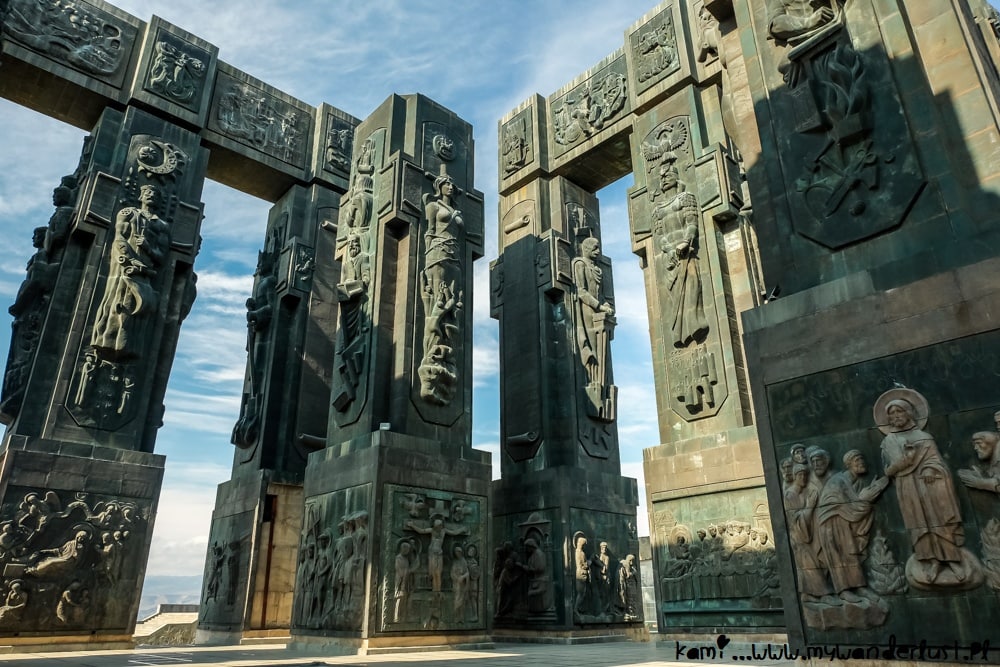
The Chronicle of Georgia is a monumental structure on Keeni Hill near the Tbilisi Sea, north of the city centre. Its enormous columns are carved with reliefs referring to Georgian history, culture and Christian tradition.
The monument lies outside the usual Old Tbilisi route and is most notable for its scale, carved details and open views over the Tbilisi Sea. It suits travellers who have already visited the central attractions or want to add a less conventional stop to their itinerary.
Quick facts
- Visit duration: between 45 minutes and 1h30
- Location: Keeni Hill, near the Tbilisi Sea, north of Tbilisi
- Best time: early morning or late afternoon
- Difficulty: easy at the monument itself, but there are steps and an open area
- Price: free admission
Is the Chronicle of Georgia worth visiting?
Yes, especially for those who enjoy monuments, photography, architecture and places off Tbilisi's most obvious route. The Chronicle of Georgia does not replace attractions like Old Tbilisi, Narikala Fortress, Sameba Cathedral or Abanotubani, but it complements a stay of more than two days in the city very well.
The main reason to visit is the sheer scale of the structure. The columns are much larger than they look in photos, and the reliefs have details worth taking the time to observe.
It is also an interesting attraction to combine with the Tbilisi Sea, although the monument itself should remain the main focus of the visit. There is no museum, indoor circuit or mandatory guided tour, so the experience mostly comes down to walking around the site, looking at the sculptures and enjoying the scenery.
What is the Chronicle of Georgia?
The Chronicle of Georgia, also known as the History Memorial of Georgia, was designed by sculptor Zurab Tsereteli in 1985. The structure was never fully completed, but it has become one of Tbilisi's most recognisable monumental works.
The monument has 16 columns, roughly 30 to 35 metres tall. The upper section features figures tied to Georgian history, including kings, queens and other important characters. The lower reliefs show scenes related to the life of Christ and the country's Christian tradition.
Next to the columns stands a grapevine cross associated with Saint Nino, the central figure in Georgia's Christianisation, along with a small chapel. The mix of national history, religious symbolism and monumental art gives the site a very different atmosphere from the traditional attractions in central Tbilisi.
How to get to the Chronicle of Georgia
Bolt or taxi
Bolt or a taxi are the simplest ways to reach the monument from Old Tbilisi, Freedom Square or other central areas. This is the best option for those short on time, travelling in a group or preferring to avoid public transport connections.
Before starting the ride, confirm the destination in the app. Search for "Chronicle of Georgia" or use the monument's location near the Tbilisi Sea.
Private driver
A private driver can be a good option for combining the Chronicle of Georgia with other attractions outside the centre. This gives more flexibility, but the route and waiting time should be agreed in advance.
Rental car
Anyone with a rental car can visit the monument easily. There is parking near the site, but drive carefully on the surrounding roads and do not block entrances or areas reserved for other vehicles.
Public transport
Public transport is possible, but requires more time and a final walk. One route used by visitors is to take the metro to Ghrmaghele station and then use bus 360 to a stop near the base of the monument.
From the final stop, it is still necessary to walk about 500 metres, including an uphill stretch. Lines, routes, schedules and frequency can change, so confirm the route on transport apps or through Tbilisi's official channels before setting out.
How the visit works
The visit is unguided and takes place entirely in an open area. You can walk among the columns, look at the reliefs up close and continue on to the spots with views over the Tbilisi Sea.
The site does not require a guide or a booking. That said, the monument is more rewarding when you allow enough time to study the panels and understand the difference between the historic reliefs on the upper section and the religious scenes below.
The circuit includes:
- Monumental columns: the main highlight of the site, with large-scale sculptures
- Historic reliefs: depictions of figures and episodes tied to Georgian history
- Religious reliefs: scenes related to Christianity and the life of Christ
- Saint Nino's cross: a religious element located near the main structure
- Chapel: a small building within the monument's grounds
- View over the Tbilisi Sea: an open panorama of the surrounding area
The site has stairs, steps and uneven ground. Wear comfortable shoes and walk carefully, especially after rain.
Tickets and prices
- Chronicle of Georgia: free admission
There is no ticket office or entry fee to visit the monument. The main cost of the outing will be transport to the area.
How long to spend
Allow between 45 minutes and 1h30 to visit the Chronicle of Georgia at a relaxed pace. This is usually enough time to walk around the area, study the reliefs, take photographs and enjoy the view.
If you are just passing through, the visit can be done in about 30 minutes. Photographers or anyone wanting to study the panels more closely should allow extra time and avoid the harshest midday light.
Best time to visit
Early morning
The morning is a good choice for those wanting more pleasant temperatures and fewer people around. It also suits anyone planning to continue the itinerary through other Tbilisi attractions after the visit.
Late afternoon
Late afternoon tends to offer the most beautiful light for photographs and makes the scale of the columns really stand out. Since the area is open, keep an eye on sunset time and plan your return before dark, especially if using public transport.
Midday
Avoid the hottest hours in summer. There is little shade, and the visit can become uncomfortable on days with strong sun.
Clear days
On clear days, the view over the Tbilisi Sea and the surrounding region is sharper. Even so, the monument remains interesting on cloudy days, when the columns take on a more dramatic look.
Practical tips
- Use Bolt or a taxi for the simplest way to get there
- If using public transport, confirm the route and schedule on the day
- Wear comfortable shoes, as there are stairs and uneven ground
- Bring water on hot days
- Prefer early morning or late afternoon
- Do not leave litter behind, and be respectful of the chapel and religious symbols
- Avoid climbing areas not meant for circulation or crossing barriers
- Only combine the visit with other attractions outside the centre if you have transport arranged