Last updated: September 2026
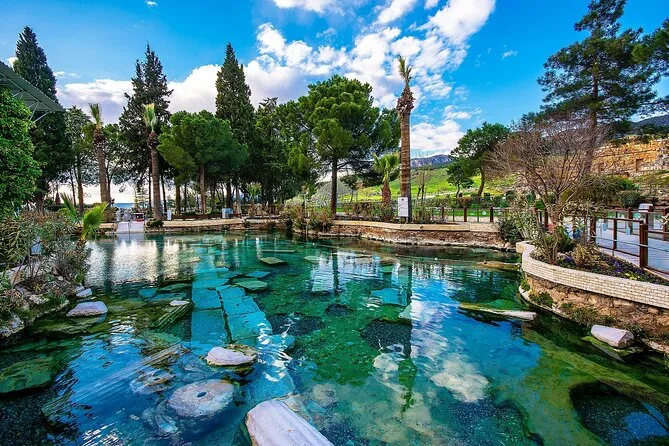
Cleopatra's Pool, also known as the Antique Pool or Antik Havuz, is a thermal pool located within the Hierapolis complex, in Pamukkale.
The main difference from the travertines is simple: here you can actually swim in thermal water.
The pool stays warm year-round, and several ancient blocks and columns remain submerged at the bottom.
After being closed for renovation during part of 2025 and early 2026, the pool reopened in 2026.
Quick information
- Location: inside Hierapolis, Pamukkale
- Status in September 2026: open
- Water temperature: approximately 36°C
- Reference rate for foreign visitors: 600 TL
- Approximate value: R$63
- Main Pamukkale + Hierapolis ticket: €30
- Pool included in the main ticket: no
- Visit duration: approximately 45 minutes to 1 hour 30 minutes
- Best time: morning
- Official name: Antik Havuz / Antique Pool
- Other name: Cleopatra Pool
Prices checked in September 2026 and subject to change.
Is Cleopatra's Pool open in 2026?
Yes.
The pool was closed for a long renovation period starting in 2025.
It reopened in 2026 and is again welcoming visitors for bathing.
Since it recently went through changes, confirm the conditions again close to your trip.
Is it worth swimming in Cleopatra's Pool?
It depends on your interest and budget.
For anyone who wants to experience Pamukkale's thermal water in a more immersive way, it's a very different experience from the travertines.
The water stays warm, and there are submerged ancient columns and blocks, creating an unusual setting.
On the other hand, the ticket is an extra cost, and the pool can get busy.
Anyone short on time can see Pamukkale and Hierapolis without getting in the water.
Why are there columns inside the pool?
Hierapolis was hit by several earthquakes throughout its history.
Parts of ancient buildings collapsed into the thermal area, and several fragments remained inside the water.
Today, these elements form one of the pool's best-known features.
While swimming, be careful when moving near the submerged stones and structures.
Did Cleopatra really swim in this pool?
The name Cleopatra's Pool is widely used in tourism, but there's no reliable historical evidence that Queen Cleopatra specifically swam at this site.
Because of this, you'll also commonly find the names:
- Antique Pool;
- Antik Havuz;
- Ancient Pool.
When looking for signs or information within Pamukkale, these names may appear more often than "Cleopatra Pool."
How much does it cost to swim?
The reference rate published for foreign visitors after the 2026 reopening is:
600 TL
At the reference rate used in September 2026:
600 TL ≈ R$63
This amount is an extra charge.
Before reaching the pool, visitors already need to be inside the Pamukkale-Hierapolis complex, whose foreign ticket costs:
€30
Cleopatra's Pool isn't automatically included in that price.
Confirm the pool's rate on site, since it can change independently of the main ticket.
What are the hours?
The pool sits within the Hierapolis complex.
The currently stated hours for the archaeological site during the daytime period are:
8am to 6:45pm
The pool may have its own operating hours and closing time within that window.
So if swimming is a priority, confirm the pool's specific hours when entering the complex, and don't leave the activity for the last few minutes of the day.
How much time should you allow?
Allow approximately:
45 minutes to 1 hour 30 minutes
to change clothes, get in the water and organise your exit.
Anyone not planning to swim needs much less time.
The pool sits inside Hierapolis, so it should be considered part of a bigger day in Pamukkale, not a standalone attraction.
What to bring
If you plan to swim, bring:
- swimwear;
- a towel;
- sandals;
- dry clothes for afterward.
The area went through renovation and has support facilities, but it's more practical to arrive prepared.
Walk carefully in the water because of the stones and ancient submerged elements.
Travertines or Cleopatra's Pool?
They're different experiences.
At the Pamukkale Travertines, visitors can walk in certain authorised shallow areas, following preservation rules.
At Cleopatra's Pool, the idea is to actually swim and stay in the thermal water.
You don't have to choose just one, but the pool requires an extra payment.
How to combine it with Hierapolis?
The pool sits within Hierapolis itself.
So the combination is simple.
A good plan is to see part of the ruins, stop at the pool, and continue through the rest of the site.
If you plan to swim, factor in the time needed to change clothes so it doesn't disrupt the itinerary too much.
Is the pool suitable for children?
Rules and children's rates can vary.
Families should confirm entry and supervision conditions on site before paying.
The presence of submerged stones and fragments also calls for extra attention.
Practical tips
- Cleopatra's Pool is open again in 2026.
- Use 600 TL as the current reference for foreign visitors.
- The amount is in addition to the Pamukkale-Hierapolis ticket.
- Bring swimwear, a towel and sandals.
- Prefer the morning to try to avoid heavier crowds.
- Walk carefully because of the submerged structures.
- Allow roughly 45 minutes to 1 hour 30 minutes if you plan to swim.
- There's no historical evidence that Cleopatra swam there.
- Confirm the pool's specific price and hours on the day of your visit.