Last updated: September 2026
Hierapolis is the ancient city located right above the Pamukkale Travertines and an essential part of a visit to the complex.
Founded during the Hellenistic period and later transformed into an important Roman city, Hierapolis grew up around the region's thermal springs.
Today, the site preserves a large theatre, streets, temples, religious areas, an extensive necropolis and other remains that show Pamukkale was always much more than its white terraces.
Quick information
- Location: Pamukkale, Denizli
- Visit duration: approximately 2 to 3 hours
- 2026 ticket for foreigners: €30
- Approximate value: 1,691 TL / R$177
- Ticket includes: Hierapolis + Travertines + Archaeological Museum
- Daytime hours: 8am to 6:45pm
- Open: daily
- Evening visit: currently 7pm to 11pm
- Best time: morning or late afternoon
- How to visit: within the same complex as the Pamukkale Travertines
Prices checked in September 2026 and subject to change.
Is Hierapolis worth visiting?
Yes.
A common mistake is travelling to Pamukkale, seeing only the white terraces, and giving little time to the ancient city.
Hierapolis has some of the region's most interesting archaeological structures and is already included in the same ticket.
What's more, the city's own history is tied to the thermal springs that formed Pamukkale.
Nature and archaeology make much more sense when seen together.
History of Hierapolis
Hierapolis was founded in the 2nd century BC during the Kingdom of Pergamon.
The city later came under Roman rule and went through several earthquakes.
Much of what's visible today relates to the reconstruction that followed a major earthquake in the 1st century.
The thermal waters helped Hierapolis develop as a centre for health, religion and rest.
During the Byzantine period, the city also gained importance for Christianity.
What to see in Hierapolis
The archaeological site is large, but a few places deserve priority.
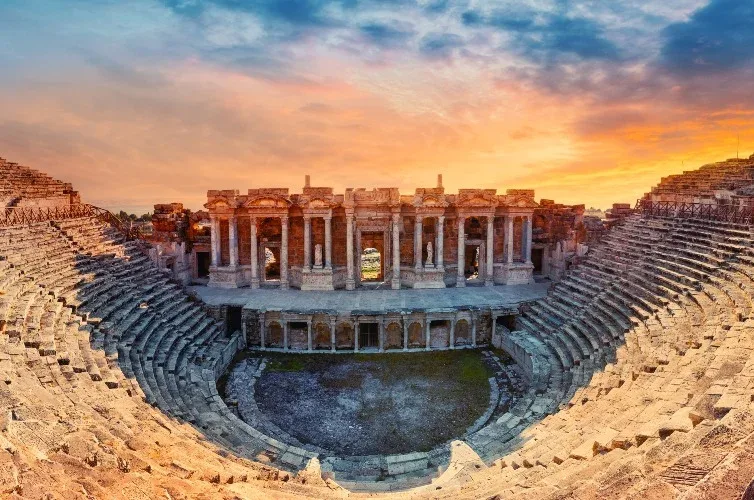
Theatre of Hierapolis
The Theatre of Hierapolis is one of the complex's most impressive structures.
Built into the slope of the terrain, it preserves much of its tiered seating and gives a good sense of the city's scale during the Roman period.
It's worth setting aside time to climb up and take in the structure calmly.
Temple of Apollo and the Plutonium
The Temple of Apollo was part of the city's religious area.
Nearby is the Plutonium, a natural opening associated in antiquity with the underworld.
The area has natural carbon dioxide emissions, a feature that contributed to the site's religious significance.
Today, the area is viewed under controlled conditions, and the safety barriers shouldn't be crossed.
Frontinus Street
The old monumental thoroughfare helps convey how Hierapolis was laid out.
Along this area you'll find gates, columns and remains of public buildings.
It's one of the best sections for understanding that Hierapolis was a complete city, not just a collection of isolated monuments.
Necropolis
The Necropolis of Hierapolis is one of the largest ancient burial grounds in the region.
Different types of tombs and monuments are spread across a fairly extensive area.
You don't need to walk every stretch, but it's worth seeing at least part of it to appreciate the site's scale.
Martyrium of St Philip
The Martyrium of St Philip is linked to the Christian tradition that associates the apostle Philip with the city.
The structure sits at a higher point and requires an extra walk.
For anyone interested in Christian history, it's one of Hierapolis's important points.
Hierapolis Archaeological Museum
The Hierapolis Archaeological Museum occupies part of a former Roman bath complex.
The collection brings together sculptures, sarcophagi and other pieces found in Hierapolis and nearby archaeological sites.
The visit is included in the complex's ticket.
It's a good way to complement the ruins and see objects no longer in their original positions.
How much does it cost to visit Hierapolis?
There's no separate ticket just for Hierapolis.
The complex ticket costs:
€30
At the reference rate used:
€30 ≈ 1,691 TL ≈ R$177
This ticket includes:
- Hierapolis;
- Pamukkale Travertines;
- the Archaeological Museum.
Cleopatra's Pool charges separately for anyone who wants to swim.
What are the hours?
The currently stated daytime hours are:
8am to 6:45pm
The site operates daily.
There's also currently an evening visit:
7pm to 11pm
As opening hours can change with the season or site management decisions, confirm them again before your trip.
How much time should you allow?
For Hierapolis, allow approximately:
2 to 3 hours
That's enough time to see the Theatre, the religious area, part of the streets and other main points without covering every corner of the site.
Anyone who wants to explore the Necropolis in more depth or climb up to the Martyrium of St Philip may need more time.
Including the travertines, allow at least half a day for the whole complex.
How to combine Hierapolis and the travertines?
The best strategy is to see both attractions on the same visit.
You can start at the Pamukkale Travertines and continue to Hierapolis, or do the route in reverse depending on which entrance you use.
There's no reason to pay for the ticket and skip one of the two parts.
Is Hierapolis accessible?
Accessibility varies quite a bit.
The site is large and has:
- uneven terrain;
- stone-paved areas;
- sloped stretches;
- long distances;
- stairs at some structures.
People with reduced mobility can see some areas, but covering the whole site can be difficult.
What to bring
Wear comfortable footwear, since there's a significant amount of walking.
Also bring:
- water;
- sun protection;
- a hat or cap;
- clothing suited to the climate.
Much of the site has little shade.
Practical tips
- Allow roughly 2 to 3 hours for Hierapolis.
- The €30 ticket already includes the travertines and the museum.
- Prioritise the Theatre and the area around the Temple of Apollo and the Plutonium.
- See at least part of the Necropolis.
- Wear comfortable footwear.
- Bring water and sun protection.
- Don't treat Hierapolis as a quick add-on of just a few minutes.
- Combine the visit with the travertines.
- Confirm the price and hours before your trip.