Last updated: September 2026
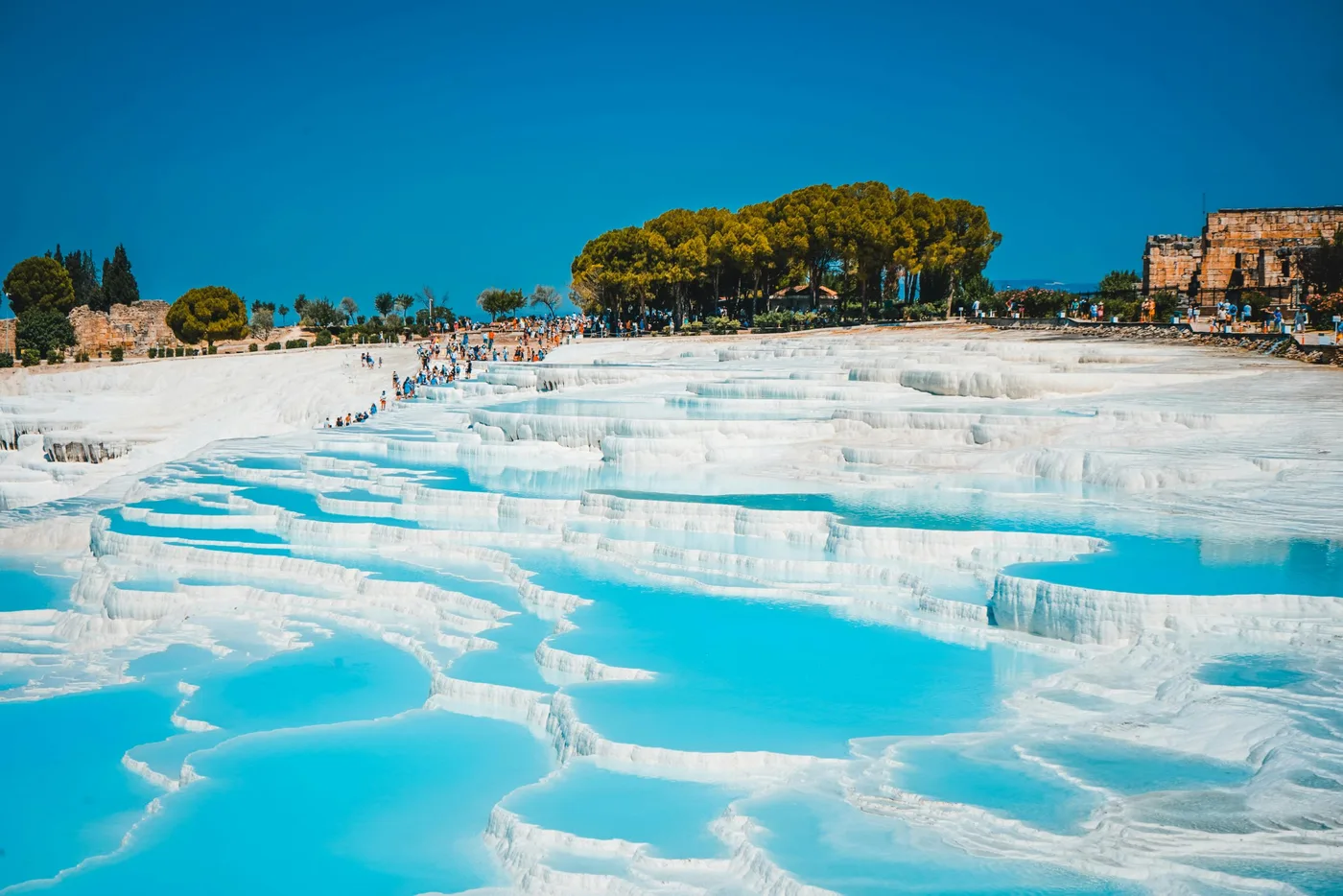
The Pamukkale Travertines form one of Turkey's most iconic natural landscapes. The white hillside was created over time by mineral-rich thermal waters flowing down the terrain, leaving calcium carbonate deposits behind.
The result is a series of terraces, small pools and water channels that gave rise to the name Pamukkale, which roughly means "cotton castle" in Turkish.
The travertines are part of the same complex as Hierapolis, so a single ticket covers both attractions.
Quick information
- Location: Pamukkale, Denizli, Turkey
- 2026 ticket for foreigners: €30
- Approximate value: 1,691 TL / R$177
- Includes: Travertines + Hierapolis + Archaeological Museum
- Currently stated daytime hours: 8am to 6:45pm
- Open: daily
- Evening visit: currently 7pm to 11pm
- Time for the travertines alone: approximately 1 to 2 hours
- Time with Hierapolis: allow at least half a day
- Footwear: must be removed in the walkable travertine areas
- Best time: early morning or late afternoon
Prices checked in September 2026 and subject to change.
Are the Pamukkale Travertines worth visiting?
Yes.
Pamukkale is unlike practically any other landscape you'll find on a trip through Turkey.
The white hillside, the thermal water and the ancient city of Hierapolis right above combine nature and archaeology in the same visit.
The main recommendation is not to travel to Pamukkale just to take a few photos on the terraces and leave.
Since Hierapolis is included in the same ticket, it's worth setting aside time to see the whole complex.
How were the travertines formed?
The region's thermal waters carry minerals, mainly calcium compounds.
As the water reaches the surface and flows down the hillside, some of these minerals settle onto the terrain.
Over thousands of years, this process formed the white travertine layers that cover Pamukkale.
The landscape continues to be shaped by the flow of water.
Because of this, the pools' appearance can change, and not every terrace holds water at the same time.
Can you walk on the travertines?
Yes, but only in authorised areas.
In certain sections open to visitors, you need to remove your shoes before entering.
This rule helps protect the white surface and reduce damage to the travertine.
The ground can be:
- wet;
- uneven;
- slippery in some spots.
Walk carefully and respect the closed areas.
Don't step into blocked terraces just to take photos.
Can you swim in the travertines?
The terraces don't function as conventional swimming pools.
In the authorised areas, you can walk through the water and stay in some shallow sections, but there are restrictions to protect the natural formation.
For anyone who really wants to swim in thermal water, the option within the complex is Cleopatra's Pool, which has an additional charge.
How much does it cost to visit Pamukkale?
The ticket for foreign visitors currently costs:
€30
At the reference rate used in September 2026:
€30 ≈ 1,691 TL ≈ R$177
The same ticket grants access to:
- the Pamukkale Travertines;
- Hierapolis;
- the Hierapolis Archaeological Museum.
There's no need to buy a separate ticket just for the travertines.
Cleopatra's Pool has its own charge for anyone who wants to swim.
What are the hours?
The currently stated daytime hours are:
8am to 6:45pm
The complex operates every day.
There's also currently an evening visit:
7pm to 11pm
with the evening ticket office closing before closing time.
Hours can change depending on the season and the site's operation, so confirm again close to your trip.
What's the best time?
Early morning is one of the best options.
Besides finding more pleasant temperatures, there's a chance of seeing the travertines before many groups arrive.
Late afternoon is also appealing for the light and cooler temperatures.
During summer, midday can be quite hot, and there's little shade across much of the complex.
How much time should you allow?
To see just the travertines, approximately:
1 to 2 hours
can be enough.
But that isn't the best plan for a first visit.
Since Hierapolis sits right above and is included in the same ticket, allow at least half a day for the whole complex.
Anyone wanting to see the ruins, the museum and Cleopatra's Pool can easily use most of the day.
What to bring
Bring:
- water;
- sun protection;
- a hat or cap;
- comfortable footwear;
- something practical to carry your shoes in while on the travertines.
In the warmer months, sun exposure is intense.
Are the travertines and Hierapolis the same attraction?
No, but they're part of the same complex.
The travertines are the white natural formation.
Hierapolis is the ancient city built on the plateau above the thermal springs.
The current ticket includes both areas, so it makes sense to see them on the same visit.
Practical tips
- Allow at least half a day for Pamukkale plus Hierapolis.
- The ticket for foreigners costs €30 in 2026.
- Remove your shoes in the travertine areas where required.
- Walk only in authorised zones.
- Don't expect every terrace to be full of water.
- Bring water and sun protection.
- Prefer early morning or late afternoon.
- Include Hierapolis on the same day.
- Confirm the price and hours before your trip.