Last updated: August 2026
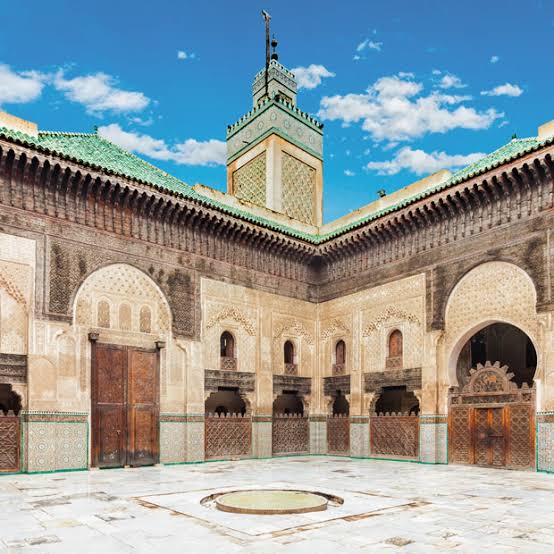
A few minutes from Bab Bou Jeloud, the Bou Inania Madrasa offers a look inside part of Marinid Fez's religious and educational architecture. The discreet entrance on Talaa Kebira leads to a courtyard surrounded by zellige, carved stucco, cedar wood, and inscriptions that run across different levels of the walls.
The building was constructed between 1350 and 1355 on the orders of Sultan Abu Inan Faris. Beyond receiving students, the complex was designed to serve religious functions and has a prayer hall and a minaret, a feature that helps set it apart from the city's other historic madrasas.
This guide is a professional recommendation based on research into the building's history and the practical conditions of the visit. The content is not presented as personal experience, since I have not yet visited this attraction.
Quick facts
- Visit time: 30 minutes to 1 hour
- Location: Talaa Kebira, in Fez el-Bali
- Distance from Bab Bou Jeloud: a few minutes on foot
- Best time: early morning or after the midday break
- Access for non-Muslims: allowed during tourist hours, with interruptions during prayers
- Reference price: between 20 and 30 MAD, approximately US$2 to US$3
- Hours: tend to vary because of prayers, the midday break, and Fridays
- Accessibility: limited by steps, thresholds, and possible restrictions on the upper floor
How to fit the Bou Inania Madrasa into a Fez itinerary
Its location close to Bab Bou Jeloud makes the Bou Inania Madrasa a good first stop for anyone starting a tour of Fez el-Bali. After the visit, the itinerary can continue along Talaa Kebira toward the central areas of the medina.
Set aside 30 minutes to 1 hour to view the courtyard, the decorative materials, the prayer hall, and whichever spaces are open at the time. The time needed depends on the crowds, religious breaks, and your interest in architecture and photography.
On your way out, cross the street and take in the façade of the Dar al-Magana, built in the same period to house an old timekeeping mechanism. The structure sits across from the madrasa and can easily be missed by anyone heading straight down Talaa Kebira.
On the same walk, you can combine the Bou Inania Madrasa with Bab Bou Jeloud, the Al Attarine Madrasa, Seffarine Square, and the Chouara Tannery. The exact order depends on your entry point, each attraction's hours, and how much time you have in the medina.
What is the Bou Inania Madrasa?
A madrasa was an educational institution tied to religious and intellectual training. Students could study Islamic law, Arabic, theology, and other subjects while living in the building's own lodgings.
Bou Inania was built during the Marinid dynasty, a period in which Fez gained a number of educational institutions and religious buildings. The name is tied to Sultan Abu Inan Faris, who commissioned the work carried out in the mid-14th century.
The complex combined teaching, lodging, and prayer. Having a larger prayer hall and a minaret allowed the building to also function as a congregational mosque.
The former student cells sit on the upper levels around the courtyard. These spaces help convey the complex's original use, but access to the upper floor may be closed during a visit.
What to look for during the visit
Most of the visit takes place around the central courtyard. Even when some areas are closed, the materials and layout of the building can be seen from the ground floor.
Zellige
Zellige covers the lower parts of the walls and forms geometric patterns from small ceramic pieces. Its position closer to the floor also helps protect the surfaces from moisture and wear.
The colors and patterns change between the walls, the pillars, and the door frames, continuing visually into the stucco bands and the wooden elements above.
Carved stucco
Above the zellige panels are bands of stucco worked with arabesques, geometric shapes, and Arabic inscriptions.
Light entering through the courtyard highlights the depth of the relief differently throughout the day. The details can be viewed up close, but the decorated surfaces should not be touched.
Cedar wood
The upper part of the courtyard brings together panels, eaves, doors, and wooden lattices. The cedar elements help create the transition between the decorated walls and the former student lodgings.
Some pieces have been restored over the building's history. Even so, the ensemble preserves the visual relationship between ceramic, stucco, and wood that's characteristic of Marinid architecture.
Courtyard and water
The courtyard organizes circulation and draws the eye toward the prayer hall. The presence of water is tied to the complex's religious and practical needs.
The open space distributes light and ventilation to the surrounding rooms, connecting the former classrooms, the prayer area, and the lodgings arranged across different parts of the building.
Prayer hall and minaret
The prayer hall occupies one side of the courtyard and remains tied to the building's religious character. Access can be limited, especially during prayers.
The ceramic-clad minaret can be seen from the street and from several points near Bab Bou Jeloud. Its presence shows that Bou Inania was designed for broader functions than just student housing.
Former student cells
The small rooms on the upper floor were used by students who lived at the madrasa.
Even when the upper floor is closed, part of these structures can be seen through the windows and galleries facing the courtyard. Whether this part of the building is open varies, and the visit tends to focus on the ground floor.
Dar al-Magana: the clock facing the madrasa
Across Talaa Kebira stands the Dar al-Magana, known as the House of the Clock. The façade belongs to a structure built in the 14th century to mark the hours tied to the religious routine.
The mechanism used water, weights, and metal containers, but its full workings have not been reconstructed with certainty. Today, the visit focuses on the façade, where windows, wooden brackets, and traces of the installation remain.
There's no need to buy another ticket to look at the façade from the street. Set aside a few minutes before or after the madrasa, and remember to look up toward the top of the building.
How to get to the Bou Inania Madrasa
The madrasa sits on Talaa Kebira, one of the main streets of Fez el-Bali.
Anyone entering through Bab Bou Jeloud reaches the building after a short walk. The street begins to slope down toward the interior of the medina, and the madrasa's entrance is near the start of that stretch.
Cars and taxis don't travel through the narrow passages of this part of the medina. Anyone staying outside Fez el-Bali can ask the driver to stop near Bab Bou Jeloud and continue on foot.
Save the location on your map before entering the medina. Since the attraction sits on a well-known street, it's usually easier to find than monuments located in smaller alleys.
How the visit works
The ticket is usually bought at the entrance. After the ticket office, visitors head to the courtyard and move through whichever areas are open at that time.
There's no need to hire a guide exclusively to enter the madrasa. An authorized guide can, however, help interpret the function of the spaces, the inscriptions, and the decorative materials as part of a broader tour of Fez el-Bali.
Since the building also retains a religious character, tourist access can be interrupted during prayers. Some rooms and the upper floor may stay closed even when the courtyard is open.
Before taking photos, check the guidance posted at the entrance. Tripods, larger equipment, and photography in religious areas may have specific rules.
Tickets and prices
Recently published prices range between 20 and 30 MAD per person, approximately US$2 to US$3 based on the August 2026 conversion.
Since there's no updated public official price list to check, confirm the price at the entrance. The dollar conversion is only a reference and changes with the exchange rate.
Bring cash in dirhams, especially smaller notes, in case card payment isn't available.
Children, students, and other groups may have their own rules, but discounts and free entry need to be confirmed on site.
Visiting hours
The most recent references point to hours close to 9am to 6pm, usually with a midday break. Hours can change depending on the season, prayers, and local scheduling.
On Fridays, tourist access tends to face greater restrictions because of congregational prayer. Adjustments can also occur during Ramadan, religious holidays, and conservation work.
Confirm opening hours with your accommodation or a local guide close to your visit. Arriving early in the morning gives more margin in case there's a change that day.
How long to spend
A 30 to 45-minute visit is enough to see the courtyard, the wall coverings, the prayer hall, and whichever areas are open.
Set aside up to 1 hour if you want to photograph the details at a relaxed pace, view the Dar al-Magana, and better understand how the complex is organized.
The madrasa is compact. Extra time tends to go toward examining the materials rather than moving through a long sequence of rooms.
Best time to visit
Early morning tends to be quieter and lets you start your tour of the medina from the Bab Bou Jeloud area.
After the midday break can also work, as long as you confirm the reopening time.
The amount of light in the courtyard changes throughout the year. Rather than relying on a time presented as ideal for photography, choose a moment that fits both religious hours and the rest of your itinerary.
Clothing and behavior
Choose clothing that covers the shoulders and knees, respecting the building's religious character.
Keep your voice low, especially near the prayer hall. If an area is closed for religious activity, wait for guidance from staff.
Don't touch the stucco panels, the zellige, or the wooden pieces. Frequent contact contributes to wear on the surfaces.
Accessibility
The route includes thresholds, possible steps, and floors that can be slippery or uneven.
The ground-floor courtyard is the main part of the visit, but entry conditions need to be confirmed by anyone using a wheelchair or with reduced mobility.
The upper floor, when open, is reached by stairs. There is no confirmed adapted route to the former student cells.
Photography
Personal photography is usually allowed in the tourist areas, as long as the guidance posted at the entrance is respected.
Avoid photographing people at prayer, and ask permission before taking close-up shots of staff or other visitors.
The mix of open courtyard and covered areas creates strong differences in light. Reducing your camera's exposure helps preserve the details of the stucco and wood in photographs.
Practical tips
- Bring cash in dirhams for the ticket
- Confirm the price and hours at the entrance
- Start your walk from Bab Bou Jeloud
- Take in the Dar al-Magana across the street
- Set aside at least 30 minutes for the visit
- Wear clothing appropriate for a religious building
- Don't count on access to the upper floor
- Don't touch the decorated surfaces
- Stay quiet near the prayer hall
- Combine the visit with other attractions in Fez el-Bali
Final tip
Start at Bab Bou Jeloud and follow Talaa Kebira down to the Bou Inania Madrasa. See the courtyard, take in the different layers of decoration, and check which areas are open at the time of your visit.
On your way out, cross the street to view the façade of the Dar al-Magana. From there, continue down through the medina toward the Al Attarine Madrasa, Seffarine Square, and the Chouara Tannery.
This order puts Bou Inania at the start of the walk and reduces the need to backtrack up the medina's sloped streets later in the day.