Last updated: August 2026
Bab Mansour sits on the south side of El Hedim Square and marks the passage between the medina and the old imperial city of Meknes. The gate was designed as a ceremonial entrance to the palace complex begun under Moulay Ismail's rule.
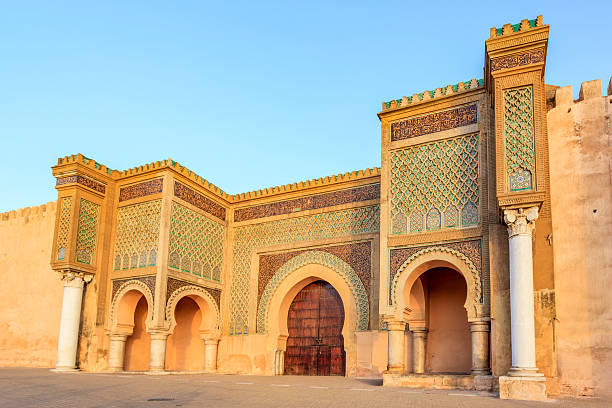
Construction started in the final years of Moulay Ismail's reign and was completed in 1732, under his son, Moulay Abdallah. The façade brings together a large central arch, zellige, inscriptions, geometric motifs, and marble columns.
The gate went through a long restoration process in recent years and its façade is once again fully visible from El Hedim Square. Viewing it from outside remains the main part of the visit, since the interior has no regular tourist opening. This guide is a professional recommendation based on historical, architectural, and practical information. It is not presented as a personal experience report, since I have not yet visited the attraction.
Quick facts
- Visit time: 30 minutes to 1 hour
- Location: south side of El Hedim Square, historic center of Meknes
- Best time: morning or late afternoon
- Viewing the façade: free
- Access to El Hedim Square: free
- Entry to the interior: no regular tourist hours
- Difficulty: easy, open area, paved ground, variable crowds
How to fit Bab Mansour into a Meknes itinerary
Bab Mansour can be visited together with El Hedim Square, the medina, and the Dar Jamaï Museum. These attractions are in the same area and form the simplest part of a walking itinerary through the historic center.
The Mausoleum of Moulay Ismail can also be part of the plan, but access should be confirmed on the day of the visit. Circulation between the monuments can change due to construction, events, or local restrictions.
Set aside about 30 minutes to view the façade, photograph the details, and walk around the square. Anyone planning to explore El Hedim Square, enter the medina, or take a break at a café should allow at least 1 hour for this part of the itinerary.
Bab Mansour also works as a good landmark for orientation. Even when the central passage stays closed, side accesses and nearby streets let you continue through the historic area.
What is Bab Mansour?
Bab Mansour, also called Bab Mansour al-Alj or Bab Mansour Laalej, is a monumental gate built as part of the imperial city of Meknes.
Moulay Ismail ruled between 1672 and 1727 and turned Meknes into the capital. During his reign, palaces, walls, gardens, storehouses, stables, reservoirs, and monumental gates were built.
Bab Mansour was part of that urban project. Its role was mainly ceremonial: the scale and decoration were meant to project the power of the new capital to visitors, officials, and delegations.
Construction wasn't finished during Moulay Ismail's lifetime. It was completed in 1732, under Moulay Abdallah's rule.
The gate's full name is associated with Mansour al-Alj, but his identity and role in the work appear differently across historical sources. There isn't enough information to reconstruct his biography with precision.
Architecture and façade details
The central arch is the dominant feature of the façade. Its scale is best understood from El Hedim Square, which offers enough distance to take in the whole structure.
The decoration combines bands of zellige, geometric motifs, arabesques, and inscriptions. Green tones stand out and create contrast with the structure's lighter shades.
Marble columns frame parts of the façade and stand out against the zellige decoration. Some accounts link these pieces to reused Roman elements, but their origin isn't documented consistently.
The decorative panels vary in design and proportion. It's worth viewing the façade from a distance first and then moving closer to the open areas to examine the zellige and the inscriptions.
Bab Mansour is part of the Historic City of Meknes, inscribed on the UNESCO World Heritage List in 1996.
How to get to Bab Mansour
The gate stands facing El Hedim Square, at the edge of the medina and the old imperial city.
The most practical options are:
- From the medina: walk toward El Hedim Square
- By petit taxi: ask to be dropped at Place El Hedim or Bab Mansour
- From the Meknes train station: use a petit taxi or transport arranged in advance
- From the modern center: a taxi is usually the most direct option
- On an organized tour: confirm whether the drop-off will be at El Hedim Square or another entrance to the medina
Taxi time from the station depends on traffic, the time of day, and which station is used. Meknes has more than one train station, so confirm your arrival point before the trip.
Vehicles may not reach every area near the medina. On busy days, drop-off may happen a few minutes' walk from the square.
Save both Bab Mansour and El Hedim Square on your map. This helps locate the façade and plan a meeting point with your driver for the return.
Suggested route for visiting Bab Mansour
Start at El Hedim Square
El Hedim Square offers the best overall view of the gate. Start by stepping back a few meters to take in the central arch, the sides of the structure, and how the façade relates to the old imperial city.
The square sees a flow of residents, visitors, vendors, and service providers. The level of activity changes a lot depending on the time of day, the day of the week, and whether events are taking place.
There's no need to follow a strict path. Walk through the public area and choose a spot that lets you view the façade without blocking the flow of people.
View the central arch
The central arch was designed as a ceremonial passage and holds much of the decoration.
Take in the outline of the arch, the bands of zellige, and the inscriptions. Light can highlight different details throughout the day, so there's no single time that guarantees the best photo.
The central passage usually doesn't function as a regular tourist entrance. Use only the marked accesses, and don't cross barriers or closed doors.
Get closer to the details
After the overall view, move closer to the open areas to see the columns, the mosaics, and the geometric motifs.
Some parts may remain off-limits for conservation, maintenance, or event setup. Respect the signage and don't touch the decoration.
Recent restoration work brought back the visibility of many façade details. Even so, occasional work or barriers can change how close you can get at certain times.
Continue through El Hedim Square
After viewing the gate, spend a few minutes walking through El Hedim Square. The area connects Bab Mansour to the medina, the Dar Jamaï Museum, and other points in the historic center.
The presence of vendors, performances, and other services varies by day, time, and whether events are happening.
Ask the price before accepting photos, performances, drawings, food, or any service. Don't photograph people up close without permission.
Interior of Bab Mansour
The interior of Bab Mansour isn't part of a regular tourist visit with set hours and a ticket.
The space has hosted exhibitions and cultural activities before, but these openings are occasional and depend on a specific program.
If there's an event during your trip, confirm access, hours, and rules directly on site.
Entrance and prices
Viewing the façade of Bab Mansour and access to El Hedim Square are free.
There's no need to buy a ticket to photograph the gate from the square or walk through the public area.
The interior has no regular tourist visit. Any exhibition or cultural activity may have its own rules, which should be confirmed on site.
Private guides, transport, food, shopping, organized photo sessions, and other services are paid separately.
How long to spend
Set aside between 30 minutes and 1 hour.
With about 30 minutes, you can view the façade, photograph the arch, and walk through part of El Hedim Square.
Allow 1 hour or more if you want to explore the square, visit the Dar Jamaï Museum, enter the medina, or take a break at a café.
Bab Mansour doesn't call for a long visit on its own. Its significance comes through better when the gate is included in a walk through central Meknes.
Best time to visit
Each period offers a different experience:
- Morning: the square is usually calmer and the temperature more pleasant
- Midday: strong sun and less comfort during the hotter months
- Late afternoon: more activity in the square and softer light
- Night: the façade and square may be lit, but architectural details are less visible
- During events: circulation and access can change
The direction and intensity of light change with the season, and the façade's appearance can vary quite a bit throughout the day.
Morning works better for anyone planning to continue into the medina. Late afternoon is a good choice for anyone wanting to spend a bit more time in El Hedim Square.
Accessibility
El Hedim Square is large, but the ground can have uneven spots, level changes, and areas with heavier crowds.
The façade can be viewed without needing stairs. Temporary barriers, construction, or events, however, can change the most direct route.
A petit taxi to the area near the square cuts down on walking distance, but drop-off may happen outside the pedestrian area.
People with reduced mobility should factor in the square's crowds and confirm the closest drop-off point with the driver.
Photography and respecting the space
The façade can be photographed from El Hedim Square.
To frame the whole structure, move back toward the center of the square and check the surrounding foot traffic before stopping.
Don't block access points or rest equipment against the historic structure. Tripods and professional gear may face restrictions during busy periods or events.
Ask permission before photographing vendors, performers, residents, or people offering services.
Drones may require specific authorization in Morocco. Don't use this kind of equipment without first confirming national and local rules.
Safety and services in the square
El Hedim Square is a busy area. Keep your phone, wallet, and camera secure, especially during events or busier hours.
Ask the price before buying food, accepting services, or taking part in organized photo sessions.
The number of stalls and services available varies by day and time.
Before choosing where to eat, check the menu, prices, and the condition of the establishment.
Practical tips
- Wear comfortable shoes for walking through the square and the medina
- Bring water and sun protection
- View the façade first from the center of the square
- Move closer afterward to examine the zellige and inscriptions
- Don't count on the interior being open
- Confirm prices before accepting services or photos
- Keep personal belongings secure during busy hours
- Combine Bab Mansour with El Hedim Square and the medina
- Check whether the Dar Jamaï Museum is open
- Arrange the meeting point with your driver in advance
Final tip
Start at El Hedim Square and view Bab Mansour from a distance to take in the scale of the arch and the façade. Then move closer to the open areas to examine the zellige, the inscriptions, and the columns.
Continue through the square and head to the Dar Jamaï Museum or the streets of the medina. If the Mausoleum of Moulay Ismail is open, it can also be included in the same outing.
Bab Mansour works best as the starting point of a walk through the historic center rather than as a standalone visit. Set aside time for the gate, but keep most of the itinerary open for exploring the rest of Meknes.