Last updated: August 2026
The Mausoleum of Moulay Ismail sits inside the old imperial city of Meknes and holds the tomb of the sultan who turned the city into the capital of Morocco. The visit moves through a sequence of decorated courtyards and rooms before reaching the area facing the tomb chamber.
Part of the complex can normally be visited by people of different faiths. Access, however, doesn't extend to every sacred area and can change during prayers, ceremonies, Fridays, or conservation work.
The mausoleum remains a religious and historic space. The visit calls for respectful clothing, quiet, and attention to the guidance posted at the entrance. This guide is a professional recommendation based on historical, architectural, and practical information. It is not presented as a personal experience report, since I have not yet visited the attraction.
Quick facts
- Visit time: 30 minutes to 1 hour
- Location: old imperial city of Meknes, near Bab Mansour
- Best time: morning or after the midday break
- Entrance: usually free
- Access for non-Muslims: allowed in part of the complex
- Reference hours: 9am to 6:30pm
- Restrictions: can occur during prayers, Fridays, ceremonies, and maintenance
- Difficulty: easy to moderate, with courtyards, thresholds, rugs, and shoe removal in one area
The schedule can include a midday break. Confirm it's open at the entrance before planning the rest of your itinerary.
How to fit the Mausoleum of Moulay Ismail into a Meknes itinerary
The mausoleum pairs well with Bab Mansour, El Hedim Square, and the old imperial city. These points are close together and can be organized in the same period.
The walk from Bab Mansour usually takes about 5 to 10 minutes, depending on which access is open and the route used. Construction or barriers can temporarily change circulation in the area.
Start at Bab Mansour and El Hedim Square. Then head to the mausoleum and leave at least 30 minutes to walk through the courtyards and take in the decoration.
Anyone planning to continue to other monuments in the imperial city should confirm beforehand which attractions are open. Meknes has gone through various restoration projects, and access to some sites can change.
Who was Moulay Ismail?
Moulay Ismail ruled Morocco between 1672 and 1727. During his reign, Meknes became the capital and received a broad set of palaces, walls, gates, gardens, storehouses, stables, and reservoirs.
His rule consolidated the power of the Alaouite dynasty and expanded the state's presence across different regions of the country. It was also a period marked by military campaigns, forced labor, conflict, and centralized administration.
Moulay Ismail's story combines political power, urban expansion, and episodes of violence. That combination helps explain why his legacy remains both significant and controversial in Moroccan history.
The mausoleum preserves his memory within the urban complex he helped build.
History of the Mausoleum of Moulay Ismail
The funerary complex was built in 1703, while the sultan was still alive. After his death in 1727, the site received his tomb and went through expansions and modifications.
A major restoration was carried out in 1960. Other conservation work followed later to preserve the courtyards, woodwork, stucco, zellige, and funerary spaces.
The building is part of the Historic City of Meknes, inscribed on the UNESCO World Heritage List in 1996.
The complex doesn't function only as a tourist monument. It retains religious, historical, and symbolic value, which explains the access restrictions on certain areas.
Architecture and decoration
The entrance leads to a sequence of courtyards that create a gradual transition between the street and the more private spaces of the mausoleum.
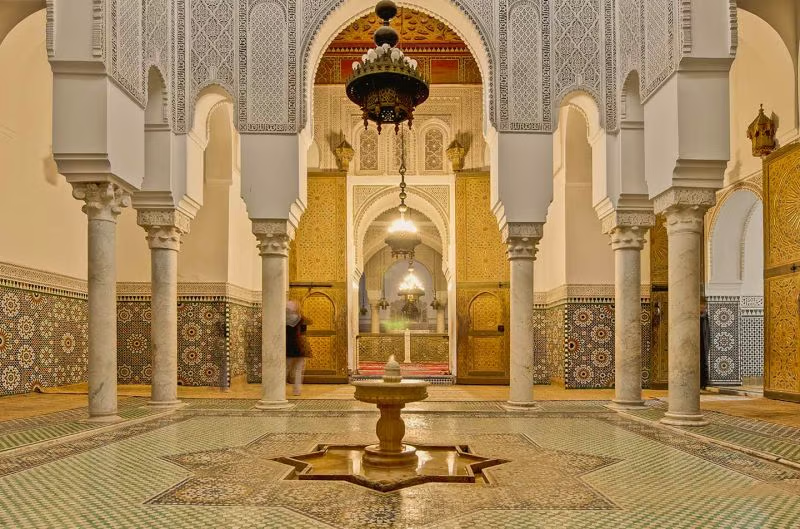
The rooms combine zellige, carved stucco, worked doors, columns, marble fountains, and cedar wood ceilings. The decoration appears at different levels, from the wall coverings to the details of the arches.
One of the courtyards is tied to ablutions and has a colonnade around it. Circulation continues through interior rooms to the antechamber near the funerary area.
The contrast between the bright courtyards and the decorated rooms helps structure the visit. It's worth taking in the overall composition first, then the details of the zellige, the stucco, and the wood.
How to get to the Mausoleum of Moulay Ismail
The mausoleum is in the old imperial city, a short walk from Bab Mansour.
The most practical options are:
- From Bab Mansour: walk about 5 to 10 minutes through the marked accesses
- From El Hedim Square: head through the Bab Mansour area toward the imperial city
- By petit taxi: ask to be dropped at the nearest accessible point to the Mausolée Moulay Ismaïl
- From Meknès-Ville station: use a petit taxi or transport arranged in advance
- On a guided tour: confirm whether the mausoleum is included and will be open at the planned time
Vehicles don't necessarily reach the entrance. Depending on the barriers in place, the final stretch will be on foot.
Save the location on your map and agree on a clear meeting point with your driver for the return. Circulation around the monuments can change on days with construction or events.
Suggested route for visiting the Mausoleum of Moulay Ismail
Entrance and first courtyards
Enter through the marked access and follow the rules posted on site. Staff may guide circulation and indicate which spaces are open.
The first courtyards form the transition between the entrance and the more decorated rooms. Walk calmly and keep passageways clear for other visitors.
Some areas have uneven ground, thresholds, and rugs. Watch your step and follow the marked route.
Ablutions courtyard
The sequence leads to a courtyard tied to ablutions, surrounded by columns and decorative elements.
Take in the fountain, the arches, and how the open and covered spaces relate to each other. Natural light changes the look of the zellige and the stucco throughout the day.
This courtyard remains part of a religious space. Keep your voice low and don't touch the decorative elements.
Decorated antechamber
The antechamber near the funerary area holds some of the complex's most elaborate details.
The space has a marble fountain, zellige, stucco, and a cedar wood ceiling. The decoration should be viewed from the area set aside for visitors.
At one of the final points along the route, you may need to remove your shoes. Follow staff instructions and leave them only in the designated spot.
Tomb chamber
The tomb chamber holds the graves of Moulay Ismail and members of his family.
Non-Muslim visitors usually stay in the public area before the most sacred part. Visibility into the chamber depends on which circulation is open at the time.
Don't cross barriers or enter restricted areas. The goal of the visit is to take in the architecture and understand the site's historical importance without interfering with its religious use.
Clocks and other details
Four clocks appear among the historical elements associated with the mausoleum. The Meknes Prefectural Tourism Council identifies them as gifts from Louis XIV to Moulay Ismail.
Tourist accounts also link these clocks to a marriage proposal turned down by the French court, though this version isn't documented with the same consistency as the objects' origin.
Also take in the doors, the fountain, the rugs, and the ceiling details. These are smaller elements that can go unnoticed on a quick visit.
Entrance and hours
Entry to the Mausoleum of Moulay Ismail is usually free.
The Meknes Prefectural Tourism Council publishes hours of 9am to 6:30pm. Even so, there can be a midday break, along with restrictions on Fridays and changes during prayers, ceremonies, or conservation work.
Since there's no ticket office with advance booking, confirm the hours at the entrance or with your accommodation before setting out.
Private guides and transport are charged separately. If someone offers a service, agree on the price before starting.
How long to spend
Set aside between 30 minutes and 1 hour.
The visit can be completed in about 30 minutes when every public area is accessible and there's no wait.
Allow up to 1 hour to take in the courtyards, the antechamber, and the decorative details without rushing.
The mausoleum can be temporarily closed, so avoid scheduling a tight connection right afterward.
Best time to visit
Each period offers different conditions:
- Morning: pleasant temperature and more room to adjust your itinerary if something changes
- Midday: possible break in opening hours
- Afternoon: a good option after reopening, if there's a break
- Friday: access subject to the religious schedule
- During ceremonies: interior circulation may be reduced
Morning tends to be the simplest choice. Arrive after opening and confirm what's open before starting the visit.
If you find the mausoleum closed at midday, see Bab Mansour, El Hedim Square, or the Dar Jamaï Museum and come back later.
Clothing and behavior
Wear clothing that covers the shoulders and knees. A head scarf usually isn't a general requirement for visitors, but follow any guidance posted at the entrance.
In one of the interior areas, you may need to remove your shoes. Wear socks and leave your shoes only in the designated spot.
Speak quietly, put your phone on silent, and don't interrupt people praying.
Avoid touching the walls, the stucco, the wood, and other decorative elements.
Accessibility
The visit crosses courtyards, thresholds, rugs, and different types of flooring. Not the whole route offers the same ease for people with reduced mobility.
The taxi drop-off point can be some distance from the entrance, depending on the barriers set up in the imperial city.
Wheelchair users should confirm in advance which courtyards and rooms are accessible. Authorized circulation can change depending on which access is open that day.
Companions can help with thresholds and areas where shoes need to be removed.
Photography
Photography may be allowed in the courtyards and parts of the route, but specific rules can apply near the tomb chamber.
Watch for signage and ask before photographing in the more restricted areas.
Don't photograph people praying or staff up close without permission. Avoid using flash inside the decorated rooms.
Tripods, professional lighting, and drones may require authorization and aren't suited to a standard visit to the mausoleum.
Practical tips
- Confirm the hours before setting out
- Factor in a possible midday break
- Wear clothing that covers the shoulders and knees
- Bring socks for the area where shoes are removed
- Keep your phone on silent
- Respect restricted areas
- Ask before photographing near the tomb chamber
- Combine the visit with Bab Mansour and El Hedim Square
- Leave some extra time in case access is temporarily closed
- Agree on the price for any guide service in advance
Final tip
Start at Bab Mansour and view the façade from El Hedim Square. Then walk to the Mausoleum of Moulay Ismail.
Walk through the courtyards at a relaxed pace, take in the zellige, the stucco, and the cedar wood, and follow the guidance to reach the public area near the tomb chamber.
After the visit, head back to El Hedim Square to continue through the medina or to the Dar Jamaï Museum. This order keeps nearby attractions grouped in the same period and makes it easy to adjust the itinerary if the mausoleum is temporarily closed.