Last updated: August 2026
Dayet Srij Lake is an intermittent wetland located near Merzouga, facing the desert landscape of Erg Chebbi. How the place looks changes a lot depending on rainfall, evaporation, and the timing of the visit. At certain times there can be water and waterbirds; at others, visitors find a dry plain, with mud, salt, or cracked ground.
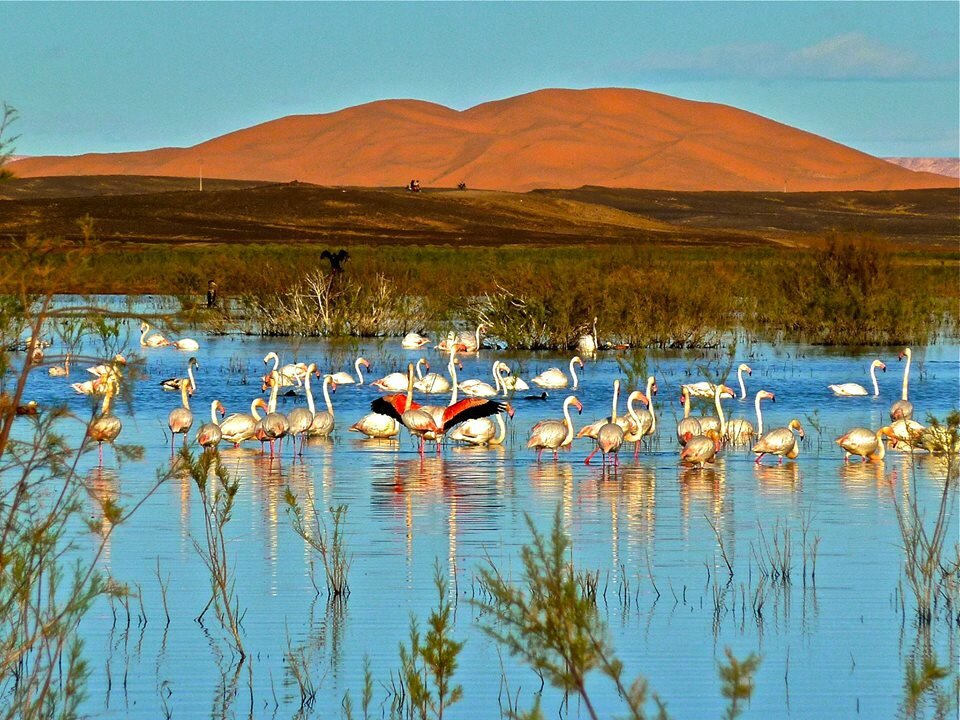
When there's enough water, the lake can host resident and migratory birds, including flamingos in some seasons. This presence is irregular. In March 2025, for example, flamingos were recorded again after a few years without appearing at the site, favored by rains that hit the region.
Because of this variability, Dayet Srij works best as a complement to a Merzouga and Erg Chebbi itinerary. Before heading out, it's worth asking your accommodation or a local guide about the current state of the lake, access, and bird presence.
This guide offers a professional recommendation based on research into the location, seasonal conditions, and the logistics of the visit. The content is not presented as a personal account, since I have not yet visited Dayet Srij Lake.
Quick facts
- Visit time: 30 minutes to 1h30
- Location: approximately 3 to 4 kilometers west of Merzouga
- Lake condition: intermittent, with water levels varying by rainfall and evaporation
- Best time of year: after rainy periods; conditions change from year to year
- Best time of day: morning or late afternoon, mainly because of temperature and light
- Entrance: no general ticket for accessing the open area
- Extra costs: a driver, guide, transfer, or booked activity is charged separately
- Infrastructure: no visitor center, restrooms, or standardized tourist route
- Swimming: not recommended
Is it worth visiting Dayet Srij Lake?
Dayet Srij can be worth visiting when there's water, birds, or a landscape that matches your interest as a traveler. Under those conditions, the contrast between the wetland, the plain, and the Erg Chebbi dunes offers a different perspective on the Merzouga region.
When the lake is dry, the experience changes completely. The site can still be interesting for anyone who enjoys desert landscapes, geology, or photography, but it will likely have less appeal for anyone hoping to find water and flamingos.
Since conditions vary so much, it's not worth planning a trip to Merzouga around the lake alone. Treat Dayet Srij as a complementary stop and check on conditions once you're already in the region.
What is Dayet Srij Lake?
Dayet Srij is a shallow, intermittent depression near Merzouga. Water accumulates after rainy periods and gradually decreases through evaporation, a process that can leave areas of mud, salt, and dry ground exposed.
This transformation is part of the landscape itself. There's no constant depth or extent, since the area covered by water changes according to the amount and distribution of rainfall.
When there's enough moisture, the environment can offer food and temporary shelter for different bird species. When the dry period stretches on, the landscape returns to predominantly arid characteristics.
Dayet Srij is not another name for Dayet Aoua. Dayet Aoua is a different lake, located in the Ifrane region, in the Middle Atlas.
Flamingos and other birds at Dayet Srij
Flamingos are Dayet Srij's best-known visitors, but their presence varies quite a bit. Whether the birds show up depends on water availability, food, weather conditions, and migratory movement.
In 2025, flamingos were seen at the lake again after a few years with no records. That episode helps illustrate how much the presence of these birds can change from one season to the next. Even when there's water, the number of animals and how long they stay are unpredictable.
Besides flamingos, the region can host ducks, wading birds, storks, and other species associated with wetland environments. The mix changes depending on the period and the condition of the ecosystem.
Use binoculars or a zoom camera to watch the birds from a distance. Repeated close approaches can make them abandon the area they're using for feeding or resting.
How to fit Dayet Srij into a Merzouga itinerary
The visit can be combined with a day dedicated to Merzouga and Erg Chebbi. Since the lake is just a few kilometers from the village, there's no need to set aside a whole day exclusively for this stop.
Before heading out, ask your accommodation about the lake's current state and whether the route is still passable. If the information isn't recent, ask for a current photo or when someone last visited the site. Conditions can change quickly after rain, wind, or several days of heat.
If there's water and birds, set aside 1 hour to 1h30 to take in the landscape calmly. If the lake is dry and that kind of scenery isn't a priority, a brief stop can be enough.
It's possible to combine sunrise at the dunes with a visit to the lake. Just leave a comfortable margin for travel, the return to your accommodation, and any other activity planned for the same period.
How to get to Dayet Srij Lake
Dayet Srij is approximately 3 to 4 kilometers west of Merzouga. The final stretch of access can involve unpaved tracks, sand, rocks, or dirt sections that change depending on recent conditions.
The main options are:
- Car with a driver: a practical option for confirming the route and conditions before setting out
- Local guide: useful for finding a viewing point and avoiding sensitive areas
- Your own or a rented vehicle: requires confirming the rental company's rules and the track's conditions
- Bicycle: possible for prepared travelers, after checking the heat, wind, and state of the path
- On foot: depends on your starting point, the temperature, and experience with desert routes
Travel time varies depending on your starting point, the route used, and ground conditions.
Regular vehicles shouldn't drive into deep sand, mud, or areas without a defined track. Beyond the risk of getting stuck, driving over the dry lakebed can damage the ground and disturb birds when water is nearby.
Quad bikes are common in the Merzouga area, but quiet transport works better for birdwatching. If you choose this option, stick to existing tracks and stop at a safe distance from the lake.
How the visit works
The visit is informal and happens along the accessible paths around the depression. There's no ticket office, visitor center, official trail, or observation platform.
On arrival, choose firm ground and keep your distance from the edge. The soil can look dry on the surface and stay wet or unstable underneath, especially after rain.
Don't walk over muddy areas, salt crusts, or stretches covered by water. Also don't wade into the lake to get closer to the birds or for a photo.
Swimming isn't recommended. Beyond the water's depth and quality varying, Dayet Srij is an environment used by wildlife and has no safety infrastructure for swimmers.
Best season to visit
There's no annual calendar that can precisely predict when Dayet Srij will be full. The volume of water depends on recent rainfall and can vary significantly between two consecutive years.
The cooler months tend to offer more comfortable conditions for travel and can coincide with wetter periods. Even so, the situation needs to be confirmed close to the date of your visit.
After heavy rain, the lake can gain water, but the access routes can also become muddy or temporarily hard to travel. Confirm track conditions before heading out in your own vehicle.
During prolonged dry spells, the water can disappear completely. In that case, the site takes on the look of a desert or salt plain.
Best time of day to visit
Morning and late afternoon tend to have more pleasant temperatures and side light over the landscape. This choice doesn't determine whether birds are present, which can vary throughout the day.
In the early morning, wind can sometimes be lighter, making it easier to observe the surface. On other days, gusts, dust, or clouds completely change how the lake looks.
Late afternoon can also work, as long as there's time to get back before dark. Since there's no lighting or marked route, avoid staying in remote areas after sunset.
Tickets and costs
There's no general ticket for visiting the open area of Dayet Srij. Access to the area around the lake usually doesn't require buying a ticket.
Costs depend on the transport you choose. A driver, guide, transfer, bike rental, or motorized activity are independent services and can have different prices.
Since these services don't follow a single fixed rate, check the price in Moroccan dirhams, ask what's included, and agree on the total before setting out.
How long to spend
Between 30 minutes and 1 hour is usually enough for a simple stop. Anyone planning to watch birds or photograph with a telephoto lens can set aside up to 1h30.
The time needed also depends on the lake's condition. If it's dry and the landscape doesn't match your interest, there's no need to extend the visit.
Factor round-trip travel into your planning, since it can take longer when the track is sandy, wet, or hard to identify.
Photography and birdwatching
Bring binoculars or a zoom lens to watch the birds without getting close. A greater distance reduces disturbance and also lets you observe the animals' behavior more naturally.
Reflections depend on the presence of water, the observer's position, and wind intensity. The surface won't always be still or reflect the dunes clearly.
Avoid playing bird sounds, surrounding groups, walking toward the animals, or pushing closer when they move away.
Before using a drone, confirm the applicable rules, required authorizations, and local restrictions. The equipment can also disturb the birds and other visitors.
Safety during the visit
The area is open, exposed to the sun, and has no tourist infrastructure. Bring water, sun protection, a hat, and closed shoes, even for a short visit.
The ground can have loose sand, rocks, mud, and fragile crusts. Walk only on firm ground, and don't proceed if you're unsure about the stability of the terrain.
Avoid heading off alone without knowing your way back. Download the map for offline use and let your accommodation or someone else know your planned route.
If heavy rain is forecast, check conditions before setting out. Water can quickly change tracks and depressions in arid regions.
Accessibility
Dayet Srij has no standardized accessible route. Sand, rocks, uneven ground, and mud can make the visit difficult for people with reduced mobility.
Depending on conditions, a vehicle may be able to get relatively close to a viewing point. This needs to be confirmed with a driver or guide who knows the current state of access.
Plan the visit without relying on restrooms, shade, or benches on site, and take care of those needs before leaving Merzouga.
Environmental care
- Keep your distance from the birds and lower your voice
- Don't offer food to the animals
- Don't leave trash, food scraps, or bottles
- Don't drive over the lakebed or off existing tracks
- Avoid loud music and noisy equipment near the birds
- Don't collect plants, feathers, eggs, rocks, or other natural elements
- Use binoculars or zoom instead of trying to get closer
- Follow local guidance when there's a temporary access restriction
Practical tips
- Confirm with your accommodation whether the lake has water
- Ask when that information about conditions was obtained
- Download the map for offline use
- Bring water, a hat, and sun protection
- Wear closed shoes
- Bring binoculars or a zoom camera
- Agree on the price for transport or a guide in advance
- Avoid the hottest hours
- Keep your distance from the birds
- Have another point of interest planned in case the lake is dry
Final tip
Before leaving Merzouga, confirm the current state of Dayet Srij and whether access can be made safely. When there's water and birds, the lake offers a landscape different from the dunes and can complement a route through the region well.
If the lake is dry, decide whether the desert plain still matches your interest. Erg Chebbi remains Merzouga's main attraction, and Dayet Srij can be an additional stop without affecting the rest of your activities.
Go with enough time to take in the landscape, keep your distance from the birds, and plan your return before dark. That way, Dayet Srij fits into the itinerary as a calm, environmentally respectful stop.