Last updated: August 2026
The Atlas Film Studios are a film production complex on the outskirts of Ouarzazate. The visit moves through sets built to represent cities, temples, and palaces from different eras.
Founded in 1983, the studios made use of the region's light and landscapes to host Moroccan and international productions. Some sets remained standing after filming and became part of the tourist route.
The complex is still connected to film production, so filming and maintenance work can affect the visit. The Kingdom of Heaven set is in a separate area and has its own ticket, or one combined with the main visit.
Quick facts
- Visit time: 45 minutes to 1 hour in the main area, or 1h30 to 2 hours with Kingdom of Heaven
- Location: Km 5 on the Route de Marrakech, west of Ouarzazate
- Founded: 1983
- Type of attraction: working studio and visit to film sets
- Atlas Studios: 80 MAD, approximately US$8
- Kingdom of Heaven: 40 MAD, approximately US$4
- Combined ticket: 110 MAD, approximately US$11
- Children: free entry under age 5
- Published hours: 8:30am to sunset
- Booking: not required for individual visitors
- Access: the route is subject to change during filming
- Accessibility: varies depending on which sets are included that day
Is it worth visiting the Atlas Film Studios?
The Atlas Film Studios are worth visiting mainly for anyone interested in cinema, set design, or the behind-the-scenes side of productions filmed in Ouarzazate.
Façades, streets, and temples built with lightweight materials show how the camera turns set structures into different places and historical periods.
The experience is simpler than a theme park, and some sets show wear or adaptations made for newer productions. The main area offers a good introduction; the combined ticket adds the larger outdoor Kingdom of Heaven area.
What are the Atlas Film Studios?
Atlas Studios was created in 1983 by Moroccan businessman Mohamed Belghmi to offer permanent infrastructure to productions drawn by Ouarzazate's landscapes.
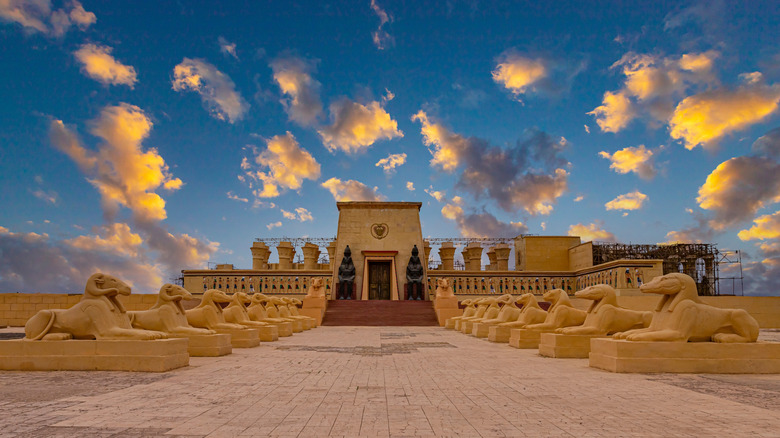
The complex brings together outdoor sets, technical areas, and structures used in films, series, shows, and events. Among the published sets are Egyptian temples, Tibetan-inspired buildings, biblical cities, set-built kasbahs, and streets in different styles.
Sets can be renovated, taken down, or reused. Paint and new decorative elements let the same structure represent different productions.
Atlas Studios and Ouarzazate's film history
Atlas Studios represents only one part of Ouarzazate's film activity. A production can use the complex, other studios, Ait Ben Haddou, desert areas, and urban locations all in the same project.
Lawrence of Arabia made use of the region's landscapes before Atlas Studios was founded in 1983. The film is part of Ouarzazate's cinematic history, but it wasn't produced inside the current complex.
The studio tour is associated with titles such as Gladiator, Kundun, Asterix & Obelix: Mission Cleopatra, Prince of Persia, Game of Thrones, and Kingdom of Heaven. The guide or on-site signage helps identify how each set was used.
Difference between Atlas Studios, CLA Studios, and the Musée du Cinéma
Ouarzazate has several film-related spaces, and they aren't the same attraction.
- Atlas Studios: a complex founded in 1983 on the Route de Marrakech, with sets and production areas
- Kingdom of Heaven: an outdoor area tied to the film, offered with a separate or combined ticket through Atlas Studios
- CLA Studios: another production complex on the outskirts of Ouarzazate, with its own management and access
- Musée du Cinéma: a museum located facing the Kasbah Taourirt, in the city center
Each space has its own location, ticket, and visiting conditions.
What might you see during the visit?
The route brings together settings inspired by different regions and periods, but the available sets can change depending on the studios' activity.
Tibetan temple
Structures inspired by Tibetan monasteries and temples were built for film productions and help show how Ouarzazate can represent distant landscapes.
Egyptian sets
Façades, columns, and courtyards inspired by Egypt appear among the settings used or adapted for different films.
Historic cities and buildings
Streets, walls, gates, and set-built kasbahs can represent ancient, medieval, or biblical cities depending on the decoration applied for each production.
Reused sets
Part of the visit reveals how wood, plaster, fiber, paint, and support structures create the look of stone or earth in front of the cameras.
Filming and maintenance can temporarily restrict some areas.
Kingdom of Heaven set
The Kingdom of Heaven area sits apart from the main area and brings together walls, gates, and buildings created to represent a fortified city in the film directed by Ridley Scott.
Access requires its own ticket or a combined one and adds travel or walking to the route. Confirm at the ticket office how the visit works that day.
How to get to the Atlas Film Studios
The published address is Km 5, Route de Marrakech, in Tamassinte, west of central Ouarzazate.
The most practical options are:
- Car: access via the main road toward Marrakech
- Taxi: agree on the price, wait time, and return before leaving the center
- Driver or transfer: an alternative for combining the studios with other attractions
- Organized tour: some Ouarzazate itineraries include a stop at the studios
- Nearby accommodation: the Oscar Hotel is integrated into the Atlas Studios area
Mark the entrance on the Route de Marrakech on your map before leaving the center.
How the visit works
At the ticket office, choose between Atlas Studios, Kingdom of Heaven, or the combined ticket, and confirm how the visit will be organized at that time.
Stay in the open areas and follow staff instructions. Façades can look solid in front of the camera, but they use lightweight walls, supports, and fragile surfaces.
For drones, professional filming, or larger equipment, ask for authorization. At the end of the route, there's a studio souvenir shop.
Tickets and prices
As of August 2026, the Atlas Studios visitor channel published the following prices:
- Atlas Studios: 80 MAD, approximately US$8
- Kingdom of Heaven: 40 MAD, approximately US$4
- Combined: 110 MAD, approximately US$11
- Under 5: free entry
The dollar amounts are approximate and change with the exchange rate; payment is made in Moroccan dirhams.
Individual visitors don't need to book in advance. Groups should contact the studios directly. Confirm prices through the official channel before your visit.
Hours
As of August 2026, the published hours were 8:30am to sunset, daily, including holidays. Since sunset time varies throughout the year, closing doesn't happen at the same hour year-round.
Arrive early to finish the route, especially if buying the combined ticket. Filming can change the itinerary even when the studios remain open.
How long to spend
Set aside 45 minutes to 1 hour for the main area. With Kingdom of Heaven, plan for 1h30 to 2 hours total.
Confirm the duration at the entrance and add a margin in case you need to wait for the visit to start.
Best time to visit
Morning offers milder temperatures and leaves time to include other Ouarzazate attractions. Late afternoon also works in cooler months, as long as the visit ends before closing.
In summer, avoid the hottest hours, since much of the route is outdoors and not every set offers shade.
Best season to visit
Spring and fall tend to offer more comfortable temperatures. Summer can be very hot, while winter mornings and late afternoons may call for warm clothing.
Filming can change the route at any time of year.
Accessibility
Accessibility varies depending on the route. Some areas have dirt, rocks, steps, or uneven surfaces.
Visitors with reduced mobility should ask which sections are accessible, especially before buying the combined ticket for Kingdom of Heaven.
Practical tips
- Confirm prices and hours through the official channel
- Choose between Atlas Studios, Kingdom of Heaven, or the combined ticket
- Wear comfortable shoes for uneven terrain
- Bring water, a hat, and sun protection
- Ask which languages are available
- Don't touch or climb on the set structures
- Ask for authorization to use a drone or professional equipment
- Mark the entrance on the Route de Marrakech on your map
Final tip
Choose your ticket based on the time you have. The main area shows how the sets are built, while Kingdom of Heaven adds a larger-scale outdoor section.
Look at the materials and supports hidden behind the façades. Up close, it's easier to see how paint, framing, and decoration turn lightweight structures into cinematic cities.
Round out the itinerary with the Kasbah Taourirt and the Musée du Cinéma. Together, the three spaces present Ouarzazate's historic architecture, set design, and film history.