Last updated: August 2026
Kasbah Taourirt sits in a historic area of central Ouarzazate, close to Avenue Mohammed V. The earthen towers, courtyards, and decorated rooms show different sides of the architecture developed in the valleys of southern Morocco.
The complex is associated with the Glaoui family, who held major political and economic influence in the region during the late 19th and early 20th centuries. Taourirt functioned as a residence, an administrative space, and a checkpoint in an area tied to the south's trade routes.
Only part of the kasbah can be visited. New work that started in 2026 may change the route, which rooms are open, the price, and the hours. Confirm this information on site before your visit.
Quick facts
- Visit time: approximately 45 minutes to 1h30
- Location: central Ouarzazate, near Avenue Mohammed V
- Type of attraction: architecture, history, and cultural heritage
- Interior access: limited to the areas open during the visit
- 2026 status: complex partially accessible, with restoration projects underway
- Entrance: paid when the interior is open to visitors
- Price: confirm at the ticket office, since published amounts vary
- Hours: confirm on site or with your accommodation before visiting
- Guide: availability and conditions should be checked at the entrance
- Accessibility: limited by steps, narrow passages, and uneven ground
Is it worth visiting Kasbah Taourirt?
Kasbah Taourirt is worth visiting for anyone wanting to see earthen architecture in central Ouarzazate. The façade, the towers, and the open interior rooms reveal different functions and levels of decoration within the complex.
The route can be short during construction work, but the preserved spaces still let you take in stucco, painted wood, zellige, and traditional building techniques. The Musée du Cinéma, located across the avenue, rounds out the visit with another side of the city's history.
What is Kasbah Taourirt?
A kasbah is a fortified residence or a complex tied to a family, an authority, or an administrative function. It differs from a ksar, made up of multiple homes and communal spaces within a fortified area.
Taourirt grew in different phases and brings together towers, courtyards, corridors, rooms, and reception areas. Regional tourism sources mention approximately 300 rooms in the complete complex, though only a portion is part of the current route.
Earth, wood, straw, clay, lime, and plaster appear in different forms across the structures and finishes.
History and the Glaoui family
The history of Kasbah Taourirt is tied to the Glaoui family, whose influence extended across parts of the High Atlas and southern Morocco.
Ouarzazate's position favored control over routes used by merchants and travelers between the valleys, the mountains, and the pre-Saharan regions.
During the period when the family expanded its influence, the complex gained residential, administrative, and reception spaces. Thami El Glaoui became the family's best-known figure during the French Protectorate, but Taourirt's history isn't limited to his personal residence.
After Morocco's independence in 1956, the Glaoui family's political influence ended, and different parts of the kasbah stopped serving their previous functions.
Architecture and decoration
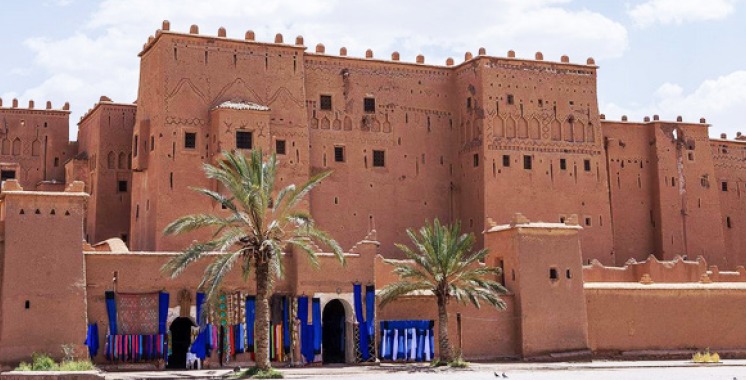
Taourirt's façade features square towers, earthen volumes, and bands with geometric motifs. In the preserved interiors, the decoration includes stucco, painted or carved wood, zellige, and ceilings made of wood and plant elements.
The contrast between the plainer exterior and some of the ornamented rooms relates to each space's function. Reception rooms and important quarters received more elaborate finishing, though not all of them are open during the construction work.
Conservation and 2026 restoration work
Earthen buildings require frequent maintenance since they're vulnerable to rain and erosion. At Taourirt, some parts have been restored or reinforced, while others remain closed or show more wear.
New work announced in April 2026 includes interpretation spaces and other improvements aimed at visitors. During construction, the route can change as rooms are closed or reopened.
Respect the barriers and stay only in the areas open to the public.
Is Kasbah Taourirt a UNESCO World Heritage Site?
Kasbah Taourirt does not have an individual listing on the UNESCO World Heritage List.
Some tourism pages describe Taourirt as UNESCO heritage, but the site officially inscribed in Ouarzazate province is the Ksar of Ait Ben Haddou, recognized in 1987.
Taourirt has its own historical and architectural significance and is part of Ouarzazate's cultural heritage. That significance doesn't depend on an individual UNESCO designation.
How to get to Kasbah Taourirt
The kasbah is in central Ouarzazate, near Avenue Mohammed V and facing the Musée du Cinéma area.
The most practical options are:
- On foot: possible for anyone staying in the central area
- Petit taxi: an alternative for hotels farther away
- Car: there are parking areas nearby, with variable availability and fees
- Driver or tour: Taourirt can appear on itineraries that also include Ait Ben Haddou or film-related attractions
Check the map from your accommodation to see whether walking is convenient.
How the visit works
When the interior is open, the visit starts at the reception or ticket office and continues through the open rooms and passages. The route can include decorated rooms, courtyards, corridors, and exhibition areas.
The sequence changes during construction, so don't count on access to a specific terrace or room. Ask at the entrance whether an independent visit is allowed and which rooms are part of the ticket.
Even when the interior route is reduced, set aside a few minutes to view the façade and walk through the historic area around it.
What to look for during the visit
Façade and towers
The façade lets you take in the square towers, the earthen volumes, and the geometric motifs used in the exterior decoration.
Decorated rooms
When open, some interiors feature stucco, painted wood, worked ceilings, and zellige elements.
Courtyards and corridors
The courtyards help with lighting and circulation between different parts of the complex. The corridors reveal how the rooms were connected across the building's construction phases.
Taourirt's historic area
The area around the kasbah is part of an old section of Ouarzazate. Walking around it lets you see the relationship between the monument and the city's later growth.
Musée du Cinéma
The Musée du Cinéma is a separate attraction, located facing Kasbah Taourirt. Its collection and sets relate to Ouarzazate's film production.
Entrance, hours, and tickets are independent, but the proximity makes it easy to combine the two visits.
Tickets and hours
The interior visit is paid when the monument is open. Since the published prices and hours vary during the construction work, confirm the information on site before buying a ticket.
Guides are charged separately. Agree on the price, duration, and language beforehand. The façade and the surrounding public areas can be viewed without a ticket.
How long to spend
Set aside between 45 minutes and 1h30, depending on how much of the route is open and whether you hire a guide. If few rooms are accessible, the visit may end sooner.
Add a separate period if you also plan to see the Musée du Cinéma.
Best time to visit
Morning offers milder temperatures and time to adjust your plan if an area is closed. In the late afternoon, lower light can bring out the relief of the façade, but check the last entry time.
In summer, avoid spending too long in outdoor areas during the hottest hours.
Accessibility
The façade can be viewed from the public areas near Avenue Mohammed V. Inside, steps, level changes, narrow passages, and uneven floors limit accessibility.
Anyone who needs to avoid stairs should ask at the entrance which parts of the route are available without major level changes.
Practical tips
- Confirm whether the interior is open and which rooms are part of the ticket
- Check the price and the last entry time
- Agree on a guide's fee in advance
- Wear comfortable shoes for steps and uneven floors
- Don't cross barriers or enter closed areas
- Check the Musée du Cinéma's hours separately
- Bring water and sun protection in summer
Final tip
Start by viewing the towers and the geometric motifs on the façade. At the entrance, confirm which rooms are open and decide whether to do the visit alone or with a guide.
In the accessible interiors, compare the simplicity of the exterior volumes with the stucco, wood, and zellige details. Then combine the visit with the Musée du Cinéma: Taourirt presents the region's architecture and political history, while the museum covers Ouarzazate's film activity.