Last updated: June 2026
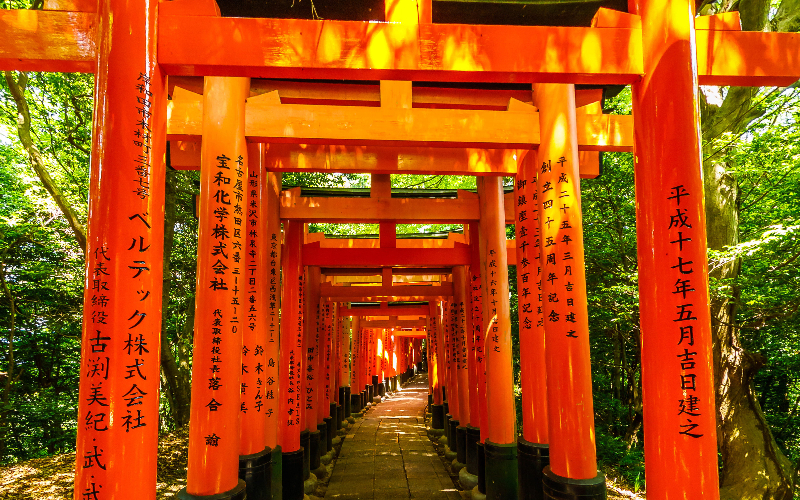
Fushimi Inari Taisha is one of Kyoto's most iconic attractions and one of the most striking places to visit in Japan. The shrine is famous for its thousands of red gates, called torii, which form paths up the mountain and create one of the country's most recognisable images.
For a first visit to Kyoto, I would make Fushimi Inari a priority. Admission is free, access is straightforward and the experience differs from the city's other temples and shrines. The main attraction is not only the central shrine, but the entire path climbing the mountain.
The experience can be short or long, depending on your time and energy. You can visit just the initial section of the torii, which is already the most famous part, or continue along the trail to higher areas, where the crowds thin out and the atmosphere becomes quieter.
Quick info
- Visit duration: 1 to 3 hours
- Location: Kyoto, near Inari Station
- Best time: early morning or late afternoon
- Difficulty: easy in the initial section, moderate if you climb further
- Price: free
- Hours: open 24 hours
- Transport from Kyoto Station to Inari Station: about ¥150, approximately US$1
Is Fushimi Inari Taisha worth visiting?
Yes, it is definitely worth visiting. On a first trip to Kyoto, Fushimi Inari is one of the city's essential attractions. It combines a spiritual setting, a mountain trail, nature and the striking sight of thousands of torii gates.
I would keep Fushimi Inari even on a short itinerary. The visit is free, sits close to central Kyoto and can be adapted to your available time. With just 1 hour, you can see the main section. With more time, you can climb the trail and find much quieter areas.
The place is very touristy, especially in the first stretches, but it is still worth the visit. The best way to enjoy it is to arrive early or climb beyond the initial area, where most people stop.
Why visit Fushimi Inari Taisha?
The main reason to visit Fushimi Inari Taisha is to walk through the corridors of red torii gates. This is one of Japan's most famous experiences and, in person, it tends to be very impressive.
Unlike other shrines, Fushimi Inari is not limited to a main hall. The visit continues up the mountain, passing small shrines, fox statues, lanterns, stairs, wooded paths and viewpoints over Kyoto.
The shrine also holds great religious importance. Fushimi Inari Taisha is Japan's head shrine for Inari, traditionally linked to prosperity, harvests, business and protection. Its history dates back to the year 711, during the Nara period.
How to get to Fushimi Inari Taisha
The most practical way is to take the JR Nara Line from Kyoto Station and get off at Inari Station. The journey takes about 5 minutes and the station sits almost directly in front of the shrine's entrance.
The ticket costs approximately ¥150 (about US$1). It is important to take the local train, because express trains do not stop at Inari Station.
It is also possible to arrive via the Keihan Line, getting off at Fushimi Inari Station. This option can be useful if you are coming from areas such as Gion or eastern Kyoto.
How the visit works
Entry to Fushimi Inari Taisha is free and access to the trails is unrestricted. There is no need to buy a ticket or book a time slot.
The visit begins at the shrine's main area, near the entrance. From there, you continue to the torii corridors, which form the attraction's most famous path.
There is no obligation to walk the entire trail. You decide how far you want to climb. Many people visit only the initial section, where the best-known torii are found. Those who keep climbing find quieter stretches and a calmer atmosphere.
What to see at Fushimi Inari Taisha
Main shrine
Before entering the torii corridors, it is worth taking your time in the main shrine area. This is where you get a better sense of the visit's religious side, with prayers, offerings and traditional rituals.
Even though it is a very touristy site, Fushimi Inari remains a sacred space. It is worth showing respect, keeping your voice down in the prayer areas and avoiding disturbing those taking part in the rituals.
Red torii gate tunnels
The red torii gates are Fushimi Inari's most famous feature. They form continuous paths up the mountain and create a very immersive feeling.
The initial section is the most sought-after for photos. If you want a cleaner shot, arrive early or be patient enough to wait a few seconds between groups.
I would not stay only in the first few metres. Walking a little further already helps you find less crowded areas with a calmer experience.
Fox statues
Throughout the shrine, you will see several fox statues. They are associated with Inari and appear as messengers of the deity.
This detail helps you better understand the shrine's visual identity. Along with the torii, the foxes are one of Fushimi Inari's most characteristic images.
Mountain trails
The trail climbs Mount Inari, a sacred mountain 233 metres tall. The full walk to the summit and back can take about 2 to 3 hours, depending on your pace and stops.
The climb is not extremely difficult, but it has stairs, sloped sections and can be tiring on hot days. For anyone who wants a lighter experience, there is no need to go all the way to the top.
Viewpoints along the way
During the climb, there are spots with views over Kyoto. One of the most popular stretches is the Yotsutsuji area, where many people stop before deciding whether to continue to the top or start heading back down.
For many travellers, reaching this point is already enough. The view is good, the walk feels more complete and you avoid using up all your energy for the day on the full trail.
How much does it cost to visit Fushimi Inari Taisha?
Entry to Fushimi Inari Taisha is free.
- Main shrine: free
- Torii trails: free
- Viewpoints: free
- 24-hour access: free
- Train from Kyoto Station to Inari Station: about ¥150, approximately US$1
The main spending can be on transport, food, drinks or a souvenir bought at the nearby shops. For anyone in Kyoto, this is one of the city's best value-for-money attractions.
How long to spend at Fushimi Inari Taisha?
The ideal time depends on how much you want to walk.
- To see only the initial torii section and the main shrine, set aside about 1 hour.
- To walk to quieter areas and return at a relaxed pace, set aside 1h30 to 2 hours.
- To do the full trail to the top and back, set aside about 2 to 3 hours.
I think the best option for most travellers is to stay between 1h30 and 2 hours. That way you do not visit only the most crowded part, but you also do not overload the day's itinerary.
Best time to visit Fushimi Inari Taisha
The best time is early morning or late afternoon.
Early in the morning, the advantage is finding smaller crowds, having more beautiful light and starting the day with a strong attraction.
In the late afternoon, the visit can feel more atmospheric, especially as the light starts to change and the crowds thin out. Since the shrine stays open 24 hours, it is also possible to visit at night, but the trail gets darker and may not be ideal for everyone.
I would avoid arriving at midday if the goal is to take photos with fewer people. That is usually when the site is busiest.
Which part of the trail is most worth it?
For a first visit, I would do at least the initial torii section and continue climbing a bit past the first, busiest stretch.
Most visitors concentrate in the initial corridors, near the entrance. After a few minutes of walking, the crowds already start to thin out.
If you have the energy, try to reach a higher point, such as the Yotsutsuji area. You do not need to climb all the way to the top to feel the visit was worthwhile.
What to combine with Fushimi Inari on the same day
Fushimi Inari pairs very well with eastern Kyoto, especially if the itinerary includes Kiyomizu-dera, Higashiyama and Gion.
A good approach would be to visit Fushimi Inari early in the morning, then continue to Higashiyama and end the day in Gion. This sequence works because it mixes a shrine, traditional streets and a historic neighbourhood without leaving the day feeling disjointed.
It is also possible to combine Fushimi Inari with Nara, since both sit along the JR Nara Line. In that case, I would visit Fushimi Inari very early and continue to Nara afterwards. But for a first trip, that can make for a rushed day.
What I would prioritise on the visit
If time is short, I would prioritise the main shrine, the first torii corridors, the fox statues and a short walk along the trail.
If there is more time, I would keep climbing to a less crowded area to better feel the place's atmosphere.
If it is very hot or raining, I would not force the full trail. The initial section is already well worth it.
What can be optional
- Climbing to the top of Mount Inari can be optional. The most famous experience happens in the initial and intermediate stretches of the trail.
- Buying souvenirs or food at the nearby shops is also optional.
- Visiting at night can be optional. It is beautiful, but the trail gets darker and may not be the best choice for anyone who does not enjoy walking in dimly lit areas.
Mistakes to avoid at Fushimi Inari Taisha
The first mistake is arriving late and expecting to find the torii empty. Fushimi Inari is one of Kyoto's most visited attractions and tends to be crowded during the day.
Another mistake is doing only the first part, taking a quick photo and leaving. The place becomes more interesting when you walk a bit further and leave the initial crowds behind.
It is also worth avoiding climbing without water on hot days. Even though it is an accessible trail, the heat and the stairs can be quite tiring.
Another mistake is forgetting that this is a shrine. Even with many tourists around, it is important to respect the prayer areas, the rituals and those visiting for religious reasons.
Practical tips for visiting Fushimi Inari Taisha
- Wear comfortable shoes, especially if you plan to climb beyond the initial section.
- Bring water if you plan to walk for longer.
- Arrive early to find smaller crowds.
- Take the local train on the JR Nara Line, because express trains do not stop at Inari Station.
- There is no need to buy a ticket, the visit is free.
- Avoid blocking the path to take photos, especially in the narrow torii corridors.
- Climb a little past the first area to find quieter stretches.