Last updated: June 2026
Todai-ji Temple is one of Nara's most impressive attractions and one of the most important visits to include in a Kansai region itinerary. Located within Nara Park, the temple is famous for housing the Great Buddha of Nara, an enormous bronze statue that impresses both for its size and its historical importance.
For anyone visiting Nara in 1 day, I would place Todai-ji as a priority. The park's deer are the city's most famous and fun part, but Todai-ji is the point that gives the trip cultural depth. It shows why Nara was so important in Japan's history and why the city deserves more than a quick visit just for photos with the deer.
The experience is different from other Japanese temples. In many places, the beauty lies in the gardens, the details or the quiet atmosphere. At Todai-ji, the impact comes from scale. The main hall is enormous, the Great Buddha dominates the interior and the visit conveys a sense of grandeur that is hard to find in other temples in Japan.
Quick info
- Visit duration: 1 to 2 hours
- Location: Nara, inside Nara Park
- Best time: early morning
- Difficulty: easy
- Adult price: ¥800, about US$5
- Price for children aged 6 to 12: ¥400, about US$2.70
- Hours April to October: 7:30am to 5:30pm
- Hours November to March: 8am to 5pm
- Open: every day
Is Todai-ji Temple worth visiting?
Yes, it is definitely worth visiting. In my view, Todai-ji is Nara's most important historic attraction and one of the most memorable cultural visits on a Japan itinerary.
If you are already going to Nara Park, it makes no sense to pass through the area and leave Todai-ji out. Admission is paid, but the price is relatively affordable considering the temple's importance and the impact of the visit.
I would prioritise Todai-ji alongside the deer in Nara Park. The two complement each other: the park offers a lighter experience with the deer, followed by the historic and monumental setting of the Great Buddha.
Why visit Todai-ji?
The main reason to visit Todai-ji is to see the Great Buddha of Nara inside the Daibutsuden, the Great Buddha Hall. The statue stands about 15 metres tall and is one of the most important Buddhist images in Japan.
The temple also impresses with its architecture. The Daibutsuden is considered one of the largest wooden structures in the world, and that scale is felt even before you go inside.
Another reason is historical importance. Todai-ji is linked to the period when Nara was the capital of Japan and represents a fundamental phase in the expansion of Buddhism in the country. Because of this, the visit is not just beautiful, it also helps you better understand Nara's cultural weight.
How to get to Todai-ji Temple
Todai-ji sits within the Nara Park area and can be visited on foot from Nara's main stations.
Kintetsu Nara Station tends to be the most practical for anyone arriving from Kyoto or Osaka via Kintetsu. The walk to the temple takes about 19 minutes, passing through areas of the park where you will already start seeing deer.
From JR Nara Station, the walk is a bit longer. Even so, you can walk or use a local bus, depending on your time and energy.
I would choose the station based on where you are coming from. For anyone leaving from Kyoto or Osaka Namba, Kintetsu Nara tends to be very convenient for visiting the park and Todai-ji.
How the visit works
The outer area of the complex can be explored freely, but access to the Great Buddha Hall is paid.
The Daibutsuden ticket costs ¥800 for adults, about US$5. Children aged 6 to 12 pay ¥400, about US$2.70. There is also a combined pass for the Great Buddha Hall and the Todai-ji Museum for ¥1,200, about US$8 for adults, and ¥600, about US$4 for children.
After passing through the entrance, the route is simple. You enter the great hall, observe the main Buddha, walk around the interior, see details of the temple and then return to the outer area.
The visit is not complicated and does not require a guide. Even so, it is worth taking your time, because the temple's impact lies precisely in its scale and details.
What to see at Todai-ji Temple
Daibutsuden
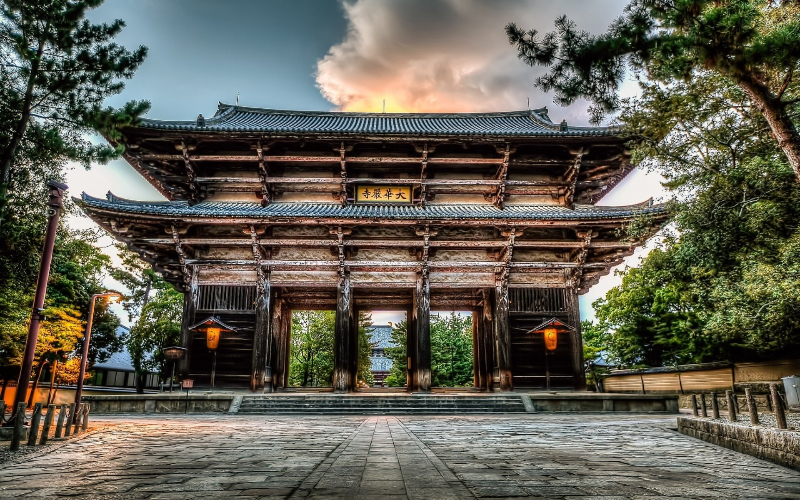
The Daibutsuden is the Great Buddha Hall and Todai-ji's main building. Even before entering, it already impresses with its size and presence.
The enormous façade, the staircase, the bronze lantern and the open space in front create a very striking arrival. It is the kind of place worth stopping at for a few minutes before entering, just to take in the scale of the building.
Great Buddha of Nara
The Great Buddha is the most important point of the visit. The bronze statue sits in the centre of the hall and completely dominates the space.
Even if you have already seen photos, the in-person experience tends to be more impactful. The size of the statue, the interior lighting and the height of the hall create a very strong sense of grandeur.
I would set aside time to observe it from different angles, not just from the entrance. Walking through the interior helps you better notice the details of the statue and the building.
Column with an opening
Inside the hall, there is a column with an opening at its base. Many visitors try to pass through this space, which is usually associated with good luck and spiritual enlightenment.
It is a curious part of the visit, especially for families and children. At busy times, it can form a queue, so I would treat it as optional.
Outer temple grounds
The outer area also deserves attention. Before reaching the main hall, you pass through the access path, the gate and open spaces that clearly show the grandeur of the complex.
The surrounding area also connects Todai-ji to the rest of Nara Park, so it is common to see deer near the temple and along the entrance path.
Nigatsu-do
If you have time and energy, I would try to include Nigatsu-do after Todai-ji. It sits in the same area and has free access.
The highlight is the terrace with a view over Nara. For anyone taking the visit at a calm pace, this can be one of the best extra stops after the Great Buddha.
How much does it cost to visit Todai-ji?
- Adult ticket: ¥800, about US$5
- Ticket for children aged 6 to 12: ¥400, about US$2.70
- Combined Great Buddha Hall plus Museum pass (adult): ¥1,200, about US$8
- Combined Great Buddha Hall plus Museum pass (children): ¥600, about US$4
- Surrounding Nara Park area: free
For a first visit, I would choose at least the Great Buddha Hall ticket. The museum can be interesting, but it is not essential if you only have 1 day in Nara.
How long to spend at Todai-ji?
The ideal is to set aside 1 to 2 hours to visit Todai-ji calmly.
- With 1 hour, you can see the entrance path, the Daibutsuden, the Great Buddha and the main area.
- With 2 hours, you can walk more calmly, observe details, visit nearby areas and perhaps include Nigatsu-do.
For a 1-day Nara itinerary, I would not rush the visit. Todai-ji is the most important historic point of the trip, so it is worth giving it enough time to enjoy.
Best time to visit Todai-ji
The best time is early in the morning, especially if you are doing a day trip from Kyoto or Osaka.
From April to October, the Great Buddha Hall opens from 7:30am to 5:30pm. From November to March, it opens from 8am to 5pm.
Arriving early helps you avoid some of the tour groups and makes the visit calmer. Since Todai-ji is one of Nara's most famous attractions, the crowds can increase significantly throughout the day.
If you arrive in the late afternoon, check the closing time carefully. It is not worth leaving Todai-ji for too late and risking a rushed visit.
What to combine with Todai-ji on the same day
Todai-ji naturally combines with Nara Park, the deer and Kasuga Taisha.
A good sequence would be to arrive via Kintetsu Nara Station, walk through Nara Park, visit Todai-ji, continue to Kasuga Taisha and then return to the historic centre before heading back to Kyoto or Osaka.
If there is time left, Nigatsu-do is a great extra stop because it is nearby and offers a beautiful view of the city.
I would avoid trying to visit Nara too quickly and rushing back to Kyoto or Osaka. Todai-ji deserves time, and the itinerary works better when the day stays focused on Nara.
What I would prioritise on the visit
If time is short, I would prioritise the Daibutsuden and the Great Buddha. These are the essential points.
With more time, I would also walk through the outer area, observe the entrance gate and continue to Nigatsu-do.
I would also try not to separate Todai-ji from Nara Park. The experience is much better when you arrive walking through the park and see the temple within the context of the city.
What can be optional
- The Todai-ji Museum can be optional if you have little time or a tighter budget.
- The column with the opening inside the hall can also be optional if there is a queue.
- Nigatsu-do can be optional if you are already tired, but I would try to include it if the day is relaxed.
- Visiting every secondary area of the complex is not mandatory on a day trip. The essential part is the Great Buddha Hall.
Mistakes to avoid at Todai-ji
The first mistake is thinking Todai-ji is "just another temple". The scale of the place and its historic importance make it one of Nara's most striking visits.
Another mistake is visiting only the deer of Nara Park and leaving Todai-ji out. That leaves the trip incomplete.
It is also worth avoiding arriving too late. Since the temple has closing hours, it is better to visit earlier and leave free walks through the park for later.
Another mistake is rushing through the visit. The interior of the hall deserves time to observe the statue, the details and the sheer size of the space.
Practical tips for visiting Todai-ji
- Arrive early to avoid the biggest crowds.
- Bring cash or a card, but confirm the payment method on the day.
- Set aside at least 1 hour for the temple.
- Combine it with Nara Park and Kasuga Taisha.
- Wear comfortable shoes, because a visit to Nara involves quite a lot of walking.
- Do not leave the temple for the end of the day without checking the closing time.
- Include Nigatsu-do if you want a beautiful, free view of Nara.