Last updated: August 2026
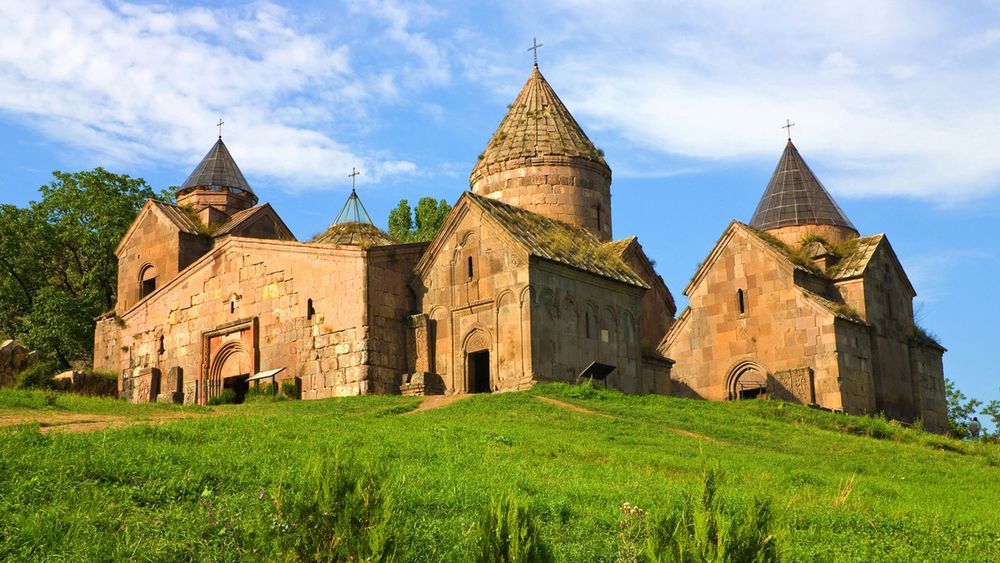
Goshavank Monastery is one of the most important monasteries for understanding the religious, intellectual and cultural history of medieval Armenia. Located in the village of Gosh, near Dilijan, the complex combines stone churches, detailed khachkars, quiet courtyards and the memory of Mkhitar Gosh, one of the most significant figures in Armenian culture.
Unlike Haghartsin, which impresses mainly for its forest location, Goshavank draws attention for its historic details. The monastery is linked to education, literature, law and Armenian religious tradition, which makes the visit richer than it first appears.
The complex was founded at the end of the 12th century and was named in honour of Mkhitar Gosh. He was a monk, writer, jurist and thinker, known for works that marked medieval Armenian culture, including an important code of laws.
For those staying in Dilijan, I would combine Goshavank with Haghartsin Monastery on the same day. The two are in the same region and complement each other very well: Haghartsin delivers forest and atmosphere; Goshavank delivers history, khachkars and medieval architecture.
Quick facts
- Visit duration: 45 minutes to 1 hour
- Recommended base: Dilijan
- Distance from Dilijan: about 18 km
- Driving time from Dilijan: about 25 minutes
- Entry: generally free
- Best time: morning or late afternoon
- Type of visit: monastery, history, medieval architecture and khachkars
- Pairs well with: Haghartsin Monastery, Parz Lake, Old Dilijan and Dilijan National Park
- Ideal for: those who want to better understand medieval Armenia
Is it worth visiting Goshavank Monastery?
Yes, it is very much worth visiting Goshavank Monastery, especially if you are staying in Dilijan and want to see the main monasteries of northern Armenia.
The monastery is important for the history of Mkhitar Gosh, the detailed khachkars and its connection to medieval Armenian intellectual and religious tradition.
It may not have as hidden a forest location as Haghartsin, nor as dramatic a landscape as Tatev, but it makes up for it with cultural importance and the richness of its details.
I would not visit Goshavank on its own if I had little time. The ideal is to combine it with Haghartsin on the same day, because together they better show the strength of the monastic tradition in the Dilijan region.
What is Goshavank Monastery?
Goshavank Monastery is a medieval monastic complex located in the village of Gosh, near Dilijan, in northern Armenia.
The monastery was founded by Mkhitar Gosh, a central figure in medieval Armenian culture. He was a clergyman, thinker, jurist and writer, known mainly for his work linked to Armenian law.
The name Goshavank means "monastery of Gosh", a tribute to its founder. Before that, the site was also linked to the name Nor Getik.
The complex brings together churches, a gavit, khachkars, a central courtyard and the tomb of Mkhitar Gosh. The visit is relatively short, but very interesting for those who enjoy history, architecture and stone details.
Who was Mkhitar Gosh?
Mkhitar Gosh was one of the most important figures in medieval Armenia. He became known as a monk, writer, thinker and jurist.
His most famous work is the Datastanagirk, known as the Book of Laws. This text held great importance for Armenian legal tradition and reinforces Goshavank's role as a centre of thought and culture.
Mkhitar Gosh is also associated with Armenian literature, especially for his collection of moral fables. Because of this, visiting Goshavank is not just about seeing an old monastery, but coming into contact with a place linked to the country's intellectual development.
For those doing an Armenia itinerary, this context makes Goshavank more interesting. It helps show that Armenian monasteries were also centres of teaching, writing, study and cultural preservation.
Why visit Goshavank?
The first reason to visit Goshavank is the history. The monastery is directly linked to Mkhitar Gosh and to medieval Armenia's intellectual tradition.
The second reason is the khachkars. Goshavank's stone crosses are among the complex's most interesting elements, with rich carvings and details that show the artistic skill of Armenian masters.
The third reason is the combination with Haghartsin. Since the two monasteries are in the Dilijan region, it makes a lot of sense to visit both on the same day.
Goshavank also helps vary the itinerary. After monasteries in dramatic landscapes, like Tatev, and monasteries carved into rock, like Geghard, Goshavank offers an experience more linked to history, education and written culture.
How to get to Goshavank Monastery
The best base for visiting Goshavank Monastery is Dilijan.
By car, the journey from Dilijan takes about 25 minutes. The road passes through green areas and small villages, with the calm climate typical of this part of northern Armenia.
It is also possible to go by taxi from Dilijan. In that case, the ideal is to arrange a wait or return with the driver, because it may not be so simple to find transport back in the village of Gosh.
With a private driver or organised tour, Goshavank is usually combined with Haghartsin Monastery, Parz Lake and Old Dilijan.
I would avoid relying only on public transport for this visit. The region's attractions are spread out, so car, taxi, driver or tour make the itinerary much more practical.
How the visit works
The visit to Goshavank Monastery is simple and usually free. The complex remains open as a religious and historic space, with access to the churches, courtyard, gavit, khachkars and outdoor areas.
The route is short and can be done in under 1 hour. Even so, it is worth walking without rushing, because the details are the strong point of the place.
The ideal is to observe the churches, go into the gavit, look for the most elaborate khachkars and pay attention to the architectural ensemble.
Since it is still a religious space, the visit should be made respectfully. If there is a ceremony or prayer taking place, stay quiet and avoid disturbing it.
What to see at Goshavank Monastery
Church of the Mother of God
The Church of the Mother of God is the main building in the Goshavank complex.
It was built at the end of the 12th century and represents the monastery's religious centre. Its stone architecture, sober proportions and presence within the ensemble help give strength to the complex.
Even though the interior is simple and dark, it is worth going in calmly. The atmosphere is an important part of the visit.
Gavit
The gavit is a covered entrance hall very characteristic of Armenian religious architecture.
At Goshavank, the gavit is one of the most interesting parts to observe. The space creates a transition between the exterior and the interior of the church, with a stone structure, a vault and an opening in the ceiling.
This opening lets in natural light and creates a very beautiful setting at certain times of day.
I would not let the gavit go unnoticed. Many people look only at the main churches, but this type of space helps you better understand the architecture of Armenian monasteries.
Church of St Gregory
The Church of St Gregory is another important building in the complex.
It was added later and helps show how Goshavank developed over time.
The church is smaller, but worth visiting for its details and the way it fits into the monastery's ensemble.
Khachkars
The khachkars are one of Goshavank's great highlights.
These carved stone crosses are one of the most characteristic expressions of Armenian art. At Goshavank, some pieces stand out for their level of detail, with delicate patterns, crosses, ornaments and religious symbols.
I would set aside time to observe the khachkars up close. They are one of the main reasons to visit the monastery.
For those doing an Armenia itinerary, Goshavank helps show how khachkars appear in different contexts, from cemeteries like Noratus to important monasteries like this one.
Tomb of Mkhitar Gosh
The tomb of Mkhitar Gosh is one of the monastery's most symbolic points.
Its presence reinforces the cultural significance of the site. Goshavank is not just an old religious building, but also a space of memory linked to one of medieval Armenia's most important intellectual figures.
Even if the visit is quick, it is worth remembering who Mkhitar Gosh was to better understand the monastery's historic weight.
Central courtyard
The central courtyard is a good area for observing the monastery's ensemble.
From there, you can see the layout of the churches, the relationship between the buildings and the general atmosphere of the complex.
I would set aside a few minutes in the courtyard just to walk, look at the khachkars and observe the architecture without rushing.
Village of Gosh
The village of Gosh is small and peaceful. It is not a major urban attraction, but it helps give context to the monastery.
If you have time, you can walk around a little or just observe the local pace before continuing to Haghartsin, Parz Lake or Dilijan.
The presence of the village makes the visit different from more isolated monasteries. Here, the monastery appears integrated into a small, calm community.
How much does it cost to visit Goshavank Monastery?
Entry to Goshavank Monastery is generally free.
There is no main ticket office to access the complex. In some spots, there may be a donation box for those who want to contribute to the maintenance of the site.
The main costs of the visit tend to be transport, taxi, driver, organised tour, food and small expenses.
I would bring cash in Armenian dram, even though entry is free. This helps with donations, taxis, cafés or simple purchases in the region.
How long to stay at Goshavank Monastery?
To visit the main churches, the gavit, the khachkars and the central courtyard, 45 minutes tend to be enough.
To observe the details more calmly, take photos and better understand the ensemble, set aside about 1 hour.
If you really enjoy architecture, medieval history or khachkars, you can stay a bit longer.
I would set aside 1 hour so as not to visit in a rush. Goshavank is a place of details, so the experience improves when you slow down a little.
Best time to visit Goshavank Monastery
- Morning: less activity and softer light
- Late afternoon: beautiful side light, enhancing the stone and the khachkars
- Midday: does not harm the visit, but the light can be harsher for outdoor photos, on the other hand, the light coming through the gavit's opening can create an interesting effect indoors at certain moments
I would avoid visiting in a rush between several stops. Even though it is a short visit, Goshavank deserves attention to detail.
Best season to visit Goshavank
Goshavank can be visited for much of the year.
In spring, the Dilijan region becomes greener and more pleasant.
In summer, the climate tends to be cooler than in Yerevan, which makes excursions in the region easier.
In autumn, the surrounding forests and mountains can become even more beautiful with golden and orange tones.
In winter, the visit can be colder and quieter, but it is important to consider road conditions.
For those who want to make the most of Dilijan, spring, summer and autumn tend to be the best seasons.
What to combine with Goshavank
Goshavank combines very well with Haghartsin Monastery on the same day.
This is the most logical combination for those staying in Dilijan. The two monasteries are in the same region, have different styles and together show the monastic tradition of northern Armenia very well.
It is also possible to combine it with Old Dilijan, Parz Lake and cafés in the city.
A good sequence would be to start with Old Dilijan, visit Haghartsin, continue to Goshavank, pass by Parz Lake if there is time and end the day in Dilijan.
Goshavank and Haghartsin on the same day
Yes, it is very much worth visiting Goshavank and Haghartsin on the same day.
Haghartsin impresses for its forest location, its quiet atmosphere and the medieval refectory.
Goshavank impresses for the history of Mkhitar Gosh, the khachkars and the complex's cultural weight.
Together, the two monasteries make the day in Dilijan more complete. They show that northern Armenia is not only worth it for nature, but also for its religious and intellectual importance.
Goshavank and Parz Lake on the same day
It is also worth combining Goshavank with Parz Lake, especially if you want to make the day lighter.
After visiting monasteries, Parz Lake works as a natural pause, with forest, water and a calmer climate.
This combination is good for those who want to mix history and nature in the same itinerary.
If time is short, I would prioritise Goshavank and Haghartsin. If the weather is good and there is still time, Parz Lake fits in very well as a complement.
Is Goshavank worth it as a day trip from Yerevan?
It is possible to visit Goshavank as a day trip from Yerevan, usually on tours that combine Lake Sevan, Dilijan, Haghartsin and Goshavank.
But in a complete Armenia itinerary, I think it is better to sleep in Dilijan. That way, you visit Goshavank more calmly and avoid too long a day on the road.
Leaving from Yerevan works for those with little time. Leaving from Dilijan, the visit is more comfortable and more logical.
Goshavank or Haghartsin: which to choose?
If you can only choose one, it depends on your interest.
I would choose Haghartsin if you want a more beautiful monastery in terms of scenery, forest and atmosphere.
I would choose Goshavank if you have more interest in history, Mkhitar Gosh, khachkars and medieval culture.
But the ideal is to visit both, because they complement each other very well.
- Haghartsin is more atmospheric
- Goshavank is more historic
Together, they form one of the best combinations leaving from Dilijan.
What I would prioritise on the visit
I would prioritise the Church of the Mother of God, the gavit, the khachkars, the tomb of Mkhitar Gosh and the central courtyard.
If time is short, the essential is to walk through the complex, observe the khachkars and go into the gavit.
If there is more time, it is worth calmly observing the stone details and walking a little around the village of Gosh.
What can be optional
A longer walk around the village of Gosh can be optional.
Photographing every detail of the khachkars can be optional if the itinerary is rushed.
Combining with Parz Lake can be optional if the weather is poor or if you prefer to focus only on the monasteries.
Visiting Goshavank as a day trip from Yerevan can be optional for those not sleeping in Dilijan.
Mistakes to avoid at Goshavank Monastery
The first mistake is visiting Goshavank without understanding who Mkhitar Gosh was. The monastery gains much more meaning when you know his importance to Armenian culture.
Another mistake is passing by the khachkars too quickly. They are one of the most important parts of the visit.
It is also worth avoiding comparing Goshavank only by its scenery. It may seem less dramatic than other monasteries, but its strength lies in the details and the history.
Another mistake is visiting too much in a rush between Haghartsin and Parz Lake. Set aside at least 45 minutes for the complex.
Also avoid relying on transport without arranging a return, especially if going by taxi from Dilijan.
Practical tips
- Combine Goshavank with Haghartsin Monastery on the same day
- Set aside about 1 hour for the visit
- Observe the khachkars up close
- Go into the gavit and notice the natural light inside
- Bring cash in Armenian dram for donations, taxi or small expenses
- Wear comfortable shoes for walking around the complex
- Respect the space if a religious service is taking place
- Visit in the morning or late afternoon for more beautiful light
- Don't visit it as "just another monastery", Goshavank's value lies in its history and details
Is it worth visiting Goshavank from Dilijan?
Yes, this is the best way to visit Goshavank.
Dilijan is close, the transfer is short and the monastery pairs very well with other attractions in the region.
Leaving from Dilijan, you can put together a balanced day with Haghartsin, Goshavank, Parz Lake and Old Dilijan.
For those doing a complete Armenia itinerary, Dilijan is the most logical base for visiting Goshavank.
Final summary of Goshavank Monastery
Goshavank Monastery is one of the most important visits in the Dilijan region for those who want to understand Armenia's medieval history.
The complex is linked to Mkhitar Gosh, brings together churches, a gavit, detailed khachkars, stone courtyards and a peaceful atmosphere in the village of Gosh.
Entry is generally free, and the main cost of the visit tends to be transport.
Goshavank pairs perfectly with Haghartsin Monastery on the same day. While Haghartsin impresses with its forest and setting, Goshavank impresses with its history, its details and its cultural importance.
Final tip
Goshavank Monastery is the perfect complement to Haghartsin on a Dilijan itinerary.
I would visit both on the same day, paying special attention to the khachkars, the gavit and the history of Mkhitar Gosh.
If Haghartsin shows the greener, more atmospheric side of northern Armenia, Goshavank shows its more intellectual, artistic and historic side. Together, they make the Dilijan visit much more complete.