Last updated: August 2026
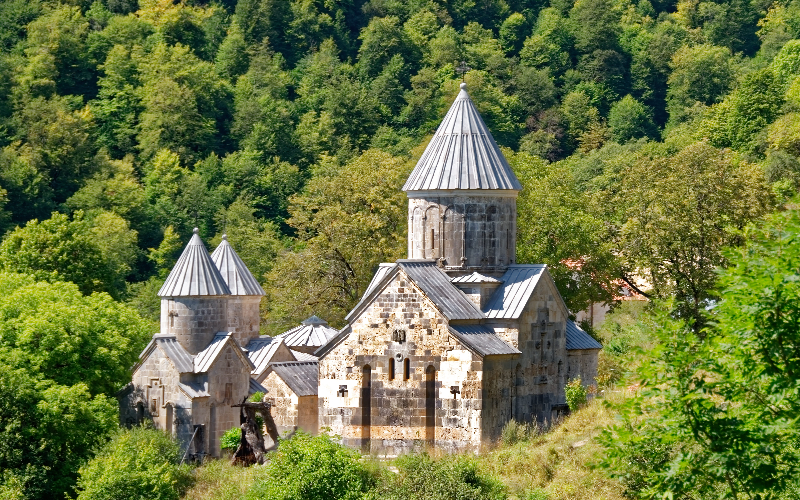
Haghartsin Monastery is one of Armenia's most beautiful and atmospheric monasteries. Unlike Tatev, which dominates a gorge, and Geghard, which is partly carved into the rock, Haghartsin appears surrounded by forest, green mountains and silence.
The location is precisely what makes the visit special. The monastery is near Dilijan, in a damper, cooler, more wooded region, quite different from the dry, dramatic landscapes of other parts of Armenia.
The road to Haghartsin is already part of the experience. The route passes through green areas, bends, trees and mountains, preparing the visitor for one of the calmest settings in the north of the country.
The complex was developed between the 10th and 13th centuries and brings together churches, courtyards, khachkars, tombs and a very well preserved medieval refectory. The combination of light stone, forest and religious architecture creates one of the most pleasant visits to do from Dilijan.
For those doing a complete itinerary through Armenia, I would place Haghartsin as a priority in Dilijan. It pairs perfectly with Goshavank Monastery, Parz Lake and Old Dilijan on the same day.
Quick facts
- Visit duration: 1h to 1h30
- Recommended base: Dilijan
- Distance from Dilijan: about 18 km
- Driving time from Dilijan: about 25 minutes
- Entry: generally free
- Best time: early morning or late afternoon
- Type of visit: monastery, forest, medieval architecture and landscape
- Pairs well with: Goshavank Monastery, Parz Lake, Old Dilijan and Dilijan National Park
- Ideal for: those who want to see the green, calm side of Armenia
Is it worth visiting Haghartsin Monastery?
Yes, it is very much worth visiting Haghartsin Monastery. This is one of the most beautiful monasteries in the Dilijan region and one of the best attractions in northern Armenia.
The main distinguishing factor is the location. Haghartsin is surrounded by forest, which creates a quieter, cooler and more enveloping atmosphere than many of the country's other monasteries.
The visit is also worthwhile for the architecture. The complex brings together stone churches, khachkars, courtyards and a medieval refectory that is one of the site's most interesting points.
I would not treat Haghartsin as just another monastery on the itinerary. It has its own atmosphere, closely linked to Dilijan's green climate, and helps show an Armenia different from that of Yerevan, Garni, Geghard, Tatev or Khor Virap.
What is Haghartsin Monastery?
Haghartsin Monastery is a medieval monastic complex located near Dilijan, in the Tavush province, in northern Armenia.
The monastery was built and expanded over several centuries, mainly between the 10th and 13th centuries. Because of this, the complex brings together structures from different eras, with churches, courtyards, tombs, khachkars and areas linked to monastic life.
Among the most important parts are the Church of St Gregory, the Church of St Stephen, the Church of Mother of God and the medieval refectory.
The name Haghartsin is often associated with the idea of "play of eagles", a poetic reference to the birds and the mountains of the region. Even without dwelling too much on the translation, the name suits the surrounding landscape, marked by forest, altitude and silence.
Today, Haghartsin is one of the main visits for those who choose Dilijan as a base in northern Armenia.
Why visit Haghartsin Monastery?
The first reason to visit Haghartsin is the atmosphere. The monastery sits in a green area, surrounded by trees and mountains, creating a feeling very different from monasteries in open or rocky landscapes.
The second reason is the architecture. The churches, the khachkars and the refectory show the strength of medieval Armenian religious architecture, but in a calmer, more natural setting.
The third reason is the location. Haghartsin is near Dilijan and pairs very well with Goshavank, Parz Lake and Old Dilijan. This allows you to put together a complete, beautiful day without excessively long transfers.
For those who enjoy photography, the contrast between the monastery's light stone and the green of the forest also produces one of the region's most beautiful visuals.
How to get to Haghartsin Monastery
The best base for visiting Haghartsin Monastery is Dilijan.
By car, the journey from Dilijan takes about 25 minutes. The road passes through a green, mountainous region, so the journey itself already helps set the mood for the visit.
It is also possible to go by taxi from Dilijan. In that case, the ideal is to arrange a wait or return with the driver, because it may not be so practical to find transport back on site.
With a private driver or organised tour, Haghartsin is usually combined with Goshavank Monastery, Parz Lake and Old Dilijan.
I would avoid relying only on public transport for this visit. The attractions around Dilijan are spread out, so car, taxi, driver or tour make the itinerary much easier.
How the visit works
The visit to Haghartsin Monastery is simple and calm. The complex sits in an open area, with courtyards, churches, khachkars and monastic buildings that can be explored on foot.
Entry is generally free, but there may be a donation box for the maintenance of the site.
The route is not long. In about 1 hour, you can see the main churches, walk through the courtyard, observe the refectory and take photos of the ensemble.
For those who enjoy architecture, photography or want to take in the atmosphere calmly, 1h30 is more comfortable.
Since it is a religious space, it is worth visiting respectfully, avoiding excessive noise and wearing suitable clothing to enter the churches.
What to see at Haghartsin Monastery
Road between Dilijan and Haghartsin
The visit begins even before reaching the monastery. The road between Dilijan and Haghartsin passes through a green region, with trees, mountains and a cooler climate.
This route shows well why Dilijan is considered one of the most pleasant areas of Armenia. The landscape is softer, forested and calm.
If you are with a driver or car, it is worth enjoying the journey without rushing. In some stretches, the vegetation and the mountains already help set the mood for the visit.
Central courtyard
The central courtyard is one of the best areas for understanding the ensemble of Haghartsin Monastery.
There you can observe the layout of the churches, the relationship between the buildings and the way the complex fits into the landscape.
I would set aside a few minutes just to stand in the courtyard, look around and take in the atmosphere. Haghartsin is not a place to visit in a rush.
Church of St Gregory
The Church of St Gregory is considered the oldest building in the complex and one of the most important parts of the visit.
It has a simpler, more sober architecture, a characteristic that fits very well with the monastery's setting.
Even though the interior is dark, it is worth going in calmly, observing the space and taking in the religious atmosphere of the site.
Church of St Stephen
The Church of St Stephen is another important building at Haghartsin Monastery.
It helps show how the complex grew over the centuries, with different churches and structures added to the original ensemble.
The visit is quick, but it is worth observing the details of the stone, the proportions of the building and its relationship to the other churches in the complex.
Church of Mother of God
The Church of Mother of God is one of the most prominent structures within the monastery.
It tends to draw attention for its size, its position and its architectural details. The building represents a more developed phase of the complex and reinforces Haghartsin's religious importance.
I would include this church as one of the priorities of the visit, along with the medieval refectory.
Medieval refectory
The refectory is one of the most interesting parts of Haghartsin Monastery.
Built in the 13th century, it shows a different side of monastic life. It was not just a religious space, but also a place linked to the monks' routine, meals and the organisation of the community.
The stone structure and the internal feel of the space are very impressive. For those who enjoy medieval architecture, this is one of the highlights of the visit.
I would not let the refectory go unnoticed. Many people focus only on the churches, but the refectory is one of the parts that most sets Haghartsin apart from other Armenian monasteries.
Khachkars
Around the complex, you can see khachkars, the traditional Armenian stone crosses.
These pieces are part of Armenia's religious and artistic identity. Each khachkar has its own details, with crosses, ornamental patterns and symbols carved into the stone.
At Haghartsin, the khachkars help enrich the visit and reinforce the monastery's connection to medieval Armenian art.
Tombs and monastic areas
The complex also includes tombs and areas linked to monastic life.
These spaces help you understand that Haghartsin was more than a group of churches. It functioned as a religious, communal and spiritual centre.
Even though some parts are simpler or less eye-catching, they help give context to the place.
Surrounding forest
The forest is one of Haghartsin's great attractions.
It completely changes the feel of the visit. Instead of an isolated monastery in an open landscape, you find a complex surrounded by greenery, shade, mountains and silence.
This atmosphere is what makes Haghartsin so special within the Armenia itinerary.
How much does it cost to visit Haghartsin Monastery?
Entry to Haghartsin Monastery is generally free.
There is no main tourist ticket office like at some paid attractions. In general, visitors can access the complex freely.
There may be a donation box for those who want to contribute to the maintenance of the site.
The main costs of the visit tend to be transport, taxi, private driver, organised tour, food and any purchases.
I would bring cash in Armenian dram for small expenses, even though entry is free.
How long to stay at Haghartsin Monastery?
To visit the churches, the courtyard, the refectory and the main khachkars, 1 hour tends to be enough.
To see everything more calmly, take photos and enjoy the forest setting, set aside 1h30.
If you enjoy medieval architecture, stone details, or want to photograph without rushing, you can stay a bit longer.
I would set aside at least 1h30 if the day is not rushed. Haghartsin is best when visited calmly.
Best time to visit Haghartsin Monastery
The best time to visit Haghartsin is early morning or late afternoon.
- Early morning: the monastery tends to be calmer, with fewer visitors and beautiful light coming through the forest area
- Late afternoon: the golden light can make the stone and the trees even more beautiful
- Midday in busier months: I would avoid this, because organised groups can make the setting less quiet
On rainy days, the forest can look beautiful, but the ground around it may be wetter. Wear suitable footwear.
Best season to visit Haghartsin
Haghartsin can be visited for much of the year, but the experience changes depending on the season.
In spring, the region becomes green and fresh, with a pleasant climate for walking.
In summer, Dilijan tends to be cooler than Yerevan, which makes the monastery visit very pleasant.
In autumn, the surrounding forest can become even more beautiful, with yellow, orange and golden tones.
In winter, the visit can be colder and quieter, with the possibility of snow or a trickier road depending on conditions.
For those who want to see Dilijan at its greenest and most pleasant, spring, summer and autumn tend to be the best seasons.
What to combine with Haghartsin Monastery
Haghartsin combines very well with Goshavank Monastery on the same day.
The two monasteries are in the Dilijan region and show different styles and atmospheres. Haghartsin stands out for its forest and more hidden setting. Goshavank reinforces the region's cultural, religious and historic side.
It is also worth combining with Old Dilijan, Parz Lake and cafés in the city.
A good sequence would be to start with Old Dilijan, continue to Haghartsin, visit Goshavank, pass by Parz Lake and end the day with coffee or dinner in Dilijan.
If the itinerary is shorter, I would prioritise Haghartsin and Goshavank.
Haghartsin and Goshavank on the same day
Yes, it is very much worth visiting Haghartsin and Goshavank on the same day.
This is one of the best combinations for those staying in Dilijan. The two monasteries are relatively close together and help show the historic and religious importance of northern Armenia.
Haghartsin has a greener, quieter atmosphere linked to the forest.
Goshavank has a presence more linked to intellectual tradition, khachkars and cultural history.
Together, they form a very complete day in the Dilijan region.
Haghartsin and Parz Lake on the same day
It is also worth combining Haghartsin with Parz Lake, especially if you want to make the day lighter and more varied.
After visiting the monastery, Parz Lake works as a natural stop for walking, resting and enjoying the green landscape.
This combination is good for those who want to mix culture and nature in the same itinerary.
If you have little time, Haghartsin should be the priority. If the weather is good, Parz Lake fits in very well as a complement.
Is Haghartsin worth it as a day trip from Yerevan?
Yes, it is possible to visit Haghartsin as a day trip from Yerevan, usually combined with Lake Sevan, Dilijan, Goshavank or Parz Lake.
But in a complete Armenia itinerary, I prefer to sleep in Dilijan. That way, you visit Haghartsin more calmly, avoid a very long day on the road and make better use of the country's green side.
Leaving from Yerevan, the excursion works for those with few days. Sleeping in Dilijan, the experience is more comfortable.
What I would prioritise on the visit
I would prioritise the central courtyard, the Church of Mother of God, the Church of St Gregory, the medieval refectory, the khachkars and the atmosphere of the surrounding forest.
If time is short, the essential is to walk through the complex, go into the main churches and observe the refectory.
If there is more time, it is worth staying a few minutes in the central courtyard and enjoying the silence of the place.
What can be optional
Exploring more remote areas around the monastery can be optional.
Doing trails or walks in the forest can be optional if the itinerary is short.
Combining with Parz Lake can be optional if the weather is poor or if you prefer to focus on the monasteries.
Visiting in the late afternoon can be optional if you are concerned about timing, the road or the return to Dilijan.
Mistakes to avoid at Haghartsin Monastery
The first mistake is visiting Haghartsin in a rush. The atmosphere of the place is one of the most important parts of the experience.
Another mistake is focusing only on the churches and ignoring the medieval refectory. It is one of the complex's most interesting points.
It is also worth avoiding going without well-organised transport. Since the monastery is outside central Dilijan, it is best to arrange a return trip with a taxi, driver or tour.
Another mistake is visiting with unsuitable shoes. The terrain can have stones, uneven areas and dampness, especially on rainy days.
I also don't recommend rushing through Haghartsin and Goshavank too quickly. Both monasteries deserve time.
Practical tips
- Combine Haghartsin with Goshavank Monastery on the same day
- Wear comfortable shoes for walking around the complex
- Bring a light jacket, because the Dilijan region can be cooler
- Bring cash in Armenian dram for donations, taxi, coffee or small purchases
- Visit early in the morning if you want less activity
- Late afternoon is beautiful for photos
- Respect the religious atmosphere inside the churches
- Observe the medieval refectory attentively
- The road to the monastery is part of the experience, so don't treat it only as a transfer
- On rainy days, walk with more care on the surrounding terrain
Is it worth visiting Haghartsin from Dilijan?
Yes, this is the best way to visit Haghartsin.
Dilijan is close, the transfer is short and the monastery pairs perfectly with other points in the region.
Leaving from Dilijan, the excursion is light, unrushed and easy to organise. You can visit Haghartsin, Goshavank and maybe Parz Lake on the same day.
For those doing a complete Armenia itinerary, I consider Dilijan the best base for exploring Haghartsin.
Final summary of Haghartsin Monastery
Haghartsin Monastery is one of the most beautiful and calm visits in the Dilijan region.
The complex combines medieval churches, a historic refectory, khachkars, stone courtyards and a special location within the forest.
Entry is generally free, and the main cost of the visit tends to be transport to the monastery.
To make the most of it, the ideal is to visit from Dilijan, in the morning or late afternoon, combining it with Goshavank, Parz Lake and Old Dilijan.
Haghartsin shows a greener, quieter and more contemplative side of Armenia, very different from the monasteries in canyons, rocks or open landscapes.
Final tip
Haghartsin Monastery is one of the best places to understand why Dilijan has such a special atmosphere.
The forest, the medieval stone, the refectory, the churches and the silence create a very beautiful and calm visit.
I would go early, explore the complex without rushing, pay attention to the medieval refectory and stay a few minutes in the central courtyard before leaving.
It is one of the most memorable visits in northern Armenia and pairs perfectly with a 2-day Dilijan itinerary.