Last updated: September 2026
Pamukkale brings together in one place one of Turkey's best-known natural landscapes and an ancient city that held great importance during the Roman and Byzantine periods. The white terraces formed by the thermal waters sit right below Hierapolis, letting you see both attractions on the same visit.
For anyone following an itinerary through western Turkey, 1 day in Pamukkale is enough to walk the travertines and see Hierapolis's main points without needing to split the visit across two days.
The best strategy is to leave Selçuk early, reach the region during the morning and set aside the rest of the day for the complex. After the visit, there's no need to return to Selçuk: the most practical option is to sleep in Pamukkale or the Denizli area and continue your trip the next day.
How this Pamukkale itinerary was planned
Pamukkale and Hierapolis shouldn't be treated as two separate attractions on different days. The travertines sit right next to the archaeological site, and the visit works far better when nature and history are combined in the same route.
The idea behind this itinerary is to arrive during the morning, see the white terraces, and then dedicate several hours to Hierapolis, taking in the theatre, former religious areas, streets and the extensive necropolis.
Since the area is large and much of the route is exposed to the sun, it's worth setting aside practically the whole day and avoiding fitting in another major destination afterward.
Pamukkale and Hierapolis in 1 day: overview
- Morning: departure from Selçuk, arrival in Pamukkale and the travertines.
- Early afternoon: Hierapolis, the Theatre and the Temple of Apollo.
- Afternoon: the Plutonium, monumental areas, the Necropolis and the rest of the archaeological site.
- End of day: check in at Pamukkale or the Denizli area.
Starting with the Pamukkale travertines
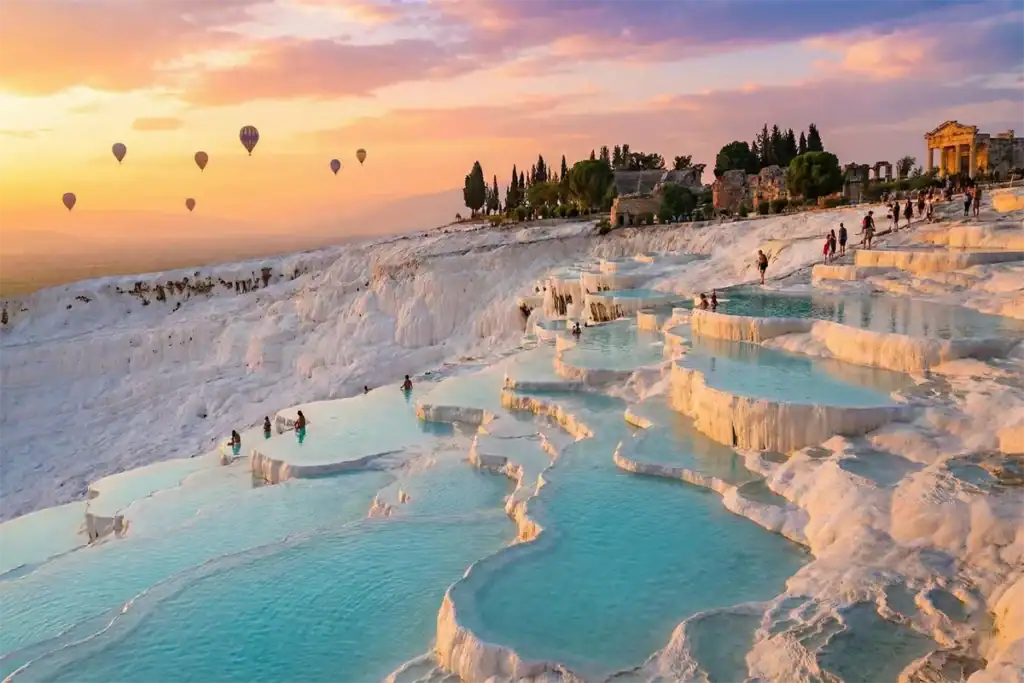
Pamukkale is known for the white terraces covering part of the hillside. This distinctive look comes from mineral-rich thermal waters flowing down the terrain and leaving travertine deposits along the way. The landscape changes depending on how much water is flowing through each area and how the light hits it, so not every terrace is necessarily full of water at the same time.
Some areas let you walk on the travertines following the site's rules. The ground can be uneven and slippery in certain stretches, so it's important to walk carefully.
The ticket for foreign visitors that grants access to Pamukkale and Hierapolis costs about 1,691 TL (approx. R$177). Prices checked in September 2026 and subject to change.
Hierapolis: the ancient city above Pamukkale
Hierapolis was built next to the thermal springs and developed into an important centre during antiquity. Much of what's visible today dates from the Roman period, although the city also held great significance during the Byzantine period. Preserved spaces include a theatre, religious areas, former baths, monumental streets and an extensive necropolis.
Theatre of Hierapolis
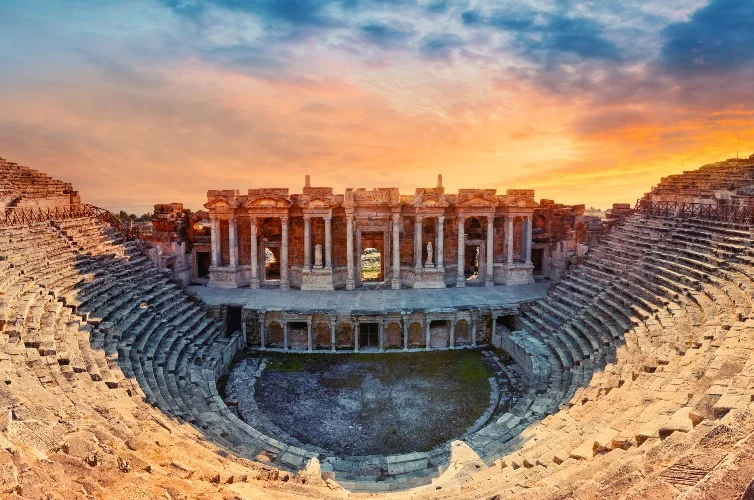
Theatre of Hierapolis is one of the archaeological site's most impressive structures and deserves to be among the visit's priorities. Built into the natural slope of the terrain, it preserves much of its tiered seating and helps convey the scale of the ancient city's public spaces. It's worth climbing up calmly and taking in both the structure's details and the surrounding landscape.
Temple of Apollo
Temple of Apollo was part of Hierapolis's religious area and tied to the spiritual importance the city held in antiquity. The ruins help you understand how the thermal springs, religion and urban life were connected in Hierapolis's development. Even though it's not as monumental as the theatre, it adds another dimension to the visit.
Plutonium
Plutonium is linked to Hierapolis's ancient religious cult and to an area of natural geological activity. In antiquity, gases coming from the ground contributed to the site's association with the underworld and with religious practices. It's one of the areas that helps show why Hierapolis was much more than a city simply built next to thermal waters.
Main street and public areas
Former urban area: Hierapolis had a long main thoroughfare with public buildings, shops and other structures spread across the city. Walking through these spaces helps you realise the archaeological site is much larger than the area near the travertines. There's no need to stop for long at every ruin, and it's best to set aside more time for the structures that interest you most.
Necropolis of Hierapolis
Necropolis of Hierapolis is one of the ancient city's major burial grounds, with different types of tombs and monuments scattered across a fairly extensive area. The scale of the necropolis helps convey the importance Hierapolis held across different historical periods.
How to get to Pamukkale from Selçuk
Selçuk: for anyone who has just visited Ephesus, the best plan is to spend the second night in Selçuk and check out only the following morning. That way, the Ephesus day stays entirely dedicated to the archaeological site, and the transfer to Pamukkale starts more calmly.
It's worth leaving early to reach Pamukkale during the morning and have several hours available to see the travertines and Hierapolis.
How much time to allow for Pamukkale and Hierapolis
To visit calmly, it's worth setting aside a good part of the day.
Seeing just the travertines and taking a few photos can be relatively quick, but that would leave out the historical part that makes the experience much more complete.
Hierapolis is large, and walking to the theatre, religious areas and necropolis takes time. Because of this, arriving only in the late afternoon can leave the itinerary too limited.
Ideally, don't treat Pamukkale as a quick stop between Selçuk and Denizli.
Visiting hours
In September 2026, the stated hours for the complex are 8:00am to 6:45pm.
Since hours can change depending on the time of year and site operation, it's worth confirming again close to your trip.
Arriving in the morning remains the best option for this itinerary, mainly because the complex is large.
What to prioritize in Pamukkale in 1 day
If time is limited, prioritise the Pamukkale travertines, the Theatre of Hierapolis and a walk through the ancient city's main areas.
The Necropolis also deserves attention, especially for anyone who enjoys archaeology, but the area is large and can require more walking.
The most important thing is not to visit only the travertines and skip Hierapolis. The two parts form a much more complete experience when seen together.
What can be optional
- There's no need to walk the entire Necropolis if time is short.
- More distant areas of Hierapolis can get less time.
- There's no need to add another archaeological site on the same day.
- Avoid heading back to Selçuk after the visit if your itinerary continues through Denizli.
Mistakes to avoid in Pamukkale
One of the main mistakes is arriving too late and setting aside only a few hours for the whole complex. Pamukkale and Hierapolis are much larger than they may seem in photos.
Another mistake is visiting only the travertines. The ancient city sits within the same complex and has important structures that justify setting aside more time.
It's also not worth doing Ephesus, the transfer to Pamukkale and the entire visit all on the same day.
Finally, don't plan to return to Selçuk afterward. Sleeping in the Pamukkale/Denizli area makes the following day's departure far more logical.
Trip planning for Pamukkale: essential tips
Before the visit, it's worth organising your transport and setting aside plenty of time for the complex. The travertines and the ruins sit in the same area, but there's more walking involved than it might initially seem.
HOW TO GET THERE
- Check out in Selçuk in the morning.
- Leave early toward Pamukkale.
- Arrange transport in advance.
- Stay in the region after the visit.
TICKET AND HOURS
Prices checked in September 2026 and subject to change.
- Pamukkale + Hierapolis: about 1,691 TL (approx. R$177).
- The ticket grants access to the archaeological site and the travertines.
- Stated hours: 8:00am to 6:45pm.
- Confirm prices and hours before your visit.
DURING THE VISIT
- Bring water along the route.
- Use sun protection.
- Prefer comfortable footwear.
- Allow several hours to walk through the complex.
ORGANISING YOUR DAY
- See Pamukkale and Hierapolis on the same visit.
- Don't try to combine Ephesus and Pamukkale on the same day.
- Set aside time for the Theatre of Hierapolis.
- Sleep in Pamukkale or the Denizli area.